
Tablet Coating Defect Overview
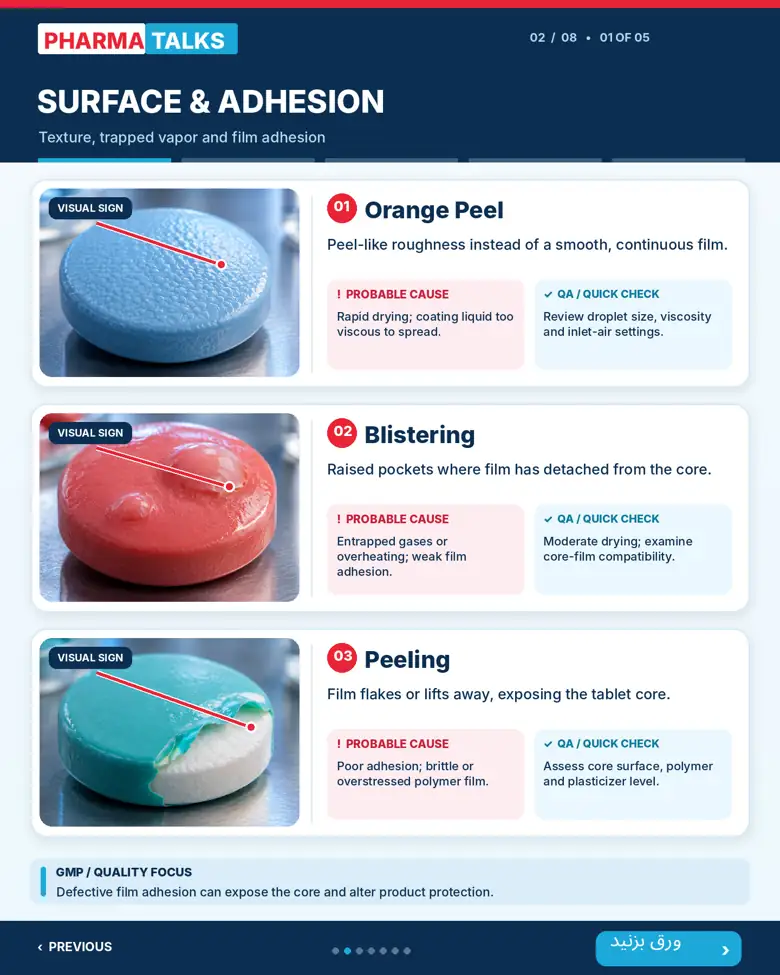
Primary keyword: Tablet Coating Defect Overview · Secondary keywords: Orange Peel, Blistering, Peeling
Direct answer: Tablet Coating Defect Overview covers Orange Peel, Blistering, Peeling and their identification, investigation, process controls, and GMP documentation. A defect is an observed or measured nonconformity that must be evaluated against an approved specification, the product's intended use and the potential patient impact. This guide is an educational investigation framework, not a substitute for validated site procedures.
What Is Tablet Coating Defect Overview?
In pharmaceutical manufacturing, defect recognition begins with a reproducible description rather than a presumed cause. For this topic, the main examples are Orange Peel, Blistering, Peeling. Inspectors should distinguish a visible symptom from a confirmed analytical failure and a potential process mechanism. A mark, fracture or abnormal result can originate from materials, tooling, process parameters, environmental exposure or downstream handling. The same appearance may have different causes across formulations and manufacturing technologies.
Record where the defect occurs, its distribution within a batch, the time it was first observed and whether reference samples show the same pattern. Where photographs are used, retain scale, orientation, lighting conditions and a traceable sample identifier. Educational illustrations are not evidence of an actual manufacturing event.
Why This Defect Group Matters
Defects can affect dose delivery, physical integrity, product stability, microbial protection, patient usability or compliance with registered specifications. The risk is route-dependent: a cosmetic variation in one product may have a very different significance in a sterile injectable. Quality units should evaluate the actual clinical and technical consequences rather than apply a universal severity label.
When multiple defects appear together, evaluate whether they share a common upstream cause. A recurring trend across batches may indicate process drift even if individual test results have not crossed a release limit. Escalation and product disposition must follow the site's pharmaceutical quality system.
Technical Comparison of Common Findings
| Defect / attribute | Typical observation | Potential impact | Verification |
|---|---|---|---|
| Orange Peel | Visible physical abnormality | Potential quality, performance or patient risk | Confirm against approved product specifications and approved method |
| Blistering | Visible physical abnormality | Potential quality, performance or patient risk | Confirm against approved product specifications and approved method |
| Peeling | Visible physical abnormality | Potential quality, performance or patient risk | Confirm against approved product specifications and approved method |
Equipment, Sampling and Testing Methods
Equipment and method suitability
Use inspection stations, calibrated measurement devices, approved analytical methods and qualified production equipment appropriate to the product. Visual assessments require controlled illumination and trained personnel. For quantitative measurements, confirm instrument calibration, system suitability and method validation or verification as applicable. Do not assume a single technique detects every failure mode.
Sample selection and investigation workflow
Sampling should reflect the suspected distribution: startup, steady state, shutdown, equipment stations and relevant material lots may require separate evaluation. Preserve chain of custody. Record all nonconforming units and avoid undocumented reinspection or selective resampling. The following workflow is illustrative and must be adapted to approved SOPs.
| Step | Equipment or record | Parameter to review | Decision |
|---|---|---|---|
| 1. Detect | Approved visual inspection / QC method | Lighting, sampling plan, method suitability | Record observation |
| 2. Contain | Batch record / quarantine status | Affected lot, line, time window | Hold potentially affected units |
| 3. Investigate | Equipment logs and material history | Settings, trends, operator interventions | Document hypothesis and evidence |
| 4. Verify | Qualified equipment / validated method | Product-specific acceptance criteria | QA disposition |
| 5. Monitor | Trend report / CAPA tracker | Recurrence and effectiveness | Escalate if adverse trend |
Acceptance Criteria and Regulatory Interpretation
There is no defensible universal acceptance limit for all of the defects discussed here. Registered specifications, applicable pharmacopoeial chapters, validated methods and justified risk assessments govern the decision. An alert threshold used for process monitoring is not automatically a batch rejection criterion. Likewise, a numerical limit applicable to one dosage form must not be transferred to another.
| Quality attribute | Acceptance approach | Status | Authority |
|---|---|---|---|
| Appearance and physical integrity | Approved product-specific specification; no universal numerical limit | Site/product specific | Approved dossier and specification |
| Identity, assay and performance | Applicable compendial or registered methods and limits | Product dependent | Marketing authorization / pharmacopoeia |
| In-process monitoring | Validated process controls and justified alert/action levels | Risk based | FDA process validation; ICH Q9 |
| Sterility / endotoxin (where applicable) | Applicable validated compendial test and registered limits | Only for relevant sterile products | Pharmacopoeia; EU GMP Annex 1 |
Regulatory caution: The table distinguishes general quality principles from product-specific acceptance criteria. Confirm the current registered dossier and applicable edition of official standards before operational use.
Root-Cause Investigation and CAPA
Investigate material properties, supplier changes, process parameters, equipment wear, cleaning status, hold times, storage conditions and operator interventions. Establish a time-based sequence and compare normal versus abnormal lots. A hypothesis is not a root cause until evidence supports it. Avoid adjusting several parameters simultaneously without a controlled study, because that can obscure causality.
| Problem | Possible cause | Investigation | Corrective action | Preventive action |
|---|---|---|---|---|
| Orange Peel | Material variability or equipment/process excursion | Compare affected and unaffected units; review trend and batch records | Contain batch; adjust only under approved change/deviation controls | Improve process monitoring and effectiveness checks |
| Blistering | Material variability or equipment/process excursion | Compare affected and unaffected units; review trend and batch records | Contain batch; adjust only under approved change/deviation controls | Improve process monitoring and effectiveness checks |
| Peeling | Material variability or equipment/process excursion | Compare affected and unaffected units; review trend and batch records | Contain batch; adjust only under approved change/deviation controls | Improve process monitoring and effectiveness checks |
Corrective action addresses the detected issue and its cause; preventive action addresses recurrence or comparable risks. Effectiveness checks should define the observation period, objective metrics, responsible owner and escalation rules. Any rework, reprocessing or additional testing must be scientifically justified and formally authorized.
GMP Documentation Requirements
At minimum, retain traceable defect observations, affected batch and unit identifiers, approved test methods, original data, contemporaneous equipment records, deviation assessments, documented root-cause evidence, disposition decisions and CAPA effectiveness outcomes. Apply data integrity principles throughout. Where a suspected defect affects released stock, evaluate complaint handling, market action and reporting obligations through the quality system.
Use cross-functional review when appropriate: Manufacturing can reconstruct process history, QC can characterize the defect, Engineering can assess equipment, Regulatory Affairs can assess registered commitments and QA can determine disposition. Clearly record uncertainties and pending tests rather than presenting assumptions as verified facts.
Related Pharmatalks Resources
This article is part of the PharmaTalks Pharmaceutical Defects collection. Related articles in the same series:
Browse the complete PharmaTalks defects article directory. External protocol links are not included because no verified matching Drive protocol was identified for this article.
Frequently Asked Questions
How is orange peel identified?
Use an approved inspection or analytical method suited to the dosage form. Record observable evidence and compare it with approved product-specific criteria.
Is every instance of orange peel a critical defect?
No. Severity depends on the dosage form, route, likelihood of harm, batch context and documented quality risk assessment.
What should operators do first?
Segregate suspect material under the approved procedure, notify QA and preserve batch and equipment evidence.
Can a visual inspection alone prove batch quality?
No. Visual inspection complements, but does not replace, applicable chemical, microbiological, physical and functional tests.
Which documents support an investigation?
Batch manufacturing and packaging records, equipment logs, calibration records, raw material results, deviation reports, trend data and CAPA records.
How are recurrence risks reduced?
Confirm root cause with evidence, implement proportionate corrective and preventive measures and verify effectiveness over a defined monitoring period.
Conclusion
Reliable control of tablet coating defect overview requires accurate observation, scientifically justified investigation, suitable methods and documented GMP decisions. The practical priority is to connect the observed symptom to evidence from materials, process and testing, then demonstrate that corrective actions work. Always use approved specifications and current applicable regulations to determine acceptance and batch disposition.
Official Reference Starting Points
- FDA: Inspection of Injectable Products for Visible Particulates
- FDA: Process Validation — General Principles and Practices
- ICH Quality Guidelines
- European Commission EudraLex Volume 4
- FDA Current Good Manufacturing Practice Regulations
References are official publisher landing pages; applicability and revision status require confirmation for each product and market. Author: PharmaTalks Editorial Team · Review date: 2026-11-08 · Educational content, not a regulatory approval.