
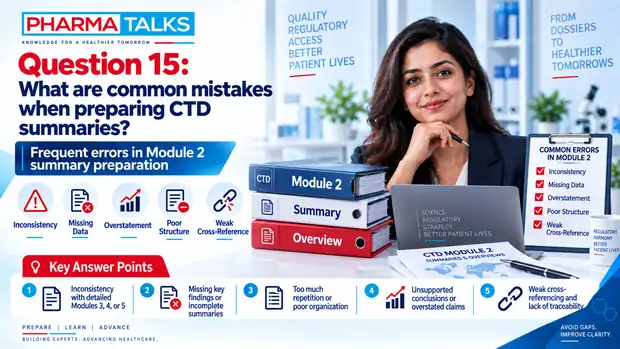
What are common mistakes when preparing CTD summaries?
Direct answer: Common errors include inconsistency with source modules, missing critical findings, unsupported conclusions, excessive repetition, weak cross-references, and outdated data. In practice, the strongest interview answer should connect this principle to dossier structure, source-data traceability, regional implementation, and reviewer expectations rather than treating it as a memorized definition.
What This Topic Means in CTD Practice
This topic concerns Module 2, which turns detailed evidence into reviewable scientific summaries and overviews. Module 2 should not introduce unsupported data; it must remain traceable to the detailed quality, nonclinical and clinical modules while helping reviewers understand the key conclusions quickly. For CTD summary mistakes, the practical question is whether the applicant can explain what the information means, where it belongs, what evidence supports it, and how a reviewer can verify the conclusion. This is especially important in interviews because experienced regulatory teams look for structured reasoning, not only terminology.
A useful working method is to start from the governing CTD or eCTD standard, then layer in topic-specific ICH guidance and the target authority’s regional requirements. The dossier should be controlled as one integrated record: names, strengths, manufacturing information, study identifiers, tables, conclusions, and lifecycle updates should remain synchronized wherever they reappear. Any site-specific practice should be clearly distinguished from a formal regulatory requirement.
Technical Comparison
| Element | Regulatory meaning | Practical review use |
|---|---|---|
| Overview | Expert interpretation | Higher-level assessment |
| Summary | Structured data summary | More detailed than overview |
| Source evidence | Modules 3–5 | Must remain traceable |
| Review value | Rapid orientation | Highlights key findings and issues |
How to Apply It in a Submission
The recommended workflow is: 1. Identify the detailed source module. 2. Extract current approved data and conclusions. 3. Draft the summary at the correct level of detail. 4. Cross-reference source sections and key tables. 5. Perform scientific and editorial consistency review. This sequence creates an auditable path from source evidence to submitted content. It also helps teams decide whether an issue is scientific, administrative, publishing-related, or cross-functional. When the topic involves a judgment rather than a fixed limit, the dossier should document the scientific basis, the governing guidance, and any product-specific rationale.
Before drafting, confirm whether the question is governed by harmonized ICH content, a regional Module 1 requirement, a technical eCTD rule, or a combination. That distinction changes the source hierarchy and the type of evidence needed. Keep source documents under document control and do not copy legacy text without checking whether the underlying data or regulatory standard has changed.
Procedure and Parameters
| Step | Action | Output / evidence |
|---|---|---|
| 1 | Identify the detailed source module | Defined scope and owner |
| 2 | Extract current approved data and conclusions | Current source data or guidance |
| 3 | Draft the summary at the correct level of detail | Mapped CTD/eCTD location |
| 4 | Cross-reference source sections and key tables | Documented assessment and correction |
| 5 | Perform scientific and editorial consistency review | QC-ready submission record |
Acceptance and Review Criteria
From a reviewer perspective, CTD summary mistakes is assessed in context rather than isolation. Reviewers compare related sections, look for unexplained differences, test whether conclusions are supported by the detailed data, and evaluate whether the submission follows the authority’s current technical rules. A clear dossier therefore uses controlled terminology, explicit references, proportionate detail, and documented rationale for decisions. Where numeric acceptance limits are product- or method-specific, this guide intentionally does not invent universal values; the current applicable guideline, compendial requirement, approved specification, or authority advice should control.
| Review criterion | Expected condition | Source basis |
|---|---|---|
| Source fidelity | Summary reflects detailed source module accurately | ICH M4Q/M4S/M4E |
| No unsupported claims | Conclusions are justified by submitted evidence | Scientific review principle |
| Traceability | Key findings cross-reference source data | CTD review practice |
| Version control | Latest approved/locked information is used | Document control |
Common Problems and Troubleshooting
Most dossier problems are not caused by lack of data alone. They often arise when valid data are presented inconsistently, the wrong version is summarized, scientific rationale is not explicit, or a publishing operation creates an unintended active-document view. The CAPA approach below separates immediate correction from preventive controls.
| Problem | Possible cause | Investigation | Corrective action | Preventive action |
|---|---|---|---|---|
| Summary/source inconsistency | Draft based on obsolete data | Compare against final source module | Revise summary and references | Lock source data before summary finalization |
| Overstatement | Conclusion stronger than evidence | Review claim against data | Moderate language and justify | Scientific review of summary claims |
| Missing critical finding | Selective summarization | Gap review vs source tables | Add material finding | Use structured summary checklist |
| Weak cross-reference | Source location unclear | Trace tables/sections | Add accurate references | Maintain traceability matrix |
GMP and Regulatory Documentation Expectations
Documentation should show who authored and reviewed the content, which controlled data source was used, what version of the guidance or regional specification was consulted, and how any late change was assessed. For interview purposes, a strong answer often includes one sentence on content, one on evidence, one on consistency, and one on lifecycle or regional control. That structure demonstrates both technical knowledge and the ability to manage a real submission.
For quality-related content, the submission record should remain aligned with the pharmaceutical quality system, change control, analytical lifecycle, stability program, manufacturing records, and approved specifications as applicable. For clinical and nonclinical content, controlled study reports and approved analyses are the authoritative source. For eCTD topics, current ICH M8 and regional technical implementation documents take precedence over informal publishing habits.
Related Pharmatalks Resources
Frequently Asked Questions
Can Module 2 contain new data not present elsewhere?
As a rule, it should summarize and interpret the evidence submitted in the detailed modules, not introduce unsupported new evidence.
What is the difference between an overview and a summary?
An overview is more evaluative and expert-driven; a summary is usually more structured and detailed.
How should Module 2 be cross-checked?
Use a traceability matrix or systematic cross-check against final Module 3, 4 and 5 source content.
Who should review Module 2?
Regulatory, medical/clinical, nonclinical and CMC experts should review the sections relevant to their evidence, with final editorial/QC review.
What causes most Module 2 deficiencies?
Outdated source data, unsupported conclusions, missing findings and poor cross-referencing are recurring causes.
Conclusion
Common errors include inconsistency with source modules, missing critical findings, unsupported conclusions, excessive repetition, weak cross-references, and outdated data. A high-quality regulatory answer then goes one step further: it explains how the principle is verified, where it is documented, how inconsistencies are prevented, and which current official source governs the decision. That approach is useful both for interview preparation and for real CTD/eCTD dossier work.