
What is the difference between bioavailability and bioequivalence studies?
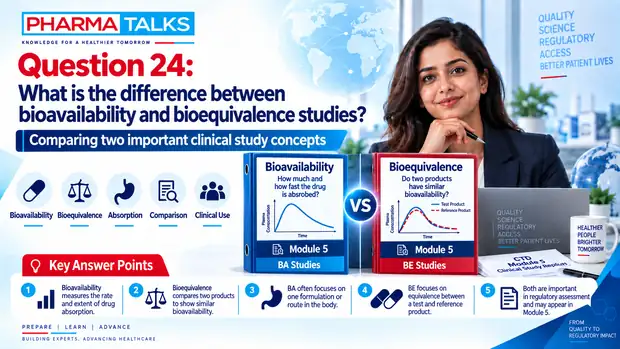
Direct answer: Bioavailability describes the rate and extent of absorption for a product; bioequivalence compares products to determine whether their relative bioavailability is sufficiently similar under defined criteria. In practice, the strongest interview answer should connect this principle to dossier structure, source-data traceability, regional implementation, and reviewer expectations rather than treating it as a memorized definition.
What This Topic Means in CTD Practice
This topic concerns the evidence reports in Modules 4 and 5. Module 4 organizes nonclinical pharmacology, pharmacokinetic/toxicokinetic and toxicology evidence, while Module 5 organizes human clinical evidence. Summaries in Module 2 should remain consistent with these source reports. For bioavailability vs bioequivalence, the practical question is whether the applicant can explain what the information means, where it belongs, what evidence supports it, and how a reviewer can verify the conclusion. This is especially important in interviews because experienced regulatory teams look for structured reasoning, not only terminology.
A useful working method is to start from the governing CTD or eCTD standard, then layer in topic-specific ICH guidance and the target authority’s regional requirements. The dossier should be controlled as one integrated record: names, strengths, manufacturing information, study identifiers, tables, conclusions, and lifecycle updates should remain synchronized wherever they reappear. Any site-specific practice should be clearly distinguished from a formal regulatory requirement.
Technical Comparison
| Element | Regulatory meaning | Practical review use |
|---|---|---|
| Module 4 | Nonclinical evidence | Pharmacology, PK/TK, toxicology |
| Module 5 | Clinical evidence | Biopharmaceutics, clinical pharmacology, efficacy, safety |
| Module 2 link | Summaries/overviews | Interprets Modules 4 and 5 |
| Study placement | By study purpose | Use ICH M4S/M4E hierarchy |
How to Apply It in a Submission
The recommended workflow is: 1. Classify each study by purpose and evidence type. 2. Place full reports in the correct Module 4/5 location. 3. Verify study identifiers and datasets. 4. Align summaries and overviews in Module 2. 5. Check traceability of conclusions to source reports. This sequence creates an auditable path from source evidence to submitted content. It also helps teams decide whether an issue is scientific, administrative, publishing-related, or cross-functional. When the topic involves a judgment rather than a fixed limit, the dossier should document the scientific basis, the governing guidance, and any product-specific rationale.
Before drafting, confirm whether the question is governed by harmonized ICH content, a regional Module 1 requirement, a technical eCTD rule, or a combination. That distinction changes the source hierarchy and the type of evidence needed. Keep source documents under document control and do not copy legacy text without checking whether the underlying data or regulatory standard has changed.
Procedure and Parameters
| Step | Action | Output / evidence |
|---|---|---|
| 1 | Classify each study by purpose and evidence type | Defined scope and owner |
| 2 | Place full reports in the correct Module 4/5 location | Current source data or guidance |
| 3 | Verify study identifiers and datasets | Mapped CTD/eCTD location |
| 4 | Align summaries and overviews in Module 2 | Documented assessment and correction |
| 5 | Check traceability of conclusions to source reports | QC-ready submission record |
Acceptance and Review Criteria
From a reviewer perspective, bioavailability vs bioequivalence is assessed in context rather than isolation. Reviewers compare related sections, look for unexplained differences, test whether conclusions are supported by the detailed data, and evaluate whether the submission follows the authority’s current technical rules. A clear dossier therefore uses controlled terminology, explicit references, proportionate detail, and documented rationale for decisions. Where numeric acceptance limits are product- or method-specific, this guide intentionally does not invent universal values; the current applicable guideline, compendial requirement, approved specification, or authority advice should control.
| Review criterion | Expected condition | Source basis |
|---|---|---|
| Correct placement | Study reports appear under the proper Module 4/5 hierarchy | ICH M4S/M4E |
| Completeness | Reports contain the data needed for review | Applicable study guidance |
| Summary alignment | Module 2 agrees with full reports | ICH M4S/M4E |
| Scientific integrity | Conclusions reflect the study design and data | ICH Safety/Efficacy guidance |
Common Problems and Troubleshooting
Most dossier problems are not caused by lack of data alone. They often arise when valid data are presented inconsistently, the wrong version is summarized, scientific rationale is not explicit, or a publishing operation creates an unintended active-document view. The CAPA approach below separates immediate correction from preventive controls.
| Problem | Possible cause | Investigation | Corrective action | Preventive action |
|---|---|---|---|---|
| Study misclassification | Purpose misunderstood | Review study objective and CTD hierarchy | Move report to correct section | Study filing map |
| Summary mismatch | Module 2 not updated after report change | Cross-check final report vs summary | Update summary and tables | Version-linked summary workflow |
| Missing report components | Incomplete submission package | Check report appendices/data list | Add missing content | Study completion checklist |
| Unsupported interpretation | Conclusion exceeds study evidence | Reassess design/results | Revise interpretation | Independent clinical/nonclinical review |
GMP and Regulatory Documentation Expectations
Documentation should show who authored and reviewed the content, which controlled data source was used, what version of the guidance or regional specification was consulted, and how any late change was assessed. For interview purposes, a strong answer often includes one sentence on content, one on evidence, one on consistency, and one on lifecycle or regional control. That structure demonstrates both technical knowledge and the ability to manage a real submission.
For quality-related content, the submission record should remain aligned with the pharmaceutical quality system, change control, analytical lifecycle, stability program, manufacturing records, and approved specifications as applicable. For clinical and nonclinical content, controlled study reports and approved analyses are the authoritative source. For eCTD topics, current ICH M8 and regional technical implementation documents take precedence over informal publishing habits.
Related Pharmatalks Resources
Frequently Asked Questions
Are study summaries enough for Modules 4 and 5?
No. Modules 4 and 5 contain detailed study reports; Module 2 contains summaries and overviews derived from them.
How are studies classified in CTD?
Classification follows the study objective and the CTD hierarchy described in ICH M4S and M4E.
What links Module 2 to Modules 4 and 5?
Module 2 summarizes and interprets the full evidence. Key numbers, populations, findings and conclusions should remain traceable to source reports.
Does bioequivalence always require the same design?
No. Study design depends on dosage form, product characteristics, scientific objective and applicable ICH/regional guidance.
What is the most important clinical/nonclinical QC check?
Verify that study identifiers, endpoints, populations, key results and conclusions match across reports, tables, summaries and labeling claims.
Conclusion
Bioavailability describes the rate and extent of absorption for a product; bioequivalence compares products to determine whether their relative bioavailability is sufficiently similar under defined criteria. A high-quality regulatory answer then goes one step further: it explains how the principle is verified, where it is documented, how inconsistencies are prevented, and which current official source governs the decision. That approach is useful both for interview preparation and for real CTD/eCTD dossier work.