
What technical checks should be completed before dispatching an eCTD sequence to a regulatory authority?
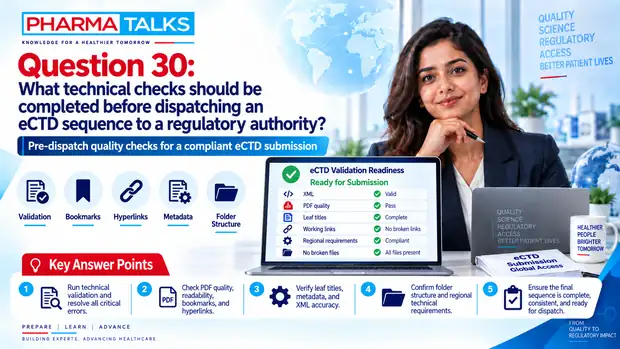
Direct answer: Run current technical validation; verify XML/metadata, files, titles, PDF quality, bookmarks, hyperlinks, folder structure, regional rules, completeness, and dispatch readiness. In practice, the strongest interview answer should connect this principle to dossier structure, source-data traceability, regional implementation, and reviewer expectations rather than treating it as a memorized definition.
What This Topic Means in CTD Practice
This topic concerns eCTD publishing and lifecycle. eCTD is more than a folder tree: it uses structured metadata, regional requirements, validation rules and lifecycle operations so regulators can reconstruct what was submitted, when it was submitted, and which content is currently active. For eCTD validation checks, the practical question is whether the applicant can explain what the information means, where it belongs, what evidence supports it, and how a reviewer can verify the conclusion. This is especially important in interviews because experienced regulatory teams look for structured reasoning, not only terminology.
A useful working method is to start from the governing CTD or eCTD standard, then layer in topic-specific ICH guidance and the target authority’s regional requirements. The dossier should be controlled as one integrated record: names, strengths, manufacturing information, study identifiers, tables, conclusions, and lifecycle updates should remain synchronized wherever they reappear. Any site-specific practice should be clearly distinguished from a formal regulatory requirement.
Technical Comparison
| Element | Regulatory meaning | Practical review use |
|---|---|---|
| CTD | Content organization | Scientific dossier structure |
| eCTD | Electronic exchange and lifecycle | Metadata + technical structure |
| Sequence | A transmission in lifecycle | Chronological regulatory event |
| Validation | Technical conformance | Region-specific criteria and supported versions |
How to Apply It in a Submission
The recommended workflow is: 1. Determine the submission type and target region. 2. Build content using supported eCTD specifications. 3. Apply metadata and lifecycle operations correctly. 4. Run technical and business validation. 5. Archive the final sequence and acknowledgements. This sequence creates an auditable path from source evidence to submitted content. It also helps teams decide whether an issue is scientific, administrative, publishing-related, or cross-functional. When the topic involves a judgment rather than a fixed limit, the dossier should document the scientific basis, the governing guidance, and any product-specific rationale.
Before drafting, confirm whether the question is governed by harmonized ICH content, a regional Module 1 requirement, a technical eCTD rule, or a combination. That distinction changes the source hierarchy and the type of evidence needed. Keep source documents under document control and do not copy legacy text without checking whether the underlying data or regulatory standard has changed.
Procedure and Parameters
| Step | Action | Output / evidence |
|---|---|---|
| 1 | Determine the submission type and target region | Defined scope and owner |
| 2 | Build content using supported eCTD specifications | Current source data or guidance |
| 3 | Apply metadata and lifecycle operations correctly | Mapped CTD/eCTD location |
| 4 | Run technical and business validation | Documented assessment and correction |
| 5 | Archive the final sequence and acknowledgements | QC-ready submission record |
Acceptance and Review Criteria
From a reviewer perspective, eCTD validation checks is assessed in context rather than isolation. Reviewers compare related sections, look for unexplained differences, test whether conclusions are supported by the detailed data, and evaluate whether the submission follows the authority’s current technical rules. A clear dossier therefore uses controlled terminology, explicit references, proportionate detail, and documented rationale for decisions. Where numeric acceptance limits are product- or method-specific, this guide intentionally does not invent universal values; the current applicable guideline, compendial requirement, approved specification, or authority advice should control.
| Review criterion | Expected condition | Source basis |
|---|---|---|
| Supported version | Submission uses an eCTD version accepted by the authority | ICH M8 + regional guidance |
| Validation status | Critical technical errors are resolved | Regional validation criteria |
| Lifecycle integrity | New/replace/withdraw operations reflect intended active content | eCTD implementation guide |
| File/metadata quality | Titles, metadata, XML and files are complete and usable | Technical conformance guide |
Common Problems and Troubleshooting
Most dossier problems are not caused by lack of data alone. They often arise when valid data are presented inconsistently, the wrong version is summarized, scientific rationale is not explicit, or a publishing operation creates an unintended active-document view. The CAPA approach below separates immediate correction from preventive controls.
| Problem | Possible cause | Investigation | Corrective action | Preventive action |
|---|---|---|---|---|
| Validation error | Unsupported file/XML/metadata | Run current validator | Correct package and rerun | Automated pre-dispatch validation |
| Wrong lifecycle operation | Active content becomes ambiguous | Review prior lifecycle history | Apply correct operation | Publisher lifecycle checklist |
| Broken hyperlink/bookmark | PDF quality issue | Automated/manual link check | Repair PDF navigation | PDF QC before publishing |
| Wrong sequence context | Submission chronology/context incorrect | Review application history | Correct metadata/sequence package | Sequence planning log |
GMP and Regulatory Documentation Expectations
Documentation should show who authored and reviewed the content, which controlled data source was used, what version of the guidance or regional specification was consulted, and how any late change was assessed. For interview purposes, a strong answer often includes one sentence on content, one on evidence, one on consistency, and one on lifecycle or regional control. That structure demonstrates both technical knowledge and the ability to manage a real submission.
For quality-related content, the submission record should remain aligned with the pharmaceutical quality system, change control, analytical lifecycle, stability program, manufacturing records, and approved specifications as applicable. For clinical and nonclinical content, controlled study reports and approved analyses are the authoritative source. For eCTD topics, current ICH M8 and regional technical implementation documents take precedence over informal publishing habits.
Related Pharmatalks Resources
Frequently Asked Questions
Is eCTD mandatory everywhere?
Requirements differ by authority and submission type. Applicants should use the current supported eCTD standard and regional specification for the target authority.
What does a sequence represent?
A sequence is a discrete regulatory transmission within an application lifecycle, such as the initial filing, amendment, response or other update.
Can lifecycle operations be used interchangeably?
No. The chosen lifecycle operation must accurately represent the intended relationship to previously submitted content.
Why are validation criteria region-specific?
The harmonized eCTD standard is supplemented by regional Module 1 and authority-specific technical requirements.
What should be archived after dispatch?
Archive the transmitted package, validation output, gateway acknowledgements, correspondence, and the controlled record of what was submitted.
Conclusion
Run current technical validation; verify XML/metadata, files, titles, PDF quality, bookmarks, hyperlinks, folder structure, regional rules, completeness, and dispatch readiness. A high-quality regulatory answer then goes one step further: it explains how the principle is verified, where it is documented, how inconsistencies are prevented, and which current official source governs the decision. That approach is useful both for interview preparation and for real CTD/eCTD dossier work.