Video 1 · Topic 1 · Career entrants
What Is Medical Writing? A Career Overview
Direct answer: Medical writing transforms validated medical evidence into accurate, audience-specific communication; it is not promotional copywriting by default. Start by naming the intended reader and the decision the document supports.
By Pharmatalks Editorial Team · Reviewed 8 November 2026 · Educational use; not legal, medical, or hiring advice.
What practitioners need to understand
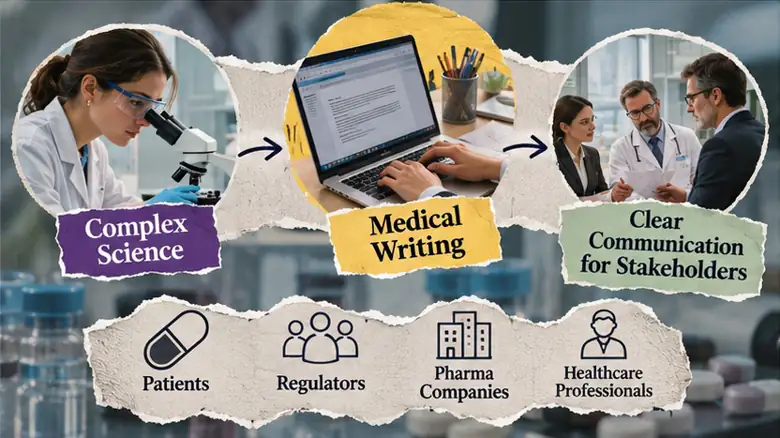
Medical writing is the process of transforming complex health and scientific information into accurate, understandable documents for a defined audience. That audience might be a regulatory assessor, a physician, a clinical trial participant, a researcher, or a patient. And the document changes with the audience. A clinical study report describes a trial in a structured way. A patient leaflet must use language people can understand. A manuscript has to explain methods and results transparently. Medical writing is not simply rewriting research papers with better English. It requires evaluating evidence, selecting the right level of detail, and checking every claim against its source. Sometimes a single word matters: an observed association is not the same as demonstrated causation. Your job is to protect that distinction. If you can make a difficult finding clear without making it sound stronger than the evidence allows, you are thinking like a medical writer.
Scope and practical meaning
Medical writing transforms validated medical evidence into accurate, audience-specific communication; it is not promotional copywriting by default. Identify the reader, expected decision and authoritative evidence before choosing an output format.
| Aspect | Appropriate practice | Risk or contrast |
|---|---|---|
| Purpose | Medical writing transforms validated medical evidence into accurate, audience-specific communication; it is not promotional… | Do not substitute style for a defined scientific or career objective. |
| Reader / decision | Career entrants; an explicitly identified outcome | One format cannot automatically address every stakeholder. |
| Evidence | A reviewer must be able to locate the originating study, approved label, dataset or recognized… | Do not rely on unsourced claims. |
| Output | One-page evidence-to-audience map | Training output is not an approved sponsor document. |
The working method
Start by naming the intended reader and the decision the document supports. Identify the source of each statement, define any specialized term, and decide whether the format calls for a controlled regulatory document or a public education resource. Preserve source identifiers, review ownership and the disposition of open questions.
| Stage | Practical action | Control or record |
|---|---|---|
| Define | Set audience, scope and expected output: one-page evidence-to-audience map. | Brief / task statement |
| Source | Locate authoritative material and record its version. | Reference inventory |
| Develop | Start by naming the intended reader and the decision the document supports. Identify the source of each sta… | Draft + decision trail |
| Review | A reviewer must be able to locate the originating study, approved label, dataset or recognized gu… | Source issue log |
| Release | Confirm required approvals and archive. | Version register |
Applied example
An analyst receives study results and prepares one plain-language summary for patients and one structured review note for clinicians. Both use identical underlying findings, while wording and detail change to fit the audience. This is a fictional training example. Keep facts and interpretations distinct.
Evidence and acceptance
A reviewer must be able to locate the originating study, approved label, dataset or recognized guideline and explain why the claim is supported. Review against actual evidence and applicable requirements; no generic numerical threshold is presumed.
| Criterion | How to evaluate | Regulatory or local status |
|---|---|---|
| Evidence | An identifiable publication, controlled record, or official standard supports the material in what is medical writing? a career overview. | Not verified: obtain a real source before delivery. |
| Clinical or role context | The evidence is suitable for career entrants and the named document or career activity. | Context-dependent: review with the responsible person. |
| Accuracy | A reviewer must be able to locate the originating study, approved label, dataset or recognized guideline and explain why the claim is supported. | Open discrepancy: do not label the material approved. |
| Governance | Record the owner, relevant reviewer, version and any access limitations. | Employer or jurisdiction-specific; no universal numeric pass limit. |
Common errors and corrective thinking
A convincing headline does not justify stronger efficacy claims than the data allow; uncertainty and limitations remain visible. Log the issue, investigate its origin, correct affected content and improve the review process.
| Problem | Possible cause | Investigation | Corrective action | Preventive action |
|---|---|---|---|---|
| Unsupported statement | Missing source | A reviewer must be able to locate the originating study, approve… | Correct after confirmation. | Claim-to-source checklist. |
| Scope mismatch | Wrong audience or document type | Compare brief with real reader needs. | Rewrite format and remove irrelevant claims. | Approve scope and owner before drafting. |
| Uncontrolled version | Unclear review history | Check versions and approvals. | Restore verified source. | Controlled archive and change log. |
| Misleading inference | Omitted limitations | A convincing headline does not justify stronger efficacy claims than the d… | Restore context and escalate. | Independent review. |
Deliverable and evidence trail
Produce a one-page evidence-to-audience map with defined purpose, input sources and review history. Clearly label training samples, protect privacy and record limitations.
Frequently asked questions
What is the central purpose of what is medical writing? a career overview?
Medical writing transforms validated medical evidence into accurate, audience-specific communication; it is not promotional copywriting by default. The aim is accurate, purpose-fit communication.
Who should use this guidance?
It is written primarily for career entrants. Qualified decision owners retain approval authority.
Which sources should be checked first?
Start with the official or professional references listed below and the authoritative material for the particular task. Verify version and local applicability.
How can I practice what is medical writing? a career overview?
Try a small, clearly labeled independent training exercise: an analyst receives study results and prepares one plain-language summary for patients and one structured review note for clinicians. Both use identical underlying findings, while wording and detail change to fit the audience. Keep a traceable evidence note.
What is a common mistake?
A convincing headline does not justify stronger efficacy claims than the data allow; uncertainty and limitations remain visible. Flag missing facts instead of guessing.
How do I know the work is ready for review?
A reviewer must be able to locate the originating study, approved label, dataset or recognized guideline and explain why the claim is supported. Check ownership, permissions and unresolved comments before release.
Related Pharmatalks Resources
The following three links are working links inside this deliverable package; they are not claims that equivalent Pharmatalks website URLs already exist.
- What Does a Medical Writer Do Daily?
- Medical Writing Career Paths Explained
- The Clinical Medical Document Lifecycle
Official and professional references
- AMWA — Medical Writing Career Guide (Professional)
- AMWA — Medical Communicators’ Guide to Regulatory Writing (Professional)
- ICMJE — Recommendations, January 2026 (Professional)
Connected Google Drive background resource (not a regulatory source): Pharmatalks Medical Writing Career Guide 2026. Access depends on the Drive permissions.
Conclusion
Next, produce a one-page evidence-to-audience map, verify its evidence and obtain suitable feedback. Maintain clear limitations, applicable approvals and honest attribution; no training exercise substitutes for a regulated decision or hiring guarantee.
Editorial attribution: Pharmatalks · Review date: 8 November 2026 · Version 1.0. No canonical URL is assigned until publication.