Osmotic Pump Tablets: Controlled Delivery
Osmotic Pump Tablets: Controlled Delivery concerns the design and control of an oral dosage form in which the timing of drug availability is deliberately modified. The central technical question is not simply whether the tablet dissolves, but whether its release mechanism remains reproducible during development, manufacturing, storage and administration. Evidence must connect critical material attributes, processing conditions and an appropriate multi-time-point dissolution method to product performance.
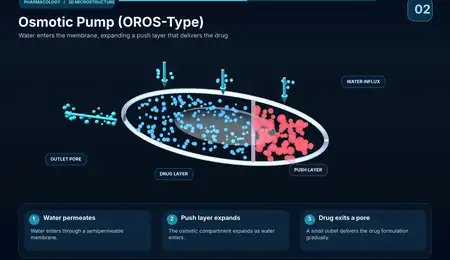
3D scientific illustration is schematic, not a validated rendering of a specific marketed medicine.
What Is Osmotic Pump Tablets?
An osmotic oral system generally uses a semipermeable membrane to admit water while retaining formulation solids. Water influx generates osmotic pressure that displaces dissolved or suspended drug through a delivery orifice. Membrane properties, osmogen content, internal architecture and orifice dimensions influence the achievable delivery profile.
Release mechanism and scientific assumptions
The membrane must remain functional during gastrointestinal transit. An oversized orifice can compromise rate control; an undersized, blocked or absent opening may reduce or prevent release. Drug solubility, osmotic-agent selection and the integrity of the coating process are essential. A pressure-driven system cannot be inferred from tablet shape alone.
Where the Technology Adds Value
Osmotic systems can reduce sensitivity to some external hydrodynamic effects, but independence from food, pH or gastrointestinal behavior must be demonstrated for the specific medicine. A retained empty shell may sometimes be observed in stool for certain marketed systems; counseling must follow the actual product label rather than a generic graphic.
Modified-release terminology requires care: sustained, prolonged and extended release describe rate or duration objectives, whereas delayed release primarily changes the start or site of release. The applicable dosage-form classification and actual label take precedence over a simplified mechanism diagram. The EMA quality guideline addresses both prolonged-release oral products and gastro-resistant delayed-release products, but does not make them equivalent.
| System or stage | Main release principle | Key sensitivity |
|---|---|---|
| Elementary osmotic pump | Osmotic solution expulsion | Solubility and membrane |
| Push–pull osmotic | Expandable push layer displaces drug | Bilayer geometry and interface |
| Matrix tablet | Polymer gel diffusion and erosion | Polymer grade and compression |
Development and Testing Workflow
Selection of measurements and instruments
Inspect the membrane and delivery opening with appropriate imaging or microscopy. Test dissolution in conditions justified by the intended use and assess complete release, lag behavior, robustness and dose dumping risks. Compare orifice dimensions, coat weights, membrane permeability and release profiles during process characterization.
Typical studies combine qualified dissolution apparatus, calibrated analytical instruments, documented sample handling, validated assay procedures and formulation-specific physical measurements. Apparatus type, agitation, media, volume, sample schedule, filtration and analytical technique must be selected for the actual product. Published illustrations and generic example curves do not replace a validated dissolution method.
| Activity | Parameters or observations | Evidence to retain |
|---|---|---|
| Core development | Osmogen, drug solubility | Core formula records |
| Membrane coating | Permeability and thickness | Coating process validation |
| Orifice formation | Opening geometry | Verified imaging record |
| Dissolution challenge | Lag, total release, robustness | Product-specific specification |
Acceptance Criteria and Regulatory Interpretation
No generic numerical specification is asserted here. Release-time limits must derive from the relevant authorized drug-product specification, applicable monograph and scientifically justified method. EMA/CHMP/QWP/428693/2013 describes quality expectations for oral modified-release products; FDA guidance addresses IVIVC and postapproval changes. ICH Q8(R2), Q9(R1) and Q10 inform development understanding, risk management and the pharmaceutical quality system.
The USP–NF <711> Dissolution chapter is a general compendial resource, but its applicability, apparatus, procedure and limits depend on the relevant product and official text. Where no USP monograph dissolution method exists, the FDA Dissolution Methods Database may provide a recommended method for a named drug product. Confirm current revision and local regulatory status before implementation.
| Assessment | Acceptance position | Source |
|---|---|---|
| Release at scheduled time points | Approved multi-point dissolution criteria | EMA-Q; USP-711 |
| Orifice and membrane integrity | Product-established dimensional/functional controls | ICH |
| Postapproval change comparability | Assessment under applicable SUPAC-MR scope | FDA-SUPAC |
Manufacturing Controls and Process Validation
Critical process parameters and material attributes
Protect coating uniformity, curing conditions, orifice drilling controls and functional membrane integrity. Maintain traceability from coating solution preparation through application and laser drilling. In-process coat-weight statistics are useful, but finished-unit dissolution and appearance must provide evidence of functional performance.
Criticality is established by data and risk assessment, not by calling every measurement a critical parameter. Development reports should explain why selected inputs affect quality attributes; commercial controls should then demonstrate continued capability. Risk assessment should include scale-up, storage, transfer between equipment, handling and relevant postapproval changes.
Common Deviations, Troubleshooting and CAPA
A damaged semipermeable membrane may permit unplanned release, while a plugged orifice can lead to incomplete release. Examine whether orifice defects are random or cluster by equipment lane or setup. Any intended opening-size range needs product-specific verification against actual release behavior.
A failed or atypical result must be assessed using the governing laboratory procedure. Do not invalidate an observation simply because a repeat sample passes. Review sampling, analyst actions, equipment, calculations, raw analytical data and the complete batch history, then document root cause and CAPA effectiveness in the quality system.
| Problem | Possible cause | Investigation | Corrective action | Preventive action |
|---|---|---|---|---|
| Release stalls | Blocked orifice or poor core wetting | Imaging and mass balance | Correct drilling/coating set-up | 100% or risk-based inspection controls |
| Unplanned burst | Membrane rupture or pinhole | Coat thickness and defect mapping | Address coating failure | Routine membrane trend review |
GMP Documentation and Lifecycle Evidence
For this topic, the technical file should link the quality target product profile to formulation choices, known material attributes, manufacturing set points, validated analytical methods and stability-indicating performance. Maintain traceable protocols, raw instrument files, calibration/qualification status, executed batch records, trend reviews, deviations and effective change controls. Decisions should be supported by contemporaneous and retrievable evidence.
For a modified-release product, early and later portions of the dissolution curve can carry different risks. Routine review should therefore evaluate the full specified profile and the scientific significance of changes, not only an average percentage. Use product-specific specifications to determine disposition; an educational article cannot authorize batch release.
Related Pharmatalks Resources
These are internal links within this ready-to-integrate Pharmatalks article package; they are not represented as live website pages.
- Coated Pellets for Modified Drug Release
- Intestinal Absorption of Extended-Release Drugs
- Membrane Reservoir Systems for Oral Drugs
Related connected resources: Pharmatalks QbD Visual Guide (supporting education, not a protocol). Return to the extended-release article directory.
Frequently Asked Questions
What is the key mechanism of osmotic pump tablets?
An osmotic oral system generally uses a semipermeable membrane to admit water while retaining formulation solids. The full profile depends on the actual formulation and physiological context.
Why does osmotic pump tablets require multi-point dissolution testing?
Because a single end point cannot identify an early burst, a mid-profile shift or late under-release. Time-point selection and limits must be justified for the specific approved product.
Is a constant plasma concentration guaranteed?
No. Dissolution, intestinal transit, absorption and elimination interact; clinical evidence is needed to support any claim about exposure stability.
Which pharmacopoeial limit applies?
The applicable current drug-product monograph or approved specification controls. There is no single universal release-percentage requirement for every extended-release product.
Can a manufacturing change alter drug release?
A damaged semipermeable membrane may permit unplanned release, while a plugged orifice can lead to incomplete release. Change impact must be evaluated through scientific risk assessment and applicable regulatory commitments.
What data should a GMP investigation retain?
Retain original and repeat dissolution observations, chromatograms, instrument suitability records, lot genealogy, process settings, deviations, change controls, approved methods and CAPA effectiveness evidence.
Conclusion
Osmotic Pump Tablets is best evaluated through combined formulation understanding, discriminatory performance testing and lifecycle controls. Use technical visualizations to clarify mechanisms, but reserve product claims and acceptance decisions for verified evidence and approved documentation. The correct scientific outcome is a robust release profile linked to the intended medicine, not a generic ideal curve.
Official References
- EMA — Quality of oral modified-release products (EMA/CHMP/QWP/428693/2013)
- EMA — Pharmacokinetic and clinical evaluation of modified-release dosage forms (Rev. 1)
- FDA — Extended-release oral dosage forms: IVIVC guidance
- FDA — SUPAC-MR postapproval changes
- FDA — Dissolution Methods Database
- USP–NF General Chapter <711> Dissolution (public abstract)
- ICH — Quality guidelines: Q8(R2), Q9(R1), Q10
Author: Pharmatalks Editorial Team · Review date: 2026-11-06 · Educational technical content; product-specific interpretation and regulatory confirmation required.