
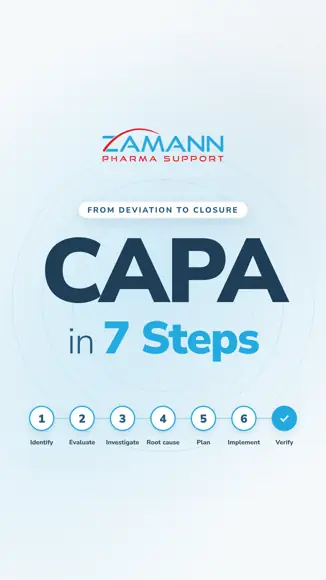
CAPA in 7 Steps: GMP Deviation to Closure

CAPA in seven steps is a practical training model for moving a pharmaceutical quality issue from identification to documented effectiveness verification. The sequence—identify, evaluate, investigate, determine root cause, plan, implement and verify—organizes responsibilities but is not a seven-step structure explicitly mandated by ICH Q10 or FDA regulations. Regulatory expectations emphasize a risk-appropriate investigation, control of affected product, measures directed at verified causes, and evidence that actions work. A completed task list alone does not demonstrate that recurrence risk has been reduced.
What Is CAPA and When Is It Needed?
Corrective and preventive action (CAPA) is an element of the pharmaceutical quality system. ICH Q10 section 3.2.2 identifies sources including complaints, product rejections, nonconformances, recalls, deviations, audits, inspection findings and process or product trends. It calls for a structured investigation aimed at determining root cause, with effort and documentation commensurate with risk. Not every isolated observation requires an identical CAPA project: the decision and escalation must follow approved procedures and the evidence of systemic risk.
A correction addresses the immediate detected condition, such as segregating mislabeled material. A corrective action addresses a cause of an observed problem; preventive action addresses potential occurrence or recurrence risks. These terms should not collapse into 'retrain the operator' without evidence. When a procedure, equipment parameter, or computerized system changes, formal change control may also be required.
Steps 1–2: Identify and Evaluate
Identification starts with an accurate event statement: what was observed, when, where, in which batch or system, and by whom. Preserve the original evidence and immediately contain or segregate any potentially affected material as needed. Record the event using the approved deviation or quality-event system, not an informal spreadsheet that bypasses traceability.
Evaluation defines urgency and breadth. Assess impact on product, patient safety, data reliability, previous lots, released products, and other equipment or campaigns. Decide whether additional testing or a production stop is warranted under approved authority. Risk assessment is a structured aid, not a score that automatically replaces expert judgment.
Steps 3–4: Investigate and Determine Root Cause
Investigation gathers chronological facts from batch records, equipment logs, calibration and maintenance history, training records, environmental data, laboratory raw data, and relevant interviews. Construct a timeline before claiming a cause. Consider alternatives and distinguish a confirmed causal mechanism from a mere correlation. For a repeated filling weight deviation, a recurring sensor drift, a weak setup instruction, and operator intervention may all be plausible until supported by evidence.
Use tools such as the five whys, fishbone analysis, causal mapping, or fault-tree analysis when they add value; no single tool is universally required. 'Human error' is not an adequate endpoint if design, procedure, workload or detectability contributed to the event. If root cause remains unconfirmed, document uncertainty and proportionate risk controls rather than inventing certainty.
Steps 5–6: Plan and Implement Actions
The CAPA plan names each action, owner, approver, due date, risk rationale, required training, and linkage to controlled change requests. Choose actions that target the cause: improve an equipment interlock, change process verification, update a validated method, or clarify an ambiguous instruction with demonstrated knowledge gaps. Specify evidence of completion before implementation starts.
Implementation may require qualification, validation, training assessment, and controlled-document revision. Verify that the change did not create a new risk. Retain objective evidence such as approved revisions, executed protocols, calibrated instrument records, and production data. 'Email sent' or 'training assigned' rarely demonstrates that a process defect was corrected.
Step 7: Verify Effectiveness and Close
Effectiveness verification asks whether the intended quality outcome occurred over a meaningful observation window. Define the metric and evidence in advance: recurrence frequency, process capability, missed alarms, investigation quality, or monitoring results. Select an appropriate period and sample size using risk and process frequency; ICH Q10 does not prescribe a universal 30-, 60-, or 90-day rule.
If an action was implemented correctly but the deviation recurs, the CAPA may be ineffective. Reopen the causal reasoning, inspect execution fidelity, consider new evidence, and escalate when needed. Closure authority should verify documentation, product-impact decisions, action completion, and the effectiveness outcome according to the local quality system.
GMP Records and Inspection Readiness
An inspection-ready file links the deviation identifier, impacted product and batches, chronology, evidence, risk evaluation, root-cause rationale, action approvals, change control, training, and verification results. In the United States, 21 CFR 211.192 requires thorough investigation of unexplained discrepancies and specification failures, including relevant other batches, and a written record with conclusions and follow-up. This is not a universal obligation to use exactly seven numbered CAPA stages.
Four Technical Tables
Table 1 — Technical comparison
| Term | Purpose | Illustrative example |
|---|---|---|
| Correction | Control or fix detected issue | Segregate potentially mislabeled units |
| Corrective action | Eliminate confirmed cause of actual deviation | Repair confirmed equipment-control weakness |
| Preventive action | Reduce risk of future occurrence elsewhere | Extend verified safeguard to similar lines |
| Effectiveness check | Demonstrate outcome using evidence | Confirm recurrence signal declines as predefined |
Table 2 — Procedure and critical parameters
| Step | Owner / tool | Key evidence | Quality decision |
|---|---|---|---|
| 1 Identify | Production / QA event record | What/where/when and original evidence | Contain as required |
| 2 Evaluate | QA/QRM, batch genealogy | Severity, scope and product impact | Escalation/disposition |
| 3–4 Investigate / RCA | Cross-functional team, timeline, causal analysis | Confirmed or qualified cause analysis | Appropriate cause basis |
| 5–6 Plan / implement | CAPA tracker and change control | Approved tasks; executed evidence | Action completion |
| 7 Verify | QA/SME, predefined metric | Observed outcome versus success criterion | Effectiveness and closure |
Table 3 — Acceptance criteria and regulatory boundary
| Element | Official expectation | Numeric limit | Practical evidence |
|---|---|---|---|
| Investigation | Risk-appropriate structured root-cause work (ICH Q10 §3.2.2) | No single mandated CAPA step count | Chronology, evidence, rationale |
| Batch discrepancy | Thorough investigation, written conclusions and follow-up (21 CFR 211.192) | No uniform CAPA duration specified | Impact on associated batches |
| Action selection | Improve process/product understanding (ICH Q10) | Site-defined goals | Actions linked to causes |
| Effectiveness | Evaluate CAPA effectiveness (ICH Q10) | Observation window is risk-based | Predefined outcome and follow-up trend |
Table 4 — Troubleshooting and corrective/preventive actions
| Problem | Possible cause | Investigation | Corrective action | Preventive action |
|---|---|---|---|---|
| Repeated deviation | Root cause not actually addressed | Compare recurrence with RCA | Redesign causal control | Replicate lessons to similar systems |
| CAPA overdue | Unrealistic plan or resource gap | Review owners, dependencies, urgency | Escalate and revise approved plan | Capacity and due-date governance |
| Retraining fails | System or process design issue | Audit procedure execution and usability | Fix instructions or equipment controls | Evaluate training in context |
| Effectiveness ambiguous | Metric or window not defined | Review original success criterion | Design meaningful verification | Require acceptance rationale at planning |
GMP Documentation and Implementation Notes
Keep the approved procedure, version, responsibilities, original observations, QA disposition, deviations, changes, and data needed to substantiate decisions. The correct level of detail depends on the product, process, risk, and applicable GMP system.
Frequently Asked Questions
Does GMP require exactly seven CAPA steps?
No. Seven steps are an educational workflow; use the approved PQS and the applicable regulations.
Is retraining an adequate corrective action?
Only if evidence identifies a knowledge or skill gap and subsequent effectiveness can be demonstrated.
Does each deviation need a CAPA?
Escalation depends on risk, recurrence, impact and site procedures; every significant investigation still needs proper documentation.
How long must a CAPA remain open?
There is no universal ICH Q10 CAPA-day limit. Set justified milestones and an effectiveness observation window.
Who can close a CAPA?
Authorized roles defined in the approved quality system, typically with QA oversight.
What if effectiveness verification fails?
Document the outcome and reassess the cause and action plan; consider renewed CAPA and broader impact.
Related Pharmatalks Resources
The article links below are internal to this offline package. Existing Drive article links are explicitly labeled as archive previews; they are not verified live Pharmatalks website URLs.
- Pharmatalks CAPA Lifecycle (existing Drive article) (existing Google Drive resource)
- ICH Q10 PDF in connected Drive (existing Google Drive resource)
Official and Professional References
- ICH Q10 Pharmaceutical Quality System, §3.2.2.
- ICH Q9(R1) Quality Risk Management.
- FDA GMP: 21 CFR 211.192 investigation records.
Conclusion
A defensible CAPA does not end when checkboxes turn green. It ends after the organization has understood the quality issue, implemented appropriate control measures, and confirmed with objective evidence that the intended improvement is sustained.
Author/brand: Zamann Pharma Support | Editorial review: 2026-11-08 | Article type: Educational, not a substitute for site SOPs or regulatory advice.