
Dirty vs Clean Hold Time: GMP Validation

Dirty equipment hold time (DEHT) is the interval between a defined end-of-manufacturing point and the start of cleaning. Clean equipment hold time (CEHT) is the interval between completion of approved cleaning and the next equipment use, under defined storage conditions. Dirty hold studies challenge cleanability and residue behavior; clean hold studies evaluate whether cleaned equipment remains fit for use, including microbiological risk where applicable. EU GMP Annex 15 section 10.8 says both intervals must be considered when defining the cleaning process. It does not set universal eight-hour, 24-hour or 72-hour limits.
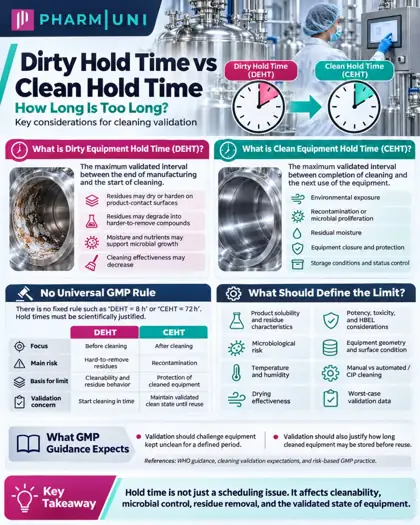
Why Dirty and Clean Hold Times Differ
During dirty storage, powders may cake, solutions may dry, and residues may form films or become difficult to remove. If the material supports microbial growth, delays and moisture may also change bioburden. The relevant challenge is the cleaning process's ability to remove residues after the proposed maximum delay, not simply whether the equipment can be wiped visually clean.
After cleaning, the equipment should remain appropriately protected. Cover status, drainage, trapped water, humidity, disassembly, room classification, traffic, and handling can alter recontamination risk. A clean hold limit is therefore connected to conditions of storage and the equipment's clean status. A validated cleaning result at time zero is not automatically proof that a stored component remains suitable indefinitely.
Regulatory Basis and Boundary
EU GMP Annex 15 section 10.8 explicitly directs manufacturers to consider time between manufacture and cleaning and time between cleaning and use. Section 10.7 requires consideration of microbial and endotoxin contamination risks during development of cleaning validation protocols. Other parts of section 10 address scientifically justified residue limits, representative sampling sites, validated analytical methods, and an appropriate number of cleaning runs based on risk.
Health Canada's cleaning validation guide discusses establishing a maximum period that cleaned equipment may be held without re-cleaning or re-sanitizing and demonstrating that the period does not result in microbial proliferation. The guide is jurisdiction-specific and not an automatic global numerical standard. Neither source provides a universal hour limit suitable for all sites and products.
Selecting Worst-Case Conditions
A dirty hold study should challenge a justified worst-case soil, equipment surface, location, temperature or humidity, and maximum proposed delay. Product solubility, potency, toxicity, degradation, formulation excipients, and process temperature can influence cleanability. The study must follow the proposed routine process closely enough to support the actual cleaning claim. A convenient laboratory coupon study alone may not represent a large vessel with shadowed spray zones.
For clean hold, challenge the intended storage state: wet or dried, assembled or disassembled, sealed or open, dedicated or shared, and the intended room and handling controls. If equipment is re-sanitized immediately before use, its role in the strategy must be justified rather than assumed to erase all earlier storage risks.
Sampling Methods and Critical Parameters
Swab samples assess selected surfaces and hard-to-clean locations when recovery is demonstrated. Rinse samples help evaluate inaccessible or extensive surfaces but may mask localized residues if poorly designed. Specific analytical methods, total organic carbon (TOC), conductivity, and microbiological recovery methods are used where justified by the residue or risk. A visual inspection is important but is not generally sufficient as the sole cleaning validation acceptance criterion under Annex 15.
Define the actual time stamps in the protocol: stop of manufacturing, start of cleaning, completion of final cleaning or sanitization, protected storage, and next use. Record equipment identity, storage conditions, operators, cleaning agent, critical cleaning parameters, sample sites, method sensitivity, and any deviation. The time convention must be consistent between study and manufacturing SOP.
Acceptance Criteria and Requalification
Hold time itself is a qualified process parameter with a scientifically justified maximum, not a toxicological exposure limit. Residue acceptance should be supported by an appropriate health-based evaluation where applicable; microbiological criteria depend on process risk, applicable standards, and approved local limits. Avoid copying a generic '8 h dirty/72 h clean' rule into a validation master plan. The limits and storage conditions must be supported by representative data.
When a proposed hold time is exceeded, use the approved site procedure to assess the equipment state, potential product impact, and need for re-cleaning, re-sanitizing or investigation. A process change, difficult new product, altered drying, new equipment, or recurring recovery failures may justify requalification. Repeated cleaning and retesting until an acceptable residue result appears is not a substitute for examining a failing process.
Documentation and Example
Consider a shared mixing tank: production ends at 18:00, cleaning begins the following morning, and the tank is covered after the approved clean. Validation would need to support the maximum defined dirty interval and the conditions under which that cleaned tank is stored. It must not infer a universal suitable duration from this example. The quality record should show the validated study, approved equipment status, actual time stamps, cleaning-log entries, analytical results, and authorized decisions.
Four Technical Tables
Table 1 — Technical comparison
| Property | Dirty equipment hold time (DEHT) | Clean equipment hold time (CEHT) |
|---|---|---|
| Clock | End of manufacturing to start of cleaning | Cleaning completion to equipment reuse |
| Main risk | Hardened or degraded residues; possible growth | Recontamination, moisture, microbial proliferation |
| Study challenge | Cleaning after maximum justified delay | Storage under defined conditions until reuse |
| Typical evidence | Post-clean residue and microbial assessment as justified | Status/conditions and microbial or other checks as justified |
Table 2 — Procedure and critical parameters
| Stage | Method or equipment | Critical parameter | Record |
|---|---|---|---|
| Define worst case | Product/equipment risk review | Solubility, geometry, wet/dry state | Approved rationale |
| Dirty challenge | Timed hold then validated clean | Elapsed time and storage environment | Time-stamped cleaning log |
| Sample after cleaning | Swab, rinse, TOC, specific assay | Recovery and method suitability | Raw data and calculations |
| Clean challenge | Controlled storage then pre-use checks | Cover, humidity, drainage, handling | Status log, samples and disposition |
Table 3 — Acceptance criteria and regulatory boundary
| Criterion | Verified expectation | Fixed numeric hours? | Reference / site rule |
|---|---|---|---|
| Dirty & clean holds | Consider both intervals in cleaning validation | No universal number | EU GMP Annex 15 §10.8 |
| Microbial risk | Consider during cleaning validation; demonstrate suitable clean storage where relevant | Risk-based | Annex 15 §10.7; Health Canada §11 |
| Residue carryover | Scientifically justified, toxicological evaluation where applicable | Product/equipment specific | Annex 15 §10.6 |
| Visual cleanliness | Important but not generally sufficient alone | No blanket numerical substitute | Annex 15 §10.2 |
| Sampling | Site selection rationale, appropriate recovery and method | Procedure-specific | Annex 15 §§10.11–10.12 |
Table 4 — Troubleshooting and corrective/preventive actions
| Problem | Possible cause | Investigation | Corrective action | Preventive action |
|---|---|---|---|---|
| Residue after long delay | Drying or chemical change | Compare worst-case soil and cleaning parameters | Improve cleaning process under change control | Validate challenged dirty interval |
| Clean tank contaminated | Poor covering or retained water | Inspect storage, handling, drying, organism ID | Reclean/sanitize per approved SOP | Improve protection and clean-hold study |
| Unclear hold start point | Conflicting timestamps | Review SOP, equipment logs and protocol | Correct procedural definition | Standardize status tracking |
| Out-of-range hold time | Production planning or equipment shortage | Review deviation and product impact | Apply approved disposition and restoration | Scheduling and alert controls |
GMP Documentation and Implementation Notes
Keep the approved procedure, version, responsibilities, original observations, QA disposition, deviations, changes, and data needed to substantiate decisions. The correct level of detail depends on the product, process, risk, and applicable GMP system.
Frequently Asked Questions
What is dirty hold time?
The defined interval between end of manufacturing and the beginning of equipment cleaning.
What is clean hold time?
The interval between completion of cleaning and equipment reuse under specified storage conditions.
Does EU GMP prescribe a standard eight-hour dirty hold?
No. Annex 15 requires consideration and scientific justification; it does not set a universal hour limit.
Must clean hold time include microbial testing?
Assess microbiological risk; select testing or other evidence where scientifically justified and applicable.
Are visual inspection and rinse checks enough?
Visual inspection alone is not generally sufficient; use justified sampling and analytical methods for the risk.
What happens if equipment exceeds its validated hold time?
Follow the site's approved risk assessment and quality disposition, potentially including re-cleaning or further investigation.
Related Pharmatalks Resources
The article links below are internal to this offline package. Existing Drive article links are explicitly labeled as archive previews; they are not verified live Pharmatalks website URLs.
- Pharmatalks Hold Time Validation (existing Drive article) (existing Google Drive resource)
- Cleaning Validation Master Plan (Drive reference PDF; verify ownership and revision before operational use) (existing Google Drive resource)
Official and Professional References
- EU GMP Annex 15 (2015), cleaning validation §§10.1–10.15.
- Health Canada Cleaning Validation Guide GUI-0028.
Conclusion
The question is not how many hours other plants use. It is whether the intended dirty delay and clean storage conditions were adequately challenged, measured, and controlled for the particular products and equipment. Defend the hold-time claim with evidence and a clear operating procedure.
Author/brand: Pharmuni | Editorial review: 2026-11-08 | Article type: Educational, not a substitute for site SOPs or regulatory advice.