
Microbiology Laboratory Governance SOP: GMP Framework
Direct answer: Microbiology laboratory governance is the controlled framework that defines who may perform, review, approve, escalate, investigate and change microbiological work. In a pharmaceutical laboratory, governance connects competence, methods, equipment, media, records, data integrity, deviations, outsourced testing and management oversight so that reported results can be scientifically trusted and defended during inspection. It is not a single acceptance limit or test method; it is the quality system that keeps laboratory decisions consistent.
What Is Microbiology Laboratory Governance?
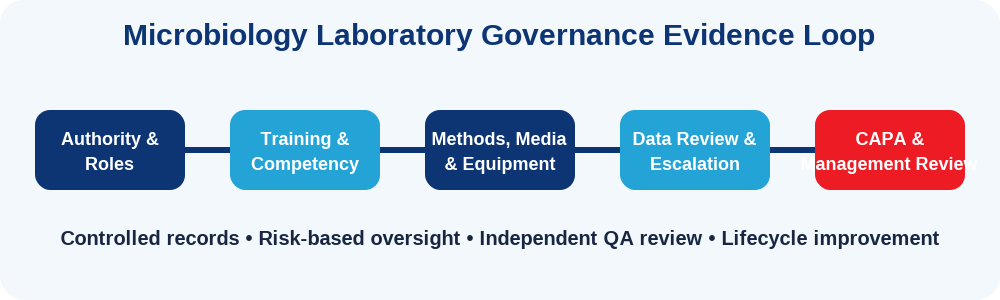
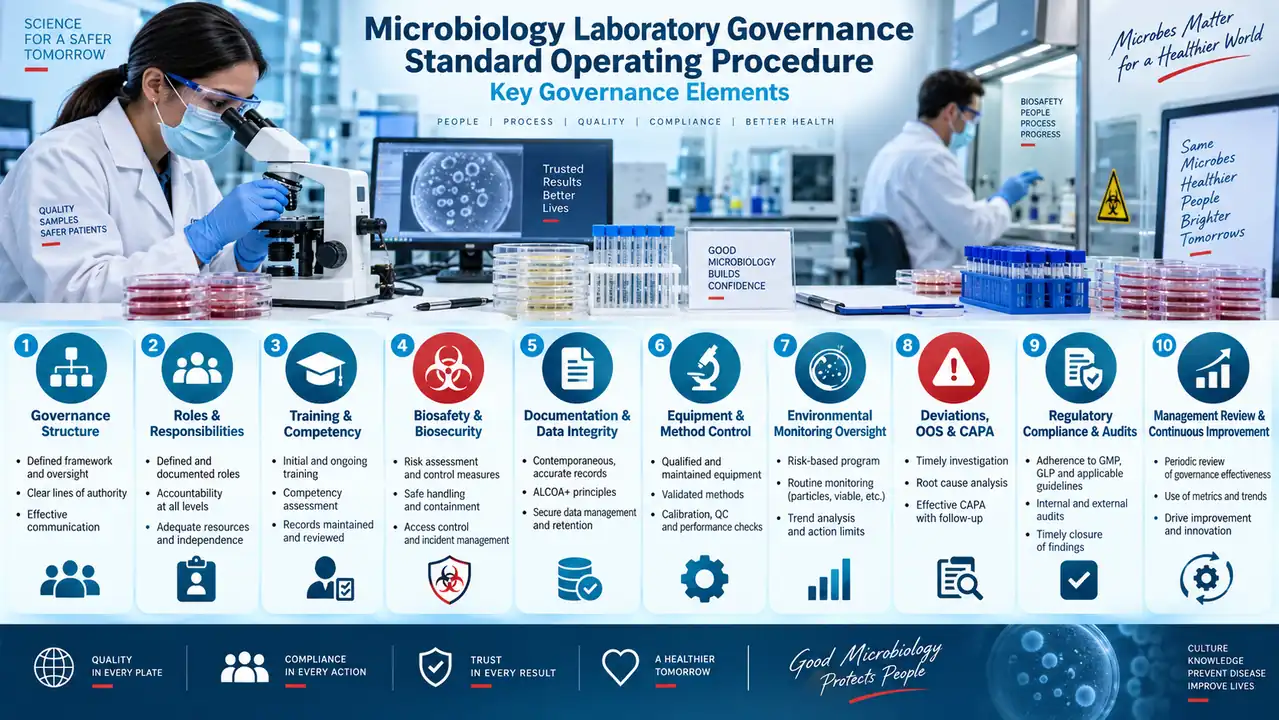
Governance converts laboratory quality expectations into defined decision rights and evidence. A mature system specifies the authority of analysts, laboratory management and independent Quality Assurance (QA); defines which activities require authorization; controls current methods and specifications; and establishes how atypical, invalid, OOS or OOT data are escalated. WHO good-practice guidance for pharmaceutical quality-control laboratories emphasizes a documented quality system, competent personnel, suitable facilities and equipment, controlled procedures and reliable records. FDA laboratory-control expectations likewise require written procedures and complete records that are reviewed appropriately.
Why Governance Matters in Pharmaceutical Microbiology
Microbiology is especially vulnerable to variation introduced by sampling, biological recovery, incubation, analyst technique, media performance and contamination. Governance reduces the risk that a technically plausible result is accepted when its supporting controls were weak. It also protects independence: a person who generated a result should not be able to bypass required review, rewrite acceptance logic after seeing the result or initiate repeated testing merely to obtain a passing outcome.
| Control area | Primary purpose | Typical controlled evidence |
|---|---|---|
| Authority and roles | Define accountability and independence | Organization chart, job descriptions, authorization matrix |
| Personnel competence | Ensure only qualified staff perform regulated work | Training plans, observation records, competency assessments |
| Method governance | Prevent uncontrolled methods or criteria | Approved SOP/STP, specifications, validation or verification records |
| Data governance | Preserve complete and attributable evidence | Raw data, audit trails, review records, controlled corrections |
Core Governance Model
Roles, authorization and segregation of duties
Analysts should perform only activities for which they are currently trained and authorized. Laboratory management owns technical execution and resources, while QA provides independent oversight for controlled documents, significant investigations, CAPA, change control and quality-impact decisions. Where one person must hold several roles, compensating review controls should be defined so that independence is not merely assumed.
Methods, media, equipment and systems
Reportable testing should reference an approved method and specification. Critical equipment should have defined ownership, qualification or suitability status, calibration/maintenance controls and traceable use records where applicable. Media, reagents and reference cultures require status, identity and storage controls. Computerized systems used for acquisition or calculation should have appropriate access, audit-trail and backup controls according to their risk and intended use.
| Step | Key parameter | Evidence expected | Escalation trigger |
|---|---|---|---|
| Pre-test readiness | Current method, trained analyst, equipment status | Version check, authorization, calibration/qualification status | Expired/unknown status |
| Execution | Aseptic technique, sample identity, timing | Contemporaneous worksheet/electronic record | Procedure departure or compromised sample |
| Incubation/recovery | Specified conditions and controls | Incubator record, media/control traceability | Control failure or excursion |
| Review | Raw data completeness and calculations | Second-person or authorized review | Atypical, OOS/OOT, missing data |
Acceptance, Review and Regulatory Expectations
Governance acceptance criteria are usually procedural rather than universal numerical limits. The laboratory should be able to show that the correct method was used, controls were valid, equipment and materials were suitable, records are complete, deviations were assessed and the conclusion is authorized. FDA states that all data—including failing, passing, suspect and obvious-error data—belong in the CGMP record and require appropriate review. FDA data-integrity guidance also expects data to be reliable and accurate, with controls scaled to risk.
| Governance checkpoint | Acceptance concept | Source / status |
|---|---|---|
| Written laboratory procedures | Established, approved and followed | FDA CGMP laboratory controls; official requirement |
| Laboratory records | Complete, reviewable and retained | FDA CGMP / data integrity; official expectation |
| Training and competence | Appropriate to assigned work | WHO laboratory good practices; official guidance |
| EM alert/action levels | Defined by applicable control strategy | Site/process specific; verify current Annex 1 and local program |
Deviations, OOS/OOT and CAPA
Unexpected microbiology results should be preserved, escalated and investigated—not normalized through informal retesting. The investigation should consider sampling validity, method execution, media and controls, equipment/environment status, analyst technique, data processing and potential product/process impact. Retesting or resampling needs a documented scientific rationale and must not erase the original result. CAPA should address the demonstrated or most credible cause and include effectiveness follow-up when required.
| Problem | Possible cause | Investigation | Corrective action | Preventive action |
|---|---|---|---|---|
| Failed growth control | Media preparation/storage issue | Review lot, preparation, incubation and organism | Quarantine affected media; repeat only under approved rationale | Strengthen media release/trending |
| Unexplained count change | Transcription or data-integrity issue | Compare raw image/plate, audit trail and worksheet | Correct through controlled process | Improve electronic/raw-data review |
| Incubator excursion | Equipment or power failure | Assess magnitude, duration, affected tests and controls | Repair/restore and assess test validity | Alarm response and backup review |
| Recurring OOS/OOT | Method, environment or process trend | Cross-batch and cross-location trend review | Risk-based containment and investigation | CAPA with effectiveness monitoring |
GMP Documentation and Management Review
A governance SOP should define required records, retention, review responsibilities and escalation channels. Useful management indicators include invalid tests, OOS/OOT, repeat tests, deviations, CAPA aging, overdue training, calibration/qualification status, environmental-monitoring trends and turnaround performance. Metrics are signals, not substitutes for scientific review: adverse trends can merit investigation even if individual results remain within specification.
Frequently Asked Questions
Is laboratory governance the same as an SOP?
No. An SOP can define the governance framework, but governance also depends on roles, authorization, systems, review practices, management oversight and enforcement.
Does governance set microbiological acceptance limits?
Not by itself. Product, process and environmental limits come from applicable compendial, regulatory and approved site control strategies.
Can an analyst repeat a test after an unexpected result?
Only under an approved investigation or scientifically justified procedure. The original result and all associated data must remain part of the record.
Who should approve microbiology investigations?
The site QMS should define this. Significant GMP investigations normally require independent quality oversight in addition to technical microbiology input.
How should outsourced microbiology be governed?
Through supplier qualification, a technical/quality agreement, defined methods and specifications, change/OOS notification rules, data ownership and record access.
What is the most useful governance audit question?
Ask whether the laboratory can reconstruct why a result was generated, who was authorized, which controlled method applied, what raw evidence supports it and how exceptions were handled.
Conclusion
Microbiology laboratory governance makes technical results defensible by connecting authority, competence, controlled methods, qualified resources, complete data and independent review. The strongest programs do not rely on generic numerical rules; they make every result traceable to an approved method, valid controls and an accountable quality decision. Use current official requirements and your site QMS when converting these principles into executable procedures.
Official References
- WHO TRS 1052 Annex 4 — Good practices for pharmaceutical quality control laboratories (2024)
- WHO Quality Control Guidelines index — includes pharmaceutical microbiology laboratory guidance
- FDA CGMP Q&A — Laboratory Controls
- FDA Data Integrity and Compliance With Drug CGMP
- EU GMP EudraLex Volume 4 — Annex 1 and applicable GMP chapters