
Defensible Qualification and Traceability in Pharma
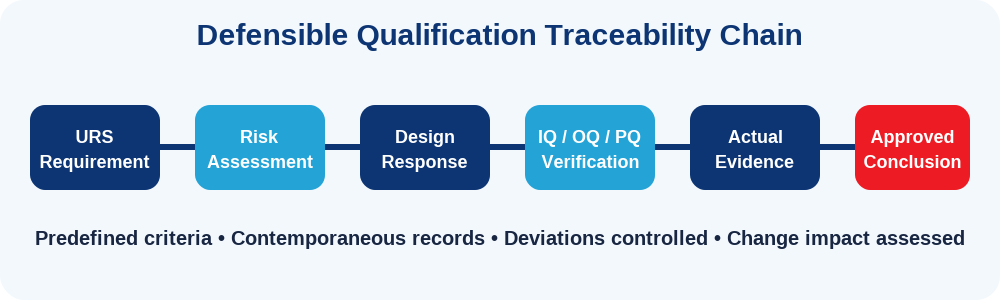
Direct answer: Defensible qualification is a lifecycle evidence system in which every critical requirement can be traced to its risk rationale, design response, approved verification method, actual result, deviation history and final conclusion. Traceability makes qualification reviewable: an auditor should be able to start from a User Requirements Specification (URS) item and find the evidence showing how it was implemented and verified. The objective is not to create more documents; it is to create an evidence chain that demonstrates fitness for intended use.
What Makes Qualification Defensible?
A defensible package is understandable without relying on the project team’s memory. Requirements are uniquely identifiable and testable; acceptance criteria are approved before execution; actual results are recorded; instruments and configurations are traceable; exceptions are handled through controlled deviation processes; and the final report resolves open items or explains their managed risk. Traceability prevents “orphan” requirements that were never verified and “orphan” tests that have no requirement or risk rationale.
Lifecycle Framework: URS, DQ, IQ, OQ and PQ
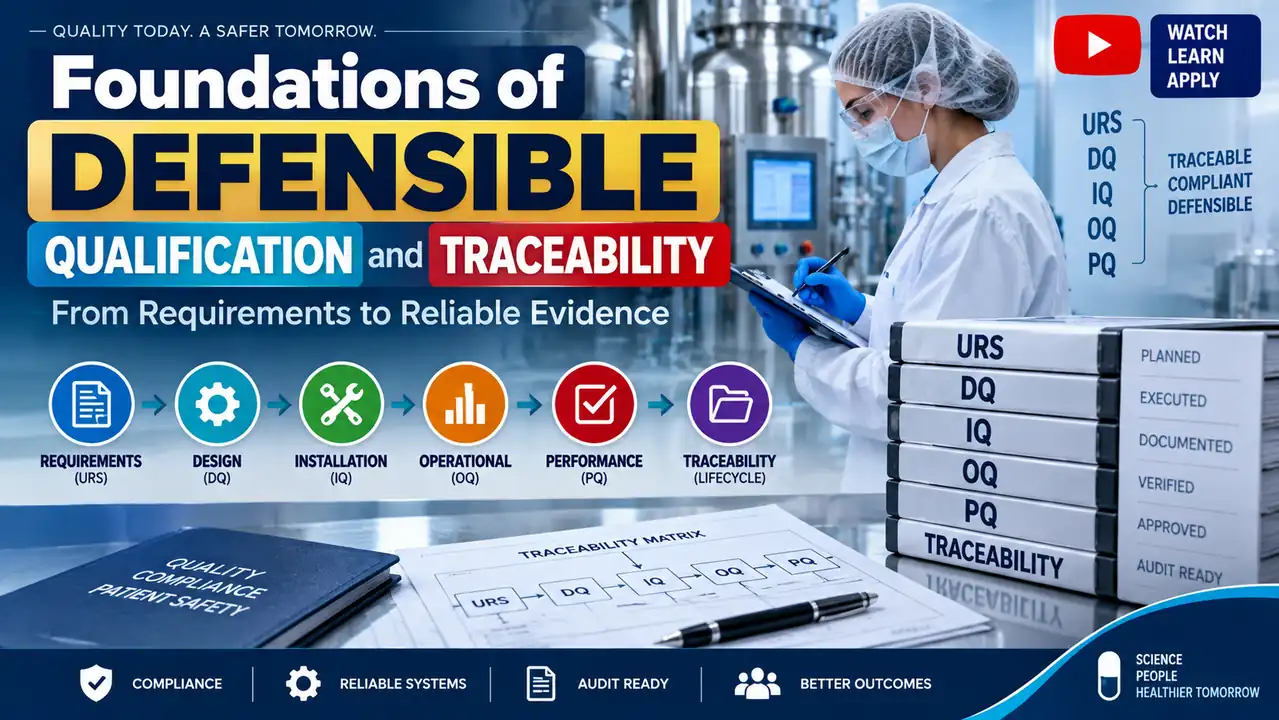
EU GMP Annex 15 describes qualification stages including URS, design qualification, installation qualification, operational qualification and performance qualification, while allowing stages to be combined when scientifically justified. The exact approach should reflect system complexity, novelty and quality risk. DQ demonstrates that the proposed design is suitable for the intended purpose. IQ establishes the installed baseline. OQ challenges operation across intended or anticipated ranges. PQ demonstrates consistent performance under representative operating conditions.
| Stage | Primary question | Typical evidence | Traceability focus |
|---|---|---|---|
| URS | What must the system do? | Approved, testable requirements | Requirement ID and criticality |
| DQ | Can the design meet the URS? | Design review, drawings/specifications, risk decisions | Requirement → design response |
| IQ | What was installed? | As-built components, utilities, versions, calibration baseline | Design → installed configuration |
| OQ | Does it operate as intended? | Functional challenges, alarms, ranges, interlocks | Functional requirement → objective test |
| PQ | Does it perform consistently in use? | Representative load/process performance | Intended use → performance evidence |
Requirements Engineering and the RTM
Write requirements that can be verified
Vague requirements such as “accurate,” “user friendly” or “sufficient capacity” are difficult to defend unless measurable expectations are defined. A strong URS states the needed outcome and, where appropriate, capacity, operating range, materials, alarms, security, data retention, interfaces, maintenance, calibration and cleaning requirements. Risk assessment then identifies which requirements need more formal or challenging verification.
Build the traceability matrix early
The Requirements Traceability Matrix (RTM) should be a planning and review tool, not closeout paperwork. During design and protocol development, it can reveal missing tests, duplicated testing or inconsistent criteria. Each critical row should identify the requirement, risk or rationale, design response, verification stage, protocol/test reference, result or evidence location and status.
| Lifecycle step | Critical parameter | Good evidence | Weak evidence |
|---|---|---|---|
| Requirement definition | Unique and verifiable wording | Approved requirement ID and rationale | Supplier brochure copied without intended-use logic |
| Test planning | Predefined criterion | Approved protocol before execution | Criterion selected after seeing the result |
| Execution | Actual observation | Contemporaneous result, instrument/configuration reference | Pass/fail tick with no supporting observation |
| Closeout | Resolved exceptions | Deviation linkage and approved conclusion | Open punch items with no impact assessment |
Acceptance Criteria and Regulatory Interpretation
Qualification acceptance criteria must be derived from approved requirements, design intent, process needs, regulatory commitments or justified engineering specifications. There is no universal acceptance limit for every piece of equipment. Criteria should be objective enough to distinguish acceptable from unacceptable performance before testing begins. ICH Q9(R1) supports risk-based rigor: higher-risk functions deserve proportionally stronger evidence and review.
| Checkpoint | Acceptance concept | Basis |
|---|---|---|
| URS | Requirements are defined and suitable for intended use | EU GMP Annex 15 lifecycle expectation |
| DQ | Design is verified against GMP and URS expectations | EU GMP Annex 15 |
| IQ/OQ/PQ | Approved protocols with justified criteria and documented results | EU GMP Annex 15; site validation system |
| Risk-based test depth | Effort/formality proportional to risk | ICH Q9(R1) |
| Requalification frequency | Defined by justified periodic review / risk strategy | Site-specific unless an applicable requirement specifies otherwise |
Deviations, Retesting and Change Control
A failed qualification step is not repaired by changing the criterion retrospectively. The deviation should preserve the original result, assess impact, determine root cause where appropriate and define scientifically justified correction or retest. If design or configuration changes, the traceability matrix should show which requirements and prior evidence are affected. Change control, periodic evaluation and requalification decisions maintain the validated state after initial approval.
| Problem | Possible cause | Investigation | Corrective action | Preventive action |
|---|---|---|---|---|
| URS item has no test | Late RTM preparation | Map all critical requirements to evidence | Create justified verification before closure | Start RTM during design |
| OQ failure | Design/configuration defect or unrealistic criterion | Review requirement, configuration and raw data | Correct defect; controlled retest if justified | Strengthen design/test review |
| Duplicate IQ/OQ tests | No risk-based protocol strategy | Assess what requirement each test verifies | Remove unnecessary duplication through change control | Use requirement-based test planning |
| Change breaks traceability | Impact assessment incomplete | Identify affected URS, design and test evidence | Update documents/requalify as needed | Make RTM part of change workflow |
GMP Documentation Requirements
Protocols and reports should identify scope, responsibilities, prerequisites, equipment or configuration, test steps, acceptance criteria, actual results, deviations and approvals. Supporting raw data must be retained in a form that allows reconstruction. For computerized or automated systems, screenshots may support evidence but should not replace audit trails, logs or source electronic data when those records are needed to demonstrate what actually occurred.
Frequently Asked Questions
Is the V-model required by regulation?
No single universal V-shaped diagram is mandated. It is a useful way to organize requirements, design and verification when it fits the system.
What makes an RTM useful?
It links each critical requirement to rationale, design, verification and evidence so gaps can be found before closeout.
Can IQ and OQ be combined?
Qualification stages may be combined when scientifically justified and consistent with the site validation plan and applicable requirements.
Should acceptance criteria be written before testing?
Yes. Predefined, approved criteria protect objectivity and prevent retrospective adjustment after results are known.
What should happen after a failed qualification test?
Preserve the result, open the appropriate deviation/investigation, assess impact, correct the cause and retest only with documented justification.
When is requalification needed?
After changes or periodic review when risk assessment shows that prior evidence may no longer demonstrate the qualified state. Frequency should be justified rather than copied generically.
Conclusion
Defensible qualification is achieved when requirements, risk, design, testing and actual evidence remain connected across the lifecycle. A concise RTM, predefined criteria, complete records and disciplined deviation/change control are more valuable than a large document set with weak linkage. Use EU GMP Annex 15 and ICH Q9(R1) as primary anchors, then scale the approach to the system’s intended use and quality risk.