
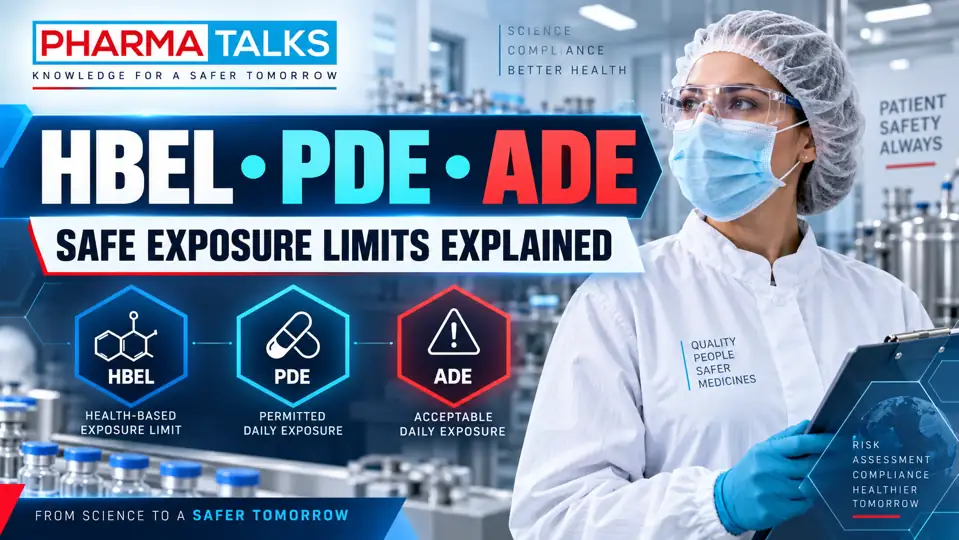
What Are HBEL, PDE and ADE?
HBEL is the health-based threshold used in EU GMP risk-based prevention of cross-contamination. EMA derives it using a PDE-type toxicological approach. The guideline describes PDE as a substance-specific dose unlikely to cause an adverse effect when an individual is exposed at or below that dose every day for a lifetime.
ADE is common industry terminology and may use closely related principles, but PDE and ADE should not be assumed identical by label alone. The report should define the method and key assumptions. For EU GMP decisions, the controlling EMA documents use HBEL and PDE terminology.
| Term | Meaning | Main use | Key caution |
|---|---|---|---|
| HBEL | Health-based exposure limit | Cross-contamination risk identification and control | Not merely a cleaning limit |
| PDE | Permitted Daily Exposure | Toxicological derivation of a daily safe exposure threshold | Requires expert selection of critical effect and factors |
| ADE | Acceptable Daily Exposure | Industry health-based exposure terminology | Define derivation; do not assume equivalence by label alone |
| Cleaning limit | Operational residue acceptance / alert criterion | Cleaning validation and routine verification | EMA says it should not simply be set equal to calculated HBEL |
How Is a PDE Derived?
EMA describes hazard review, selection of the critical effect and point of departure, then application of adjustment factors. The guideline presents the relationship:
This equation is an educational summary of the EMA approach. Selection of the critical effect, point of departure and factors requires qualified toxicology/pharmacology expertise.
The calculation is only the visible end of the assessment. The difficult work is selecting the relevant data, resolving conflicting studies, considering pharmacological activity, reproductive or developmental effects, sensitisation, genotoxicity, clinical exposure and route-specific bioavailability, and documenting why the chosen endpoint protects the intended population.
| Procedure step | Evidence / input | Critical parameter | Output |
|---|---|---|---|
| Hazard review | Nonclinical, clinical, pharmacology and toxicology data | Completeness and relevance | Candidate critical effects |
| Point of departure | NOAEL or justified alternative | Dose, species, endpoint, study quality | Starting value |
| Adjustment | Uncertainty factors and weight adjustment | F1–F5 rationale; route assumptions | Calculated PDE/HBEL |
| Application | Process, equipment and cleaning data | Carryover pathway and control capability | QRM controls and cleaning strategy |
How HBEL Is Used in Shared Facilities
EMA’s 2018 Q&A says HBELs should be established for all medicinal products and periodically reassessed. Their purpose extends beyond cleaning limits. Manufacturers should use the confirmed HBEL within QRM to determine whether organisational and technical controls are adequate and proportionate.
If controls cannot consistently keep contamination below the HBEL, EMA states the relevant products should be manufactured in dedicated facilities. The HBEL assessment should therefore connect toxicology to facility, process and cleaning controls.
Cleaning Limits and Verification
A common mistake is to turn the PDE/HBEL directly into a swab limit without considering process capability and the receiving product. EMA says the HBEL guideline may justify cleaning limits but is not intended to set them at the calculated HBEL itself. Analytical testing at each changeover is expected unless robust documented QRM justifies otherwise.
| Control point | Verified expectation | Acceptance / decision rule | Source |
|---|---|---|---|
| HBEL coverage | Establish HBELs for all medicinal products | Assessment available and periodically reassessed | EMA HBEL Q&A Q1 |
| Cross-contamination control | Use HBEL through QRM to define controls | Controls demonstrably keep contamination risk within the health-based boundary | EMA HBEL Q&A Q3 |
| Cleaning limit | Do not simply set at calculated HBEL | Cleaning / alert limits justified by capability and prevention of HBEL excursion | EMA HBEL Q&A Q6 |
| Changeover testing | Analytical testing expected unless justified by QRM | Documented QRM addresses repeatability, hazard and visual-inspection capability | EMA HBEL Q&A Q7 |
Competence and Documentation
EMA expects HBEL assessors to have adequate toxicology/pharmacology expertise and relevant experience. External experts should be qualified and appropriately contracted. The HBEL assessment should retain the source data, rationale, calculations, expert qualifications, approvals and reassessment triggers.
Common Problems, Investigation and CAPA
| Problem | Possible cause | Investigation | Corrective action | Preventive action |
|---|---|---|---|---|
| HBEL copied from vendor summary | Provider not technically qualified | Review expert credentials, source data and derivation | Reassess using qualified expert | Formal contractor qualification and review standard |
| Cleaning limit equals PDE without rationale | Health limit confused with operational limit | Recalculate carryover model and assess cleaning capability | Set justified operational criterion | Separate toxicology and cleaning-limit SOP logic |
| Repeated alert-limit excursions | Cleaning process not in control | Trend residues, cycle parameters and manual variability | Correct cleaning failure mechanism | Capability monitoring and automated controls where justified |
| Old HBEL after new safety data | No lifecycle review trigger | Compare current knowledge with original assessment | Reassess HBEL and impacted controls | Periodic and event-driven toxicology review |
Related Pharmatalks Resources
- Part III – HBEL: Health Based Exposure Limits for Shared Facilities
- Part III – Q9 Quality Risk Management
- Pharmatalks Standards Library
- Pharmatalks Resource Library
Frequently Asked Questions
Is HBEL the same as a cleaning limit?
No. HBEL is a health-based boundary used in risk management. EMA explicitly says its guideline is not intended to set cleaning limits at the level of the calculated HBEL.
Are HBELs required for every medicinal product?
EMA’s 2018 Q&A says yes, and the toxicological or pharmacological basis should be reassessed through the product lifecycle.
Are PDE and ADE always identical?
They can be conceptually similar in industry practice, but the assessment must define terminology, method and assumptions. EU GMP/EMA controlling documents use HBEL/PDE terminology.
Can an engineer calculate a PDE from a formula alone?
No. The formula does not replace expert selection of the critical effect, point of departure, uncertainty factors, route and data interpretation. EMA expects adequate toxicology/pharmacology expertise.
Is analytical testing needed after every product changeover?
EMA expects testing at each changeover unless a robust documented QRM process justifies another approach, considering cleaning repeatability, product hazard and visual-inspection capability.
When is a dedicated facility required?
EMA states that if organisational and technical controls cannot adequately assure contamination is consistently controlled below the HBEL, the products concerned should be manufactured in dedicated facilities.
Conclusion
HBEL, PDE and ADE belong to a health-based risk framework, not a simple residue-number exercise. A defensible program links expert toxicology to QRM, cleaning and facility controls, verifies capability, and reassesses the scientific basis as knowledge evolves.
Official References
- EMA, Guideline on setting health based exposure limits in shared facilities
- EMA, Questions and Answers on HBEL and cross-contamination (2018)
- European Commission, EudraLex Volume 4 GMP
- ICH Quality Guidelines (Q9, Q10 and Q3C context)
Author / brand: Pharmatalks Technical Education · Review date: 7 November 2026 · HBEL/PDE derivation requires appropriately qualified toxicology/pharmacology expertise.