Push–Pull Osmotic Tablets: Bilayer Design
Push–Pull Osmotic Tablets: Bilayer Design concerns the design and control of an oral dosage form in which the timing of drug availability is deliberately modified. The central technical question is not simply whether the tablet dissolves, but whether its release mechanism remains reproducible during development, manufacturing, storage and administration. Evidence must connect critical material attributes, processing conditions and an appropriate multi-time-point dissolution method to product performance.
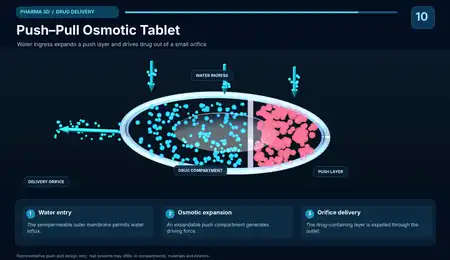
3D scientific illustration is schematic, not a validated rendering of a specific marketed medicine.
What Is Push–Pull Osmotic Tablets?
A push–pull osmotic system contains a drug layer and a swellable push layer within a semipermeable membrane. Water entering the tablet hydrates the push layer; its expansion displaces the drug formulation through a delivery opening. Mechanical layer geometry, coating behavior and drug-layer rheology are therefore linked.
Release mechanism and scientific assumptions
Unlike a basic osmotic pump that relies primarily on dissolved core contents, a push–pull configuration can support formulations in which drug is presented as a suspension. The performance is sensitive to relative layer masses, polymer swelling force, interface adhesion, laser-drilled opening and physical integrity.
Where the Technology Adds Value
The engineering is useful to explain controlled extrusion over a prolonged period, but the rate is not automatically constant across all drugs or gastrointestinal conditions. A cutaway graphic is a mechanism illustration rather than a claim about a named product design or patented construction.
Modified-release terminology requires care: sustained, prolonged and extended release describe rate or duration objectives, whereas delayed release primarily changes the start or site of release. The applicable dosage-form classification and actual label take precedence over a simplified mechanism diagram. The EMA quality guideline addresses both prolonged-release oral products and gastro-resistant delayed-release products, but does not make them equivalent.
| System or stage | Main release principle | Key sensitivity |
|---|---|---|
| Elementary osmotic pump | Single formulation zone | Core solution and orifice |
| Push–pull pump | Swelling layer extrudes drug | Layer interface and swelling force |
| Osmotic capsule variants | Other membrane-supported geometry | Design-specific controls |
Development and Testing Workflow
Selection of measurements and instruments
Characterize bilayer compression force, weight distribution, interface strength, semipermeable coating and opening geometry. Study whether the drug layer remains extrudable as the push layer expands. Dissolution and incomplete-extrusion measurements are especially informative when late release appears abnormal.
Typical studies combine qualified dissolution apparatus, calibrated analytical instruments, documented sample handling, validated assay procedures and formulation-specific physical measurements. Apparatus type, agitation, media, volume, sample schedule, filtration and analytical technique must be selected for the actual product. Published illustrations and generic example curves do not replace a validated dissolution method.
| Activity | Parameters or observations | Evidence to retain |
|---|---|---|
| Layer formulation | Drug rheology; swellable polymer | Layer input specification |
| Bilayer compression | Weights and bonding | Press control record |
| Coating and drilling | Membrane + outlet | Imaging and inspection |
| Dissolution | Early, middle and end release | Approved multipoint profile |
Acceptance Criteria and Regulatory Interpretation
No generic numerical specification is asserted here. Release-time limits must derive from the relevant authorized drug-product specification, applicable monograph and scientifically justified method. EMA/CHMP/QWP/428693/2013 describes quality expectations for oral modified-release products; FDA guidance addresses IVIVC and postapproval changes. ICH Q8(R2), Q9(R1) and Q10 inform development understanding, risk management and the pharmaceutical quality system.
The USP–NF <711> Dissolution chapter is a general compendial resource, but its applicability, apparatus, procedure and limits depend on the relevant product and official text. Where no USP monograph dissolution method exists, the FDA Dissolution Methods Database may provide a recommended method for a named drug product. Confirm current revision and local regulatory status before implementation.
| Assessment | Acceptance position | Source |
|---|---|---|
| Bilayer integrity | Development-justified in-process limits | ICH |
| Orifice and membrane performance | Product-specific qualified acceptance controls | EMA-Q |
| Release profile | Approved multipoint dissolution criteria | USP-711; EMA-Q |
Manufacturing Controls and Process Validation
Critical process parameters and material attributes
Separate traceability for drug and push-layer components, blend uniformity and bilayer tooling. Control punch alignment, delamination and coating integrity. Treat orifice formation as a critical operation and verify that the opening communicates with the intended drug compartment.
Criticality is established by data and risk assessment, not by calling every measurement a critical parameter. Development reports should explain why selected inputs affect quality attributes; commercial controls should then demonstrate continued capability. Risk assessment should include scale-up, storage, transfer between equipment, handling and relevant postapproval changes.
Common Deviations, Troubleshooting and CAPA
Delamination may disrupt the force transfer from the push layer. A blocked opening may prevent release while a punctured membrane can change its rate-control function. Root cause assessment must include both layers rather than focusing only on coating mass gain.
A failed or atypical result must be assessed using the governing laboratory procedure. Do not invalidate an observation simply because a repeat sample passes. Review sampling, analyst actions, equipment, calculations, raw analytical data and the complete batch history, then document root cause and CAPA effectiveness in the quality system.
| Problem | Possible cause | Investigation | Corrective action | Preventive action |
|---|---|---|---|---|
| Incomplete extrusion | Weak push layer or obstructed orifice | Layer expansion study | Correct controlled process/formulation | Trend push-layer attributes |
| Variable release | Bilayer thickness or drilling variability | Layer mass and opening study | Requalify affected process | In-process interface monitoring |
GMP Documentation and Lifecycle Evidence
For this topic, the technical file should link the quality target product profile to formulation choices, known material attributes, manufacturing set points, validated analytical methods and stability-indicating performance. Maintain traceable protocols, raw instrument files, calibration/qualification status, executed batch records, trend reviews, deviations and effective change controls. Decisions should be supported by contemporaneous and retrievable evidence.
For a modified-release product, early and later portions of the dissolution curve can carry different risks. Routine review should therefore evaluate the full specified profile and the scientific significance of changes, not only an average percentage. Use product-specific specifications to determine disposition; an educational article cannot authorize batch release.
Related Pharmatalks Resources
These are internal links within this ready-to-integrate Pharmatalks article package; they are not represented as live website pages.
- Release Profiles vs Plasma Drug Exposure
- Hydrophilic Matrix Tablets: Release Mechanism
- Osmotic Pump Tablets: Controlled Delivery
Related connected resources: Pharmatalks QbD Visual Guide (supporting education, not a protocol). Return to the extended-release article directory.
Frequently Asked Questions
What is the key mechanism of push–pull osmotic tablets?
A push–pull osmotic system contains a drug layer and a swellable push layer within a semipermeable membrane. The full profile depends on the actual formulation and physiological context.
Why does push–pull osmotic tablets require multi-point dissolution testing?
Because a single end point cannot identify an early burst, a mid-profile shift or late under-release. Time-point selection and limits must be justified for the specific approved product.
Is a constant plasma concentration guaranteed?
No. Dissolution, intestinal transit, absorption and elimination interact; clinical evidence is needed to support any claim about exposure stability.
Which pharmacopoeial limit applies?
The applicable current drug-product monograph or approved specification controls. There is no single universal release-percentage requirement for every extended-release product.
Can a manufacturing change alter drug release?
Delamination may disrupt the force transfer from the push layer. Change impact must be evaluated through scientific risk assessment and applicable regulatory commitments.
What data should a GMP investigation retain?
Retain original and repeat dissolution observations, chromatograms, instrument suitability records, lot genealogy, process settings, deviations, change controls, approved methods and CAPA effectiveness evidence.
Conclusion
Push–Pull Osmotic Tablets is best evaluated through combined formulation understanding, discriminatory performance testing and lifecycle controls. Use technical visualizations to clarify mechanisms, but reserve product claims and acceptance decisions for verified evidence and approved documentation. The correct scientific outcome is a robust release profile linked to the intended medicine, not a generic ideal curve.
Official References
- EMA — Quality of oral modified-release products (EMA/CHMP/QWP/428693/2013)
- EMA — Pharmacokinetic and clinical evaluation of modified-release dosage forms (Rev. 1)
- FDA — Extended-release oral dosage forms: IVIVC guidance
- FDA — SUPAC-MR postapproval changes
- FDA — Dissolution Methods Database
- USP–NF General Chapter <711> Dissolution (public abstract)
- ICH — Quality guidelines: Q8(R2), Q9(R1), Q10
Author: Pharmatalks Editorial Team · Review date: 2026-11-06 · Educational technical content; product-specific interpretation and regulatory confirmation required.