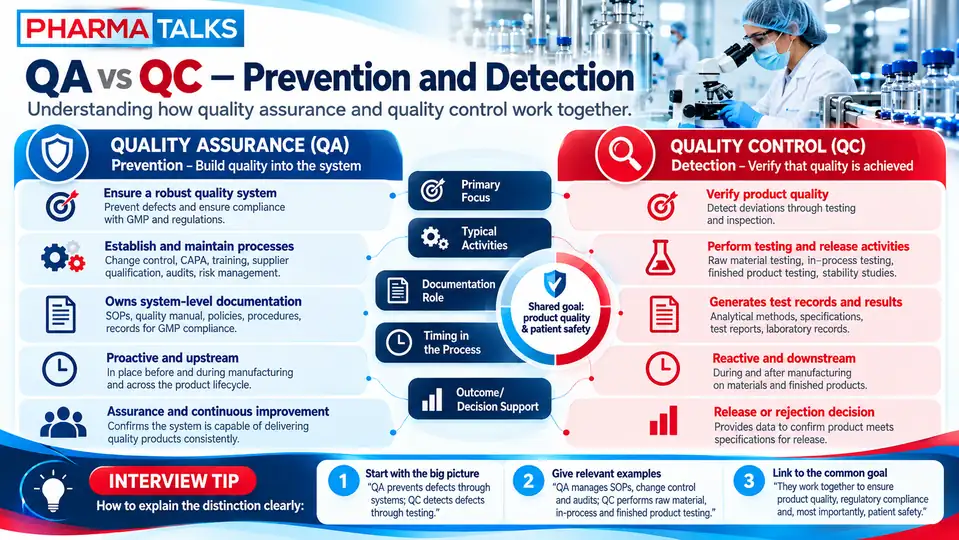
Quality Assurance: System and Process Oversight
QA activities typically include document control, training oversight, deviations, CAPA, change management, self-inspection, supplier quality, quality review, batch-record review and support for release decisions. These activities are preventive and system-oriented because they aim to make compliant execution repeatable.
ICH Q10 places CAPA, change management, monitoring and management review inside the pharmaceutical quality system. QA often coordinates or oversees these elements, although responsibilities can be shared across functions. The key principle is that the quality system must define responsibilities clearly and ensure independence where required.
Quality Control: Testing and Scientific Evidence
QC laboratories generate analytical and microbiological data used to evaluate materials, in-process samples and finished products. Their work includes controlled methods, qualified instruments, reference standards, sample handling, calculations, review of raw data and investigation of atypical or OOS results.
FDA CGMP regulations include laboratory controls and record requirements. QC is therefore not simply “detecting defects”; it operates within validated or otherwise appropriate methods and controlled procedures. Laboratory data become part of the evidence used by the Quality Unit when determining whether a batch or material meets established requirements.
Where QA and QC Intersect
The functions intersect most visibly in investigations. A laboratory OOS event may begin with QC review of the analytical execution and then require broader Quality Unit oversight, manufacturing review, impact assessment and disposition. Change controls affecting an analytical method require QC scientific input and QA system oversight. CAPA effectiveness may require QC trend data and QA evaluation of whether the system-level issue has been resolved.
This collaboration is why organizational charts alone do not explain quality responsibilities. The approved procedures should define who performs, reviews, approves and makes final decisions for each process.
Release, Rejection and the Quality Unit
In U.S. CGMP, the Quality Control Unit has authority and responsibility defined in 21 CFR 211.22; companies may organize that function using QA/QC terminology. In other regions, responsibilities may be structured differently, including Qualified Person responsibilities in the EU. Therefore, interview answers should avoid claiming that a particular job title universally owns final release.
A safe professional answer is to describe your site’s approved responsibility model and distinguish generation of evidence from independent quality review and authorization.
How to Explain QA vs QC in an Interview
A concise explanation is: QC generates and evaluates product and laboratory evidence, while QA ensures the quality system is designed, implemented, monitored and improved so that compliant quality outcomes are consistently achieved. Then add a practical example. For an OOS result, QC reviews the test execution and raw data; QA or the Quality Unit ensures the overall investigation, impact assessment, CAPA and disposition are appropriately controlled according to the site procedure.
This framing is more accurate than saying QA only prevents and QC only detects, because both functions can contribute to prevention, detection and improvement.
Practical Industry Example
Suppose a finished-product assay produces an OOS result. QC would typically lead the immediate scientific review of the analytical execution, including raw data, calculations, system suitability, instrument performance and sample preparation. QA or the designated Quality Unit would ensure that the overall investigation is timely, unbiased, appropriately scoped and connected to manufacturing review when required. If a cause is confirmed, both functions may contribute to CAPA and effectiveness evidence. The example shows why the QA-versus-QC distinction should not be reduced to “QA prevents, QC detects.” QC and QA contribute different expertise and oversight to a shared quality decision, while the approved procedure defines who owns each review and approval step.
Technical Tables
Regulatory status note: Numerical or product-specific limits are not generalized. Where a universal numeric criterion is not established by the cited source, the table states that the criterion is risk-based, product-specific or site-specific.
Technical Comparison
| Dimension | QA emphasis | QC emphasis |
|---|---|---|
| Primary focus | System and process oversight | Testing and scientific evidence |
| Typical records | SOPs, deviations, CAPA, change | Raw data, methods, results, laboratory records |
| Investigation role | System oversight and impact | Analytical evaluation and hypotheses |
| Improvement | Quality-system effectiveness | Method and laboratory performance |
Procedure and Parameters
| Activity | QA contribution | QC contribution |
|---|---|---|
| OOS | Overall investigation and disposition oversight | Laboratory assessment and raw-data review |
| Change control | Impact / compliance review | Method and laboratory impact |
| CAPA | Systemic action / effectiveness | Data and technical verification |
| Release support | Independent quality review | Testing evidence |
Acceptance Criteria
| Interface | Acceptance criterion | Source / status |
|---|---|---|
| Responsibilities | Defined in approved procedures | Site-specific / GMP |
| Data review | Complete and traceable | CGMP records |
| Decision authority | Matches regulatory and site governance | Jurisdiction dependent |
| Independence | Sufficient for objective quality review | Applicable GMP framework |
Troubleshooting and CAPA
| Problem | Possible Cause | Investigation | Corrective Action | Preventive Action |
|---|---|---|---|---|
| QA/QC role conflict | Unclear RACI | Review SOPs and org roles | Clarify ownership | Periodic governance review |
| Duplicate review | Poor process design | Map handoffs | Remove redundant steps | Workflow standardization |
| Missed escalation | Interface gap | Review event timeline | Define trigger | Cross-functional training |
GMP Documentation Requirements
Maintain records that demonstrate the approved procedure was followed, the relevant evidence was reviewed, responsibilities were clear, and the final decision was authorized by the appropriate role. The exact record set depends on the process and site system. Examples may include controlled procedures, investigation or assessment forms, approval histories, linked change or CAPA records, training evidence, raw data, trend reports and management-review outputs.
Documentation should distinguish facts, assumptions, decisions and follow-up actions. Where an official requirement is applicable, the record should be traceable to the implemented control. Site-specific scoring schemes, classification labels and due-date conventions should not be presented as universal regulatory requirements.
Related Pharmatalks Resources
Public Pharmatalks internal URLs are intentionally not fabricated. Website-specific links must be resolved against the live existing routes during integration.
Frequently Asked Questions
Is QA always separate from QC?
Not necessarily. Organizational structures vary. What matters is that responsibilities, authority, independence and review requirements are defined and compliant with applicable GMP.
Does QC approve final batch release?
Release authority depends on the regulatory system and company organization. QC data support release decisions, while the designated Quality Unit or Qualified Person responsibilities must follow applicable requirements.
Can QA perform laboratory investigations?
QA may oversee or participate in investigations, while laboratory specialists typically evaluate analytical execution and scientific causes. The approved procedure should define roles.
Is QA only about documentation?
No. QA includes oversight of quality systems, investigations, change, CAPA, audits, supplier quality, training, monitoring and continual improvement.
Why do QA and QC need to be independent?
Appropriate independence helps prevent conflicts of interest and supports objective review. The required structure depends on the applicable GMP framework.
What is the best interview answer for QA vs QC?
Explain the different primary purposes, then give a real process example showing how the functions interact and where decision authority sits.
Conclusion
QA vs QC in the Pharmaceutical Industry is best understood as part of a connected pharmaceutical quality system rather than an isolated checklist. Effective practice combines clear responsibilities, current procedures, reliable evidence, risk-based decisions and review of outcomes. For interview preparation, use the same logic: explain the governing principle, the operational control, the evidence you would review, and the way the result protects product quality and patients.