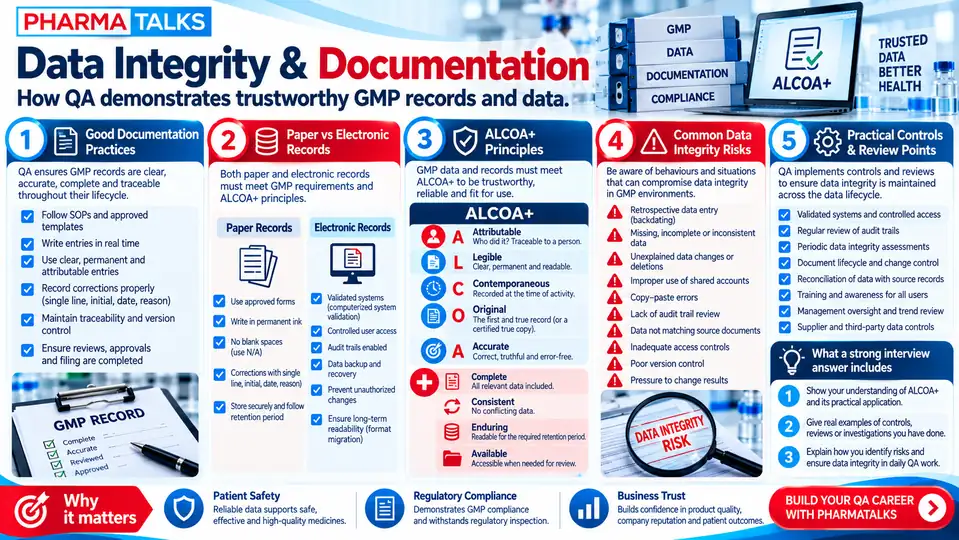
Good Documentation Practices for Paper Records
Paper records should be created and maintained according to approved procedures. Entries should be readable, made at the time the activity occurs, attributable to the person performing the work, and protected against unauthorized alteration. Corrections should preserve the original entry and follow the approved method so the reason, date and person making the change are clear where required.
Blank fields, unofficial worksheets, uncontrolled copies and transcription without verification can create data-integrity risk. The documentation system should define when original data are created, how forms are issued and reconciled, and how completed records are reviewed and retained.
Electronic Records and Access Control
Electronic systems require controls appropriate to their intended use and risk. Unique user credentials, role-based permissions, secure authentication, backup, time synchronization, record retention and protection of configuration are common controls. Shared accounts can undermine attribution and should be avoided where individual accountability is required.
Validation or qualification should demonstrate that the system is fit for intended use. Data governance should address the complete data lifecycle, including creation, processing, review, reporting, retention and archival.
Audit Trails and Review
Audit trails can record who changed data, what changed and when. Their value depends on whether relevant events are retained, protected and reviewed. A procedure should define which audit trails are meaningful to the process and how review is performed based on risk. Merely enabling an audit trail without reviewing significant events does not provide effective control.
Reviewers should also examine source data, calculations, metadata and associated records as appropriate. The review must be capable of detecting inconsistencies, omissions or unexplained changes that could affect the quality decision.
ALCOA+ as a Control Framework
Attributable means the record can be linked to the person or system responsible. Legible means it remains readable. Contemporaneous means it is recorded at the time of the activity. Original refers to the first capture or a verified true copy where appropriate. Accurate means the record correctly represents the activity or result. The “plus” concepts reinforce completeness, consistency, endurance and availability.
These principles apply to paper, electronic and hybrid records. They are not separate requirements that can be satisfied by a checklist alone; they describe characteristics of trustworthy data throughout the lifecycle.
Investigating Data-Integrity Concerns
When a concern is identified, preserve evidence before making system or record changes. Determine the scope across users, systems, products, dates and related records. Assess the potential impact on released product, ongoing studies, regulatory submissions and prior quality decisions. Investigations should avoid assuming that the issue is isolated to one individual until the evidence supports that conclusion.
Corrective actions may involve system controls, procedure redesign, governance, training, technical restrictions, retrospective review or management oversight. Significant findings may require regulatory assessment depending on scope and jurisdiction.
Practical Industry Example
Consider an electronic laboratory system in which several analysts share one generic login. Even when the analytical results themselves appear acceptable, the account structure weakens attribution because individual actions cannot be reliably assigned. A data-integrity assessment would review system capability, access configuration, audit-trail records, the period of use and the GMP decisions supported by those data. Corrective action could introduce unique accounts and role-based permissions, while retrospective review may be needed depending on the significance and scope of the records. The lesson is that ALCOA+ is not an abstract checklist: system design, user behavior and review practices must collectively ensure that the data remain attributable, complete, accurate and available throughout their lifecycle.
Technical Tables
Regulatory status note: Numerical or product-specific limits are not generalized. Where a universal numeric criterion is not established by the cited source, the table states that the criterion is risk-based, product-specific or site-specific.
Technical Comparison
| Principle | Paper example | Electronic example |
|---|---|---|
| Attributable | Signed/initialed entry | Unique user identity |
| Contemporaneous | Entry at time of activity | Timestamped capture |
| Original | Original controlled record | Raw data / protected source |
| Accurate & complete | Verified entries | Validated processing and review |
Procedure and Parameters
| Control | Key parameter | Evidence |
|---|---|---|
| Access control | Unique roles/privileges | User-role records |
| Audit trail | Relevant changes retained/reviewed | Audit-trail review |
| Backup/retention | Availability through lifecycle | Restore / archive evidence |
| Correction process | Original preserved and reason traceable | Record history |
Acceptance Criteria
| Control | Acceptance criterion | Source / status |
|---|---|---|
| Data reliability | Reliable and accurate | FDA Data Integrity Guidance |
| Attribution | Actions traceable to responsible user/person | GMP/data governance |
| Review | Relevant source data and changes reviewed | Risk-based procedure |
| Retention | Records remain readable and available | Applicable record requirements |
Troubleshooting and CAPA
| Problem | Possible Cause | Investigation | Corrective Action | Preventive Action |
|---|---|---|---|---|
| Shared account use | System configuration / culture | Review logs and access | Implement unique access | Periodic access review |
| Late entries | Workflow / workload issue | Assess timestamps and process | Correct record per SOP | Process redesign / training |
| Unreviewed audit trail | Procedure gap | Identify critical events | Perform risk-based review | Audit-trail governance |
GMP Documentation Requirements
Maintain records that demonstrate the approved procedure was followed, the relevant evidence was reviewed, responsibilities were clear, and the final decision was authorized by the appropriate role. The exact record set depends on the process and site system. Examples may include controlled procedures, investigation or assessment forms, approval histories, linked change or CAPA records, training evidence, raw data, trend reports and management-review outputs.
Documentation should distinguish facts, assumptions, decisions and follow-up actions. Where an official requirement is applicable, the record should be traceable to the implemented control. Site-specific scoring schemes, classification labels and due-date conventions should not be presented as universal regulatory requirements.
Related Pharmatalks Resources
Public Pharmatalks internal URLs are intentionally not fabricated. Website-specific links must be resolved against the live existing routes during integration.
Frequently Asked Questions
What does ALCOA+ stand for?
Attributable, Legible, Contemporaneous, Original and Accurate, plus commonly used extensions such as Complete, Consistent, Enduring and Available.
Are shared user accounts acceptable?
Shared accounts can prevent attribution and create integrity risk. Systems should use individual access where accountability for GMP actions is required, subject to justified technical constraints and controls.
Must every audit trail be reviewed every time?
The review approach should be defined and risk-based. Relevant audit trails and events should be reviewed at a frequency and depth appropriate to the process and data risk.
Is a scanned copy always an original record?
Not automatically. Procedures should define when an electronic or paper copy is a verified true copy and how the original data and metadata are preserved.
What is contemporaneous recording?
Recording the activity or result at the time it is performed, rather than reconstructing it later from memory.
What should happen after a data-integrity concern?
Preserve evidence, investigate scope and impact, assess affected decisions, implement sustainable controls and evaluate whether regulatory notification or additional review is required.
Conclusion
Data Integrity and GMP Documentation: ALCOA+ in Practice is best understood as part of a connected pharmaceutical quality system rather than an isolated checklist. Effective practice combines clear responsibilities, current procedures, reliable evidence, risk-based decisions and review of outcomes. For interview preparation, use the same logic: explain the governing principle, the operational control, the evidence you would review, and the way the result protects product quality and patients.