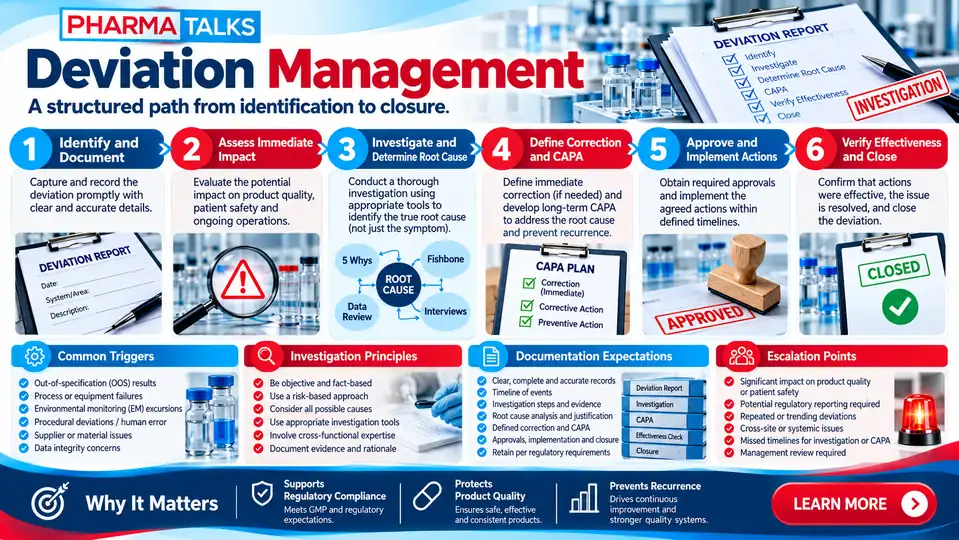
Detection, Documentation and Immediate Control
Record the event as soon as practical with objective facts: what happened, when and where it occurred, affected equipment or material, who observed it, and what immediate actions were taken. Avoid writing a root cause before the investigation has started. If product, data or process control may be affected, identify and control potentially impacted material or records according to approved procedures.
The immediate objective is not to “fix the paperwork.” It is to preserve evidence, stop further impact where justified, and create a reliable chronology for the investigation.
Impact Assessment and Scope
Impact assessment asks what could have been affected and what evidence is needed to make that determination. Consider product quality, patient risk, data integrity, validated state, regulatory commitments, other batches, related equipment, shared utilities, prior events and ongoing operations. ICH Q9(R1) supports a level of formality proportionate to risk and uncertainty.
The scope should be revisited as new information appears. A deviation initially believed to be isolated may require expansion if trending shows recurrence or if a common system, supplier or procedure is implicated.
Investigation and Root Cause
A structured investigation should distinguish direct evidence from hypothesis. Review records, raw data, alarms, maintenance history, training status, process parameters, interviews and relevant trends. Tools such as Five Whys or fishbone diagrams can organize thinking, but the tool itself is not proof of root cause.
A defensible root cause explains the event and is supported by evidence. If no root cause can be conclusively demonstrated, document the investigation limits and manage residual uncertainty rather than forcing an unsupported conclusion.
Correction, CAPA and Effectiveness
A correction addresses the immediate detected condition. CAPA is broader and should be used when investigation and risk justify actions to eliminate causes, prevent recurrence or improve the system. ICH Q10 expects a CAPA system arising from investigations, deviations, complaints, audits, regulatory findings and trends, with effort commensurate with risk.
Effectiveness checks should be defined when the action plan is created. Measures may include recurrence review, process indicators, audit results, trend data or verification that a revised control is being used as intended. Passing a due date is not evidence of effectiveness.
Trending and Management Review
Deviation data are valuable beyond individual closures. Trend by failure mode, process, equipment, shift, supplier, root-cause category, recurrence and closure performance. Repeated “human error” conclusions are especially important to challenge because they may indicate weak procedures, design, workload, training systems or supervision.
Periodic review helps identify systemic issues that are not visible in one record. Significant recurring or cross-functional themes should feed CAPA, risk management, management review or improvement programs as appropriate.
Practical Industry Example
Assume an operator discovers that a process step was performed outside the approved sequence but all recorded process parameters remain within their established ranges. The deviation should still be documented because the approved instruction was not followed. Immediate actions may include identifying affected material and preserving the records. The investigation would determine why the sequence changed, whether any critical quality attribute or validated control was affected, whether similar events occurred previously, and whether the procedure or workflow contributed. The final decision might require only correction and documented closure, or it might justify CAPA if the event reveals a recurring or systemic weakness. The important point is that deviation classification and action should follow evidence and risk rather than the absence of an obvious failed test result.
Technical Tables
Regulatory status note: Numerical or product-specific limits are not generalized. Where a universal numeric criterion is not established by the cited source, the table states that the criterion is risk-based, product-specific or site-specific.
Technical Comparison
| Stage | Purpose | Typical evidence |
|---|---|---|
| Detection / containment | Control immediate impact | Event record, hold/status evidence |
| Impact assessment | Define scope and risk | Batch/process/data review |
| Investigation | Determine supported cause(s) | Records, trends, interviews, testing |
| Closure | Document decision and actions | CAPA/effectiveness / approvals |
Procedure and Parameters
| Step | Important parameter | Requirement |
|---|---|---|
| Record event | Fact-based chronology | Timely, attributable record |
| Assess impact | Product, process, data, compliance | Risk-based scope |
| Investigate | Evidence quality and hypothesis testing | Objective rationale |
| Trend | Recurrence and systemic themes | Periodic review |
Acceptance Criteria
| Control | Acceptance criterion | Source / status |
|---|---|---|
| Root-cause conclusion | Supported by evidence; uncertainty documented | PQS / site procedure |
| CAPA decision | Risk- and recurrence-based | ICH Q10 |
| Closure | Required actions and approvals complete | Site-specific |
| Classification | Defined by approved procedure | No universal scoring limit |
Troubleshooting and CAPA
| Problem | Possible Cause | Investigation | Corrective Action | Preventive Action |
|---|---|---|---|---|
| Recurring deviation | Cause not addressed | Trend prior records | Revise CAPA | Systemic review |
| Human error repeated | System factor missed | Evaluate design/workload/procedure | Fix contributing controls | Human-factors review |
| Late closure | Poor scope/resources | Review aging and blockers | Replan critical actions | Management monitoring |
GMP Documentation Requirements
Maintain records that demonstrate the approved procedure was followed, the relevant evidence was reviewed, responsibilities were clear, and the final decision was authorized by the appropriate role. The exact record set depends on the process and site system. Examples may include controlled procedures, investigation or assessment forms, approval histories, linked change or CAPA records, training evidence, raw data, trend reports and management-review outputs.
Documentation should distinguish facts, assumptions, decisions and follow-up actions. Where an official requirement is applicable, the record should be traceable to the implemented control. Site-specific scoring schemes, classification labels and due-date conventions should not be presented as universal regulatory requirements.
Related Pharmatalks Resources
Public Pharmatalks internal URLs are intentionally not fabricated. Website-specific links must be resolved against the live existing routes during integration.
Frequently Asked Questions
Is every procedural departure a major deviation?
No. Classification should follow the approved site procedure and consider actual and potential impact. There is no universal major/minor scoring model for all manufacturers.
Can human error be a root cause?
It may describe what happened, but a robust investigation should also evaluate why the error was possible, including system, design, procedure, training, workload and supervision factors.
When is CAPA required after a deviation?
When investigation and risk indicate that action beyond immediate correction is needed to address causes, recurrence risk or systemic weakness.
Should deviation investigations use Five Whys?
Five Whys can be useful, but no single tool is mandatory for every case. Use a method proportionate to complexity and supported by evidence.
What should an effectiveness check measure?
It should test whether the intended risk reduction or recurrence prevention occurred, using an objective indicator appropriate to the action.
Can a deviation be closed without a confirmed root cause?
Sometimes an investigation may remain inconclusive. The record should transparently document the evidence, limitations, impact assessment and how residual risk is controlled.
Conclusion
Pharmaceutical Deviation Management is best understood as part of a connected pharmaceutical quality system rather than an isolated checklist. Effective practice combines clear responsibilities, current procedures, reliable evidence, risk-based decisions and review of outcomes. For interview preparation, use the same logic: explain the governing principle, the operational control, the evidence you would review, and the way the result protects product quality and patients.