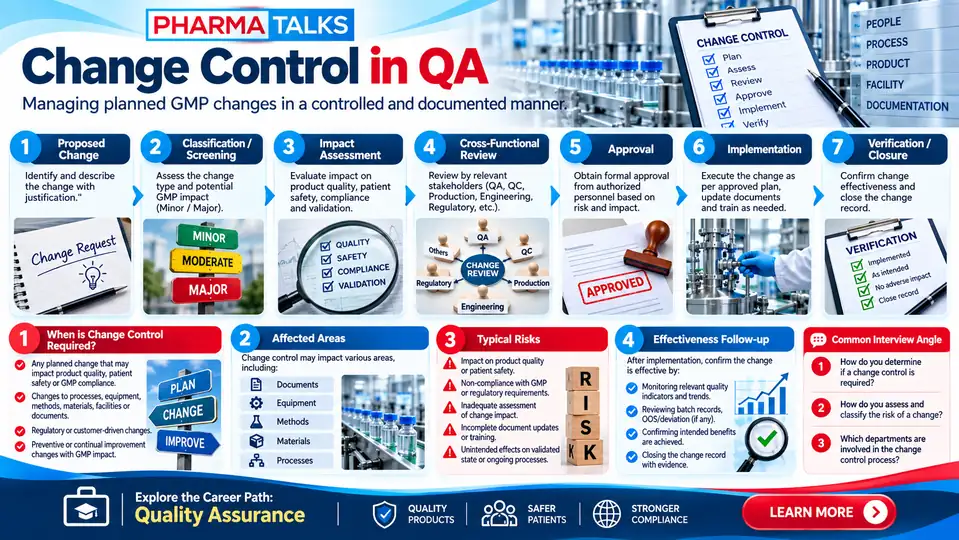
Initiation and Change Definition
A high-quality change request clearly describes the current state, proposed state, business or technical justification, affected systems, owner and intended timing. Ambiguous descriptions create weak impact assessments because reviewers cannot determine what is actually changing. Attach drawings, specifications, method revisions or configuration details when they are needed to define the scope.
Do not implement the change first and create the record later unless an approved emergency process specifically permits immediate action. Planned changes should be evaluated before implementation.
Risk and Impact Assessment
Impact assessment should be cross-functional where appropriate. Consider product quality, patient safety, process capability, equipment qualification, validation, analytical methods, computerized systems, utilities, cleaning, suppliers, materials, training, documents, stability, regulatory filings and ongoing studies. The depth should be proportionate to risk and uncertainty.
A risk score is only useful if the rationale is clear. ICH Q9(R1) cautions against subjectivity in risk assessments and emphasizes formality appropriate to the context. Document assumptions and identify additional data required before approval.
Approval and Implementation Planning
Approvals should come from the functions defined in the site procedure and should be completed before implementation unless a justified approved exception applies. The implementation plan should convert the assessment into specific actions with owners and due dates. Typical tasks include SOP revision, qualification or validation work, training, inventory management, supplier documentation, master-data changes and regulatory actions.
Dependencies matter. For example, training should not be considered complete if the revised procedure has not yet been approved, and production should not use modified equipment before required qualification has been completed.
Verification and Closure
Closure should verify that required actions are complete and that the change was implemented as approved. Depending on the change, post-implementation review may include process data, deviations, complaints, analytical results, audit observations, qualification evidence or stability information.
Effectiveness is different from task completion. A revised SOP can be issued on time but still fail to control the intended risk. Define the success criteria before implementation when practical, and document any new issue identified during follow-up.
Change Control and Regulatory Commitments
Some changes may require regulatory assessment or submission before implementation. The pathway depends on jurisdiction, product type and the approved dossier or application. QA should therefore involve Regulatory Affairs when the change could affect registered information or post-approval reporting requirements.
Do not assume that an internal “minor” classification means the change is minor from a regulatory perspective. Site risk classification and regulatory reporting category answer different questions and should be evaluated separately.
Practical Industry Example
Consider replacing a laboratory instrument with a new model. The change record should define whether the intended use is unchanged, what methods will run on the instrument, and which qualification or method-transfer activities are required. QA would coordinate impact assessment across QC, validation, engineering, IT or computerized-system support, and Regulatory Affairs when registered information could be affected. Documents, user access, training, maintenance plans and data-integrity controls may all need action before routine use. Post-implementation review could examine qualification results, method performance and early deviations. This example shows why a change is not complete when equipment is physically installed; the controlled state must be demonstrated before the change can be responsibly closed.
Additional control point: Change ownership should remain clear when implementation spans several departments. A single change record can contain linked technical actions, but closure should not occur until critical dependencies are complete and any justified open follow-up is controlled through the approved system.
Technical Tables
Regulatory status note: Numerical or product-specific limits are not generalized. Where a universal numeric criterion is not established by the cited source, the table states that the criterion is risk-based, product-specific or site-specific.
Technical Comparison
| Change type | Potential impact | Typical reviewers |
|---|---|---|
| Equipment | Qualification, process, cleaning | Engineering, Production, QA |
| Method | Validation/verification, specification | QC, QA, Regulatory |
| Supplier/material | Quality, continuity, filings | Supply, QC, QA, Regulatory |
| Computerized system | Validation, access, data integrity | IT/CSV, process owner, QA |
Procedure and Parameters
| Step | Key parameter | Evidence |
|---|---|---|
| Initiate | Current vs proposed state | Change request |
| Assess | Quality/regulatory/validation impact | Cross-functional assessment |
| Implement | Prerequisites and owners | Action plan / linked records |
| Verify | Intended outcome and new risk | Post-implementation review |
Acceptance Criteria
| Control | Acceptance criterion | Source / status |
|---|---|---|
| Pre-approval | Impact assessed before implementation | ICH Q10 / site procedure |
| Regulatory assessment | Applicable filing impact evaluated | Jurisdiction-specific |
| Validation impact | State of control maintained | Risk-based |
| Closure | Actions complete and outcome verified | Site-specific |
Troubleshooting and CAPA
| Problem | Possible Cause | Investigation | Corrective Action | Preventive Action |
|---|---|---|---|---|
| Change implemented early | Governance bypass | Review timeline/approvals | Restore control / assess impact | System access and training |
| Missed affected document | Incomplete impact assessment | Trace interfaces | Update document | Impact checklist |
| Unexpected post-change issue | Assumption invalid | Review new data | Contain and investigate | Stronger verification plan |
GMP Documentation Requirements
Maintain records that demonstrate the approved procedure was followed, the relevant evidence was reviewed, responsibilities were clear, and the final decision was authorized by the appropriate role. The exact record set depends on the process and site system. Examples may include controlled procedures, investigation or assessment forms, approval histories, linked change or CAPA records, training evidence, raw data, trend reports and management-review outputs.
Documentation should distinguish facts, assumptions, decisions and follow-up actions. Where an official requirement is applicable, the record should be traceable to the implemented control. Site-specific scoring schemes, classification labels and due-date conventions should not be presented as universal regulatory requirements.
Related Pharmatalks Resources
Public Pharmatalks internal URLs are intentionally not fabricated. Website-specific links must be resolved against the live existing routes during integration.
Frequently Asked Questions
What types of changes need change control?
Any planned change that may affect GMP systems, product quality, validated status, records or regulatory commitments should be evaluated under the site procedure.
Is every change subject to validation?
No. The impact assessment determines whether qualification, validation, verification or other evidence is required.
Can a minor internal change require regulatory action?
Yes. Internal risk classification does not determine the regulatory reporting category. Regulatory Affairs should assess applicable filing requirements.
What is post-implementation review?
It is a planned check after implementation to confirm that the intended outcome was achieved and no unacceptable new risk was introduced.
Who should approve a change control?
The approved site procedure should define required approvers based on the change type and impact. Relevant technical, quality and regulatory functions may be involved.
What is the biggest change-control mistake?
Implementing a poorly defined change before completing an adequate impact assessment and prerequisite actions is a common and high-risk failure mode.
Conclusion
Change Control in Pharmaceutical Quality Assurance is best understood as part of a connected pharmaceutical quality system rather than an isolated checklist. Effective practice combines clear responsibilities, current procedures, reliable evidence, risk-based decisions and review of outcomes. For interview preparation, use the same logic: explain the governing principle, the operational control, the evidence you would review, and the way the result protects product quality and patients.