
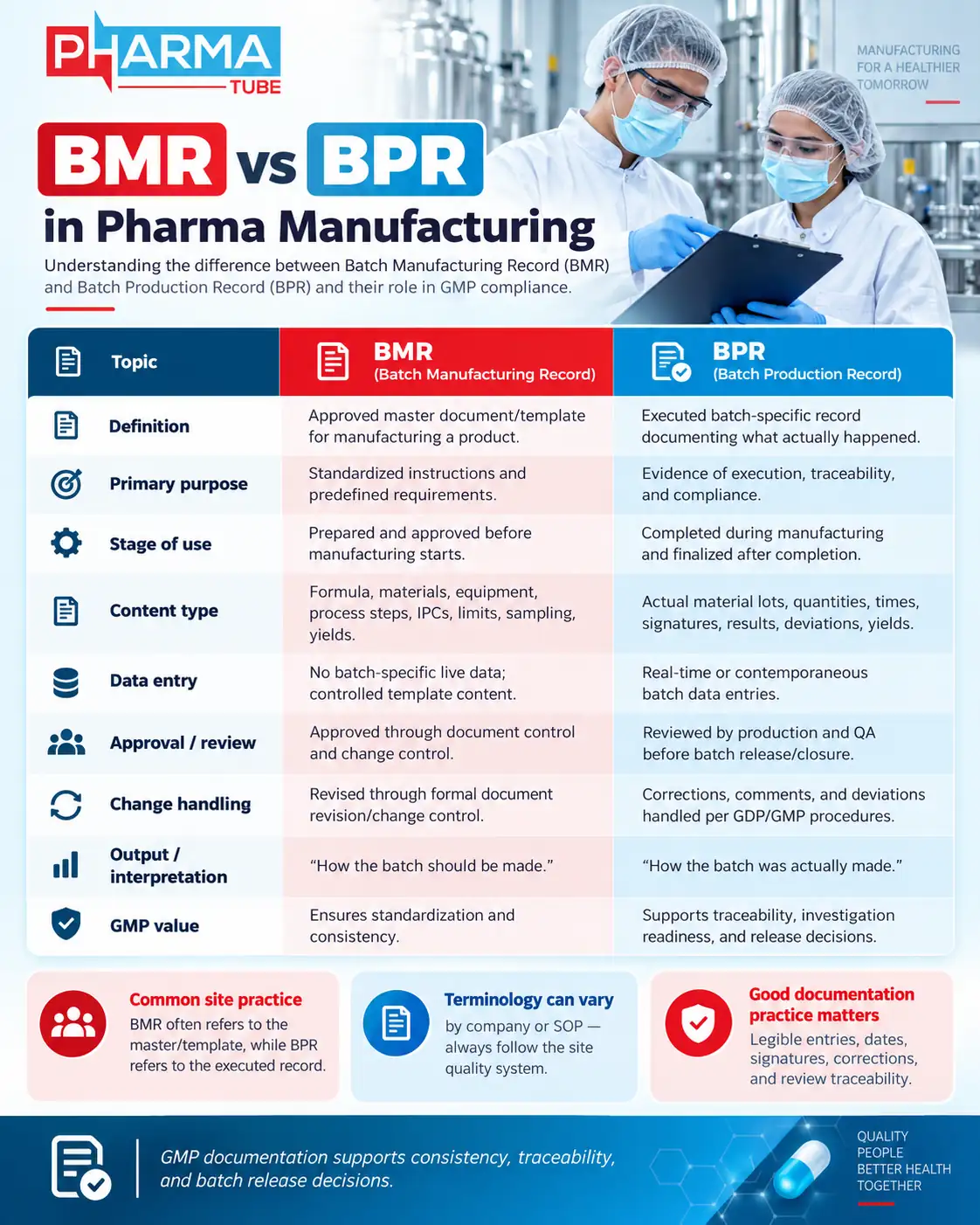
What Do BMR and BPR Mean in GMP?
Direct answer: In common training usage, BMR may describe the approved manufacturing template, while BPR describes the executed batch record. However, these abbreviations are not internationally standardized labels. Many manufacturers call their executed document a Batch Manufacturing Record. The reliable GMP distinction is between a master production and control record defining how to manufacture and a batch production and control record proving what happened for one batch. US requirements distinguish these in 21 CFR 211.186 and 211.188; EU GMP Chapter 4 distinguishes Manufacturing Formula and Processing Instructions from Batch Processing Records.
| Control dimension | Approved master instructions | Executed batch record |
|---|---|---|
| Role | Prescribes validated or approved manufacturing approach | Records actual activities and results for a named batch |
| Version | Current effective, uniquely controlled revision | References the effective approved master revision |
| Values | Target settings, limits and expected yield | Actual times, temperatures, quantities and yields |
| People | Authorized preparer and independent checker as applicable | Persons performing, supervising or checking significant steps |
| Evidence | Approved manufacturing and control instructions | Contemporaneous traceable execution and deviations |
How Master Instructions Become Executed Evidence
Preparation, issuance and shop-floor execution
Document control first confirms the product, strength, batch size, approved formula, equipment requirements and effective revision. The authorized issuer supplies a reconciled copy or validated electronic workflow. Before any step, trained operators verify material identity, area clearance and equipment status against the approved instructions. During manufacturing, entries must be made when the activity occurs, not reconstructed after the shift. Where a critical process parameter, in-process control (IPC) or sampling result is outside its approved specification, follow the established hold and deviation procedure rather than silently changing the instruction.
| Stage | Example evidence | Relevant control |
|---|---|---|
| Master authorization | Product code, formula, acceptance limits, signatures | 21 CFR 211.186(a)–(b); EU GMP 4.17–4.18 |
| Controlled issuance | Correct revision, copy identifier, batch number | EU GMP 4.1–4.3; site issuance SOP |
| Manufacturing | Actual component lots, equipment, event times, IPC results | 21 CFR 211.188(b); EU GMP 4.20 |
| Reconciliation | Actual/theoretical yield; packaging material reconciliation | 21 CFR 211.188(b)(7)–(8); EU GMP 4.21 |
| Review and disposition | Signatures, deviation impact, test status, QA approval | 21 CFR 211.192; EU GMP Chapter 4 |
What QA examines before disposition
QA reviewers connect the record to source evidence: weighing printouts, electronic equipment logs, IPC forms, environmental or line-clearance records and linked laboratory results where relevant. They check that the correct master was used, all significant steps are attributable, corrections preserve the original entry, and missing or conflicting information is investigated. A signed executed record does not itself establish that the batch passed all release requirements. Other relevant records and investigations must be considered before the authorized disposition decision.
Acceptance Criteria and Regulatory Requirements
There is no universal numerical batch-yield tolerance across all products. Under 21 CFR 211.186(b)(7), the master specifies the maximum and minimum percentages of theoretical yield beyond which an investigation is required. The limits, sampling frequencies, hold times, test specifications and critical process parameters should come from the product-specific approved manufacturing and control strategy—not from a generic online checklist. “Complete” means all required data, exceptions and authorizations can be reconstructed and evaluated, not that every form field happens to contain text.
| Control / decision | Verifiable requirement | Source / status |
|---|---|---|
| Master authorization | Prepared and independently checked, dated and signed by authorized personnel | 21 CFR 211.186(a) — US regulation |
| Executed batch history | Record for every produced batch; significant steps and controls documented | 21 CFR 211.188(a)–(b) — US regulation |
| Record timing and correction | Entries made as actions occur; changes signed/dated with original readable | EU GMP 4.8–4.9 — published guidance |
| Yield acceptance | Use product-approved investigation boundaries, not a generic percent | 21 CFR 211.186(b)(7) — product-specific |
| Pre-release review | Quality unit review and approval of production/control records | 21 CFR 211.192 — US regulation |
Frequent BMR/BPR Errors and CAPA
One frequent failure is treating the template and executed form as interchangeable in training or document titles. Another is issuing an obsolete master revision to the manufacturing floor. A third is a partial batch story: materials are recorded but a line clearance, yield explanation or intervention is missing. When a discrepancy appears, preserve the original record, determine the scope across related batches, and assess product impact before deciding whether the batch is suitable for release.
| Problem | Possible cause | Investigation | Corrective action | Preventive action |
|---|---|---|---|---|
| Wrong master revision | Weak document issuance control | Trace issuance log and effective dates | Quarantine record and assess affected batch | Version gate and periodic reconciliation |
| Unexplained yield variance | Loss, measurement or arithmetic issue | Recalculate; review balances and process logs | Deviation with batch-impact decision | Validated calculations and operator checks |
| Missing operator initials | Poor form design or training | Interview personnel; inspect source records | Document contemporaneous investigation | Role-linked fields and training |
| Retrospective correction | Workload or poor GDP practice | Compare original entry with timestamps/logs | Preserve original; assess integrity impact | Form redesign and error trending |
GMP Documentation and Change Control
Approved master content changes through formal document revision and, when relevant, product change control; employees must not rewrite process instructions inside a running batch record to authorize a different process. Deviations from approved steps follow documented authorization, investigation and impact assessment. Batch-specific corrections follow good documentation practice: preserve what was originally recorded, identify the person and date, and supply a reason when appropriate. A harmonized document taxonomy should define BMR, MBR, BPR, eBR and packaging records so the same label cannot mean two different things at the same site.
Practical Example: Tablet Compression
Consider a film-coated tablet batch. The master identifies approved granulation, blending, compression and coating sequence, defines IPC tests and gives the theoretical-yield investigation limits. The executed record identifies the granule lot, blender and press, actual compression weight checks, sampling results, rejects, production times, equipment identifiers and deviations. A late weight excursion prompts an approved investigation and documented batch-impact assessment. The master explains the process expectation; the executed record, linked raw data and QA review establish whether the actual batch can be accepted.
Related Pharmatalks Resources
- Paper versus Electronic Batch Records (this technical series)
- Pharmatalks QA batch documentation review training SOP (draft)
- Pharmatalks document control training SOP (draft)
- PharmaTalks Pharmaceutical Documentation Guide 2026 (PDF)
- Pharmuni batch records: introductory guide
Frequently Asked Questions
Is BMR always the approved master record?
No. Many sites use BMR for an executed Batch Manufacturing Record. Define abbreviations in the site document taxonomy; the regulatory distinction is between approved master instructions and batch-specific executed records.
What is the FDA term for an executed record?
21 CFR 211.188 calls it a batch production and control record. It must document each manufactured batch and reproduce the appropriate master record.
Does a BPR replace the master formula?
No. The batch-specific record must be based on the current approved master production or control record and capture actual execution.
Who reviews the record before release?
Under 21 CFR 211.192, the quality control unit reviews and approves production and control records before release or distribution; EU batch certification has its own Qualified Person framework.
Where should unexpected yield be investigated?
Compare actual percentage yield with the preapproved maximum and minimum percentages in the master record; unexplained discrepancy requires investigation under 21 CFR 211.192.
Can a batch record be electronic?
Yes. Paper, electronic and hybrid documentation are possible if appropriate GMP, integrity, security, validation and retention controls are implemented.
Conclusion
Master versus executed is the defensible distinction even when site-specific acronyms differ. The master establishes the controlled recipe, acceptable operating windows, required checks and authorization path. The executed record captures the real batch history, discrepancies, observations and decisions without obscuring the original evidence. Together they create an auditable chain from the approved process to the quality unit’s disposition. Teams improve inspection readiness by maintaining controlled issuance, contemporaneous entries, product-specific limits, traceable corrections and an effective review process. Train staff on your organization’s exact terminology before using BMR or BPR as a universal label.
Official References and Further Reading
- 21 CFR § 211.186 — Master production and control records (FDA rule via Cornell LII)
- 21 CFR § 211.188 — Batch production and control records (FDA rule via Cornell LII)
- 21 CFR § 211.192 — Production record review (FDA rule via Cornell LII)
- EU GMP Chapter 4 — Documentation (effective January 2011) (European Commission)
- European Commission EudraLex Volume 4 document status (European Commission)
- 2025 consultation on draft Chapter 4, Annex 11 and Annex 22 revisions (European Commission)
- Pharmuni — A Quick Guide to Batch Records in the Pharmaceutical Industry (Pharmuni educational resource)