
What Changes When a Batch Record Becomes Electronic?
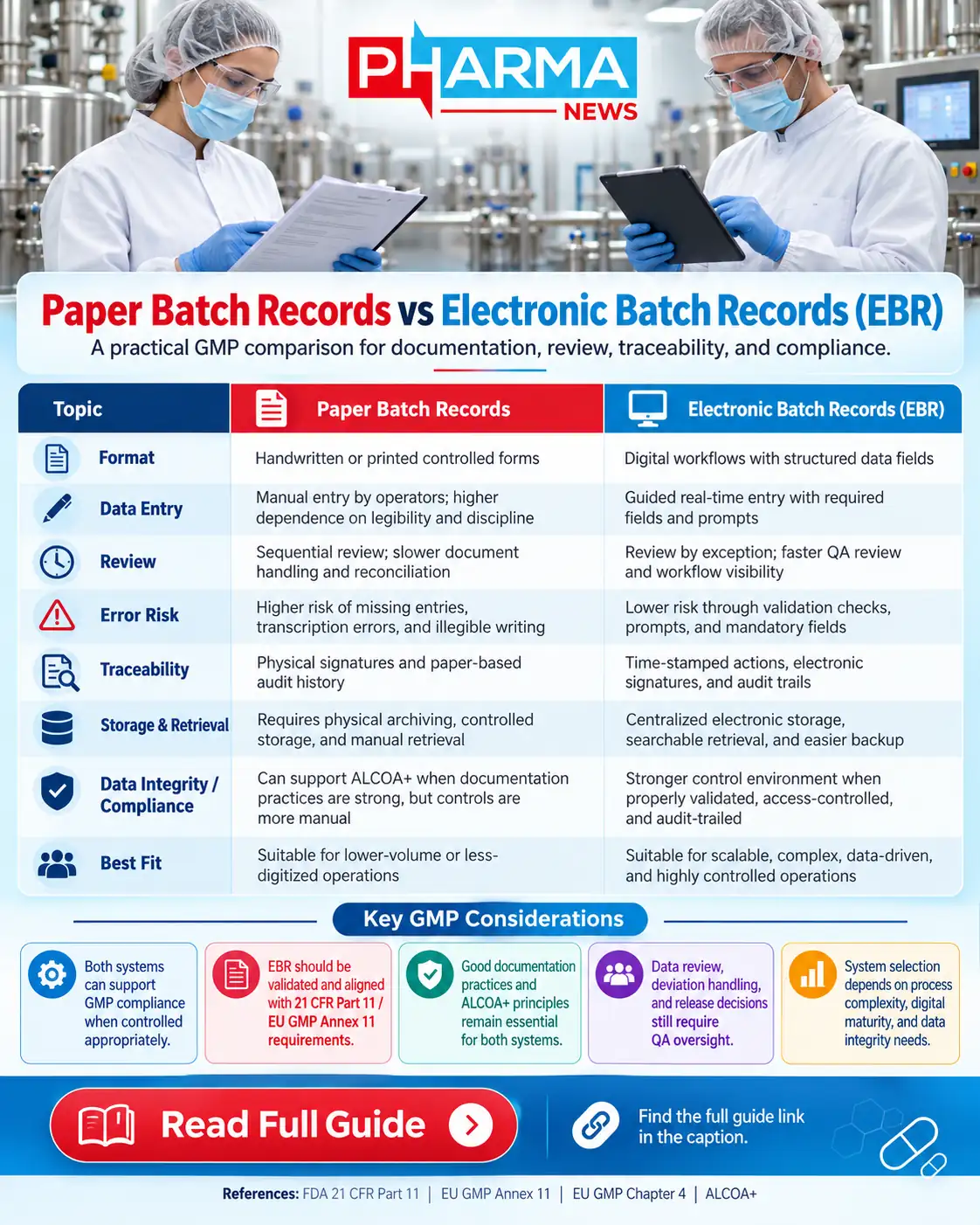
Direct answer: A paper batch record uses controlled printed forms, handwriting and physical signatures. An electronic batch record (EBR or eBR) uses software to guide data capture, link manufacturing events and maintain electronic evidence. Both can support GMP. Digital records can prevent omissions and enable structured review, but only where configuration and controls are appropriate. The regulatory questions are whether records are trustworthy, attributable, complete, retrievable and suitable for decisions. FDA 21 CFR Part 11 may apply to electronic predicate-rule records; EU GMP Chapter 4 and Annex 11 establish documentation and computerised-system expectations.
| Technical dimension | Controlled paper | Electronic batch record |
|---|---|---|
| Capture | Handwritten, printouts, manual signatures | Guided fields, direct integration, e-signatures |
| Error checks | Training and independent human verification | Configured mandatory fields, rules and plausibility checks |
| Auditability | Original entry/correction and issuance history | Attributable timestamps, protected audit trails and metadata |
| Review | Manual reconciliation of pages and attachments | Search, queues and potentially review by exception |
| Integrity risk | Loss, transcription, late entry, overwritten correction | Shared accounts, bad configuration, missing audit-trail review |
| Continuity | Controlled physical archive, disaster recovery for paper | Backup/restore testing, export and long-term readability |
System Architecture and Record Design
Data capture, equipment interfaces and master data
A credible EBR is more than a scanned paper form. It can link recipes, equipment states, material status, user roles, weighing devices and laboratory systems. Each interface needs documented ownership, error handling and reconciliation. Direct device integration can reduce rekeying, but a mismatched timestamp or duplicate message could create a new failure mode. Paper processes instead rely on controlled issuance, page numbering, independent transcription checks where risk warrants and effective archiving. Hybrid records need a clear declaration of which elements are the originals.
| Lifecycle step | Paper implementation | EBR implementation / verification |
|---|---|---|
| Issue batch | Copy control, revision and reconciliation | Approved electronic recipe, version and access rights |
| Record material | Lot and weight entered against source | Barcode/equipment integration; exception handling |
| Execute IPC | Manual checks, corrections and sign-offs | Configured limits, workflows and attributable e-signatures |
| Review deviation | Cross-reference physical deviation report | Electronic event linkage; audit-trail review based on risk |
| Retain history | Secure archive with retrieval index | Backup, restore, migration and human-readable export |
Regulatory Acceptance and Validation Gates
There is no universal percentage by which an EBR must outperform paper or a fixed maximum QA review time. Acceptance criteria should be preapproved, risk-based and testable: correct recipe selection, authorized access, required data completeness, attributable signatures, appropriate audit-trail capture, successful restoration and reliable record export. FDA’s Part 11 guidance describes enforcement discretion for selected provisions but does not waive predicate-rule obligations. Under the published 2011 Annex 11, the validation extent and data-integrity controls are justified through risk management; the 2025 Chapter 4 and Annex 11 consultation documents are drafts, not automatically effective requirements.
| Control | Acceptance gate / evidence | Authority and status |
|---|---|---|
| Record completeness | All significant batch activities and associated controls documented | 21 CFR 211.188 — regulation; both formats |
| Quality-unit review | Review and approval before release or distribution | 21 CFR 211.192 — regulation |
| Electronic scope | Determine predicate records and applicable electronic-signature rules | 21 CFR 11.1; FDA Part 11 scope guidance |
| Computerised system | Validation, access control, backup, archiving and audit-trail strategy justified by risk | EU GMP Annex 11 (2011 published) |
| Corrections and records | Original entry remains legible; contemporaneous and controlled documentation | EU GMP Chapter 4 §§4.7–4.11 |
| Performance KPIs | Cycle time, error rate or completion targets defined locally | Site-specific improvement metrics; NOT regulatory limits |
Common Failure Modes and CAPA
Digitization may move errors from handwriting to system configuration. A required field that is wrongly optional can be harder to detect than a blank printed box; a shared operator account can destroy attribution; and an untested restore may make archived batches unavailable. Paper has its own weaknesses: missing pages, delayed corrections and difficult reconciliation of many handwritten values. QA should prioritize risks by product impact and ability to reconstruct the full event history, not assume that one medium is intrinsically compliant.
| Problem | Possible cause | Investigation | Corrective action | Preventive action |
|---|---|---|---|---|
| Blank critical paper field | Weak issuance/form design | Inspect original pages and process log | Open deviation; assess affected data | Form redesign and in-process review |
| Missing EBR audit event | Misconfigured event capture | Review configuration and validation evidence | Preserve evidence; assess affected batches | Risk-based audit-trail test cases |
| Shared EBR login | Inadequate identity governance | Check access and activity history | Disable shared access; investigate integrity | Unique IDs and periodic access review |
| Batch export unreadable | Format/retention defect | Restore and verify representative batch | Controlled remediation and impact assessment | Periodic restore/export challenge |
Review by Exception Does Not Mean No Review
For a validated EBR, rule-based checks may direct the reviewer to out-of-range data, missing signatures, unresolved deviations, alarms or audit-trail anomalies. The reviewer still evaluates whether rules cover the intended critical risks and whether raw evidence is available when needed. False negatives, bypass permissions and changing recipe logic must be tested. Review by exception should be governed by a documented policy with escalation when electronic flags cannot be trusted; it cannot replace quality-unit responsibility for the batch disposition.
Choosing Paper, Hybrid or EBR
Selection depends on production scale, process complexity, batch frequency, equipment integration maturity, cybersecurity controls and the organization’s ability to maintain validated systems. A low-volume facility may control paper effectively if issuance, review and retrieval are robust. A high-volume, multi-line facility may benefit from standardized electronic workflows and faster access to history. The migration plan should define originals, the handling of in-flight batches, training, change control, data conversion, contingency operation and legacy record retention. Evaluate measurable benefits only after qualifying baseline error and review metrics.
Related Pharmatalks Resources
- BMR vs BPR: Master and Executed Records (this technical series)
- PharmaTalks Pharmaceutical Documentation Guide 2026 (PDF)
- Pharmatalks batch record QA review training SOP (draft)
- Pharmatalks document control training SOP (draft)
- Pharmuni batch records in the pharmaceutical industry
Frequently Asked Questions
Is an EBR automatically GMP compliant?
No. Configuration, intended-use validation, access control, data protection, audit-trail controls, training and operational governance determine compliance.
Does FDA Part 11 apply to every digital file?
No. Its scope depends on predicate-rule records maintained electronically in place of paper or records submitted electronically, subject to FDA’s published scope guidance.
Can review by exception replace batch review?
Only with validated, scientifically justified controls and a documented review strategy. Review by exception does not remove quality-unit release responsibility.
Are paper batch records allowed?
Yes. EU GMP Chapter 4 expressly permits different documentation media, provided records remain accurate, legible, complete, retrievable and controlled.
Does Annex 11 require an audit trail for every electronic field?
The published 2011 Annex 11 calls for risk-based consideration of audit trails for GMP-relevant changes and deletions; applicability and review must be justified.
What is the biggest hybrid-record risk?
Uncontrolled handoffs between paper and electronic sources can obscure the true original record, signatures, timestamps, reconciliation and the complete audit history.
Conclusion
Paper and electronic batch records are two media for the same fundamental evidence requirement: demonstrate that an approved pharmaceutical process was followed and provide reliable data for review. Paper demands disciplined issuance, legible contemporaneous entries and physical reconciliation. EBR can enforce workflows and reduce transcription, but introduces computerised-system lifecycle, security and configuration responsibilities. Hybrid workflows demand special attention to original data and handoffs. An effective decision weighs process risk, validated controls and long-term retrievability rather than promising automatic compliance or universal efficiency gains. Choose the system that your quality organization can govern, test and inspect confidently.
Official References and Further Reading
- 21 CFR § 211.188 — Batch production and control records (FDA rule via Cornell LII)
- 21 CFR § 211.192 — Production record review (FDA rule via Cornell LII)
- 21 CFR § 11.1 — Part 11 scope (FDA rule via Cornell LII)
- FDA Part 11 — Electronic Records; Electronic Signatures: Scope and Application (FDA guidance)
- FDA Data Integrity and Compliance With Drug CGMP: Questions and Answers (2018) (FDA guidance)
- EU GMP Chapter 4 — Documentation (effective January 2011) (European Commission)
- EU GMP Annex 11 — Computerised Systems (revision January 2011) (European Commission)
- European Commission EudraLex Volume 4 document status (European Commission)
- 2025 consultation on draft Chapter 4, Annex 11 and Annex 22 revisions (European Commission)
- Pharmuni — A Quick Guide to Batch Records in the Pharmaceutical Industry (Pharmuni educational resource)