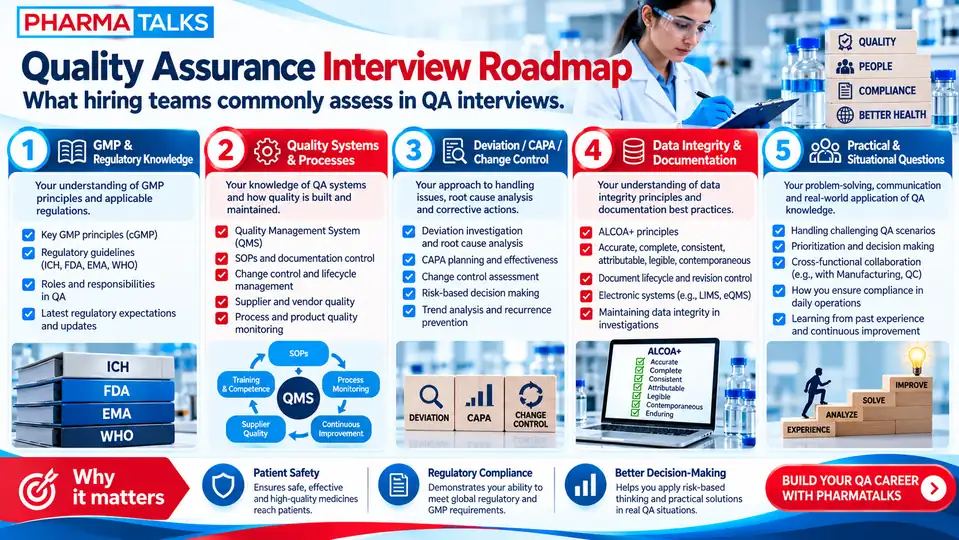
What Does a Pharmaceutical QA Interview Assess?
Interviewers commonly evaluate three layers at the same time: knowledge, judgment, and communication. Knowledge includes GMP principles and the site systems that implement them. Judgment appears when the candidate is asked what to do after an unexpected event, an OOS result, an incomplete record, or a proposed change. Communication is demonstrated by explaining a decision clearly, separating facts from assumptions, and showing when escalation is required.
ICH Q10 describes a pharmaceutical quality system that includes monitoring, CAPA, change management and management review. These elements provide a useful structure for interview preparation because they reflect how quality work is actually connected rather than performed in isolated silos.
Build a Core GMP Knowledge Base
Start with the regulatory framework relevant to the employer. For a finished-drug role in the United States, the candidate should understand the purpose of 21 CFR Parts 210 and 211 and know that FDA guidance explains current regulatory thinking without replacing the regulations. For an EU environment, EudraLex Volume 4 and its chapters and annexes provide the core GMP framework. ICH Q9(R1) and Q10 are especially useful for explaining risk-based decisions and the pharmaceutical quality system.
The objective is not to memorize every clause. A stronger answer explains where the requirement comes from, how the site procedure implements it, what record demonstrates compliance, and how QA verifies that the control remains effective.
Prepare Evidence-Based Examples
Prepare several examples from real work or realistic training cases. Useful themes include a deviation investigation, a change-control assessment, a CAPA effectiveness review, an audit observation, a documentation correction, or a cross-functional quality decision. Each example should distinguish the problem statement, immediate control, evidence reviewed, risk assessment, decision, and outcome.
Avoid presenting confidential company details. The interview value comes from the reasoning process: what information was available, what additional information was needed, who had decision authority, and what record supported the final conclusion.
How to Structure a Technical Answer
A concise answer can follow five steps: answer the question directly, identify the relevant QA responsibility, describe the evidence or procedure used, connect the decision to GMP or risk, and close with the outcome. This prevents long answers that never resolve the interviewer’s question.
For situational questions, a STAR-style structure can help, but pharmaceutical QA answers usually need an additional quality lens. State the situation and task, describe the action, explain the regulatory or quality rationale, and conclude with the result and learning. If a decision depended on another function or the Quality Unit, say so rather than implying authority you did not have.
Common Preparation Gaps
Common weaknesses include describing QA as only document approval, treating CAPA as a synonym for correction, assuming every OOS result is laboratory error, or quoting ALCOA+ without explaining practical controls. Another frequent gap is giving a risk score without explaining how the scoring model was selected or how uncertainty was handled.
A well-prepared candidate can explain both the principle and the control. For example, data integrity is not only an acronym; it includes controlled access, contemporaneous recording, audit trails where applicable, review of source data, and governance that makes unreliable records difficult to create or hide.
Practical Industry Example
Consider a candidate who is asked about a recurring documentation error in batch records. A weak answer says that the operators should be retrained. A stronger answer first explains how affected records would be identified and reviewed for product impact, then describes how the deviation history and error pattern would be examined. The candidate would consider whether the issue reflects form design, confusing instructions, workload, training, supervision, or a broader data-integrity risk. If the evidence supports a systemic cause, the response would describe an appropriate CAPA and a measurable effectiveness check. This example demonstrates the interview skill that matters most: linking a practical event to evidence, quality risk, the approved quality-system process, and a documented outcome rather than jumping immediately to a preferred corrective action.
Technical Tables
Regulatory status note: Numerical or product-specific limits are not generalized. Where a universal numeric criterion is not established by the cited source, the table states that the criterion is risk-based, product-specific or site-specific.
Technical Comparison
| Interview domain | What it tests | Evidence to prepare |
|---|---|---|
| GMP & regulation | Ability to identify governing frameworks | Example linking requirement → SOP → record |
| Quality systems | Understanding of connected PQS processes | Deviation, CAPA, change and review examples |
| Data integrity | Trustworthy records and controls | Paper/electronic data controls |
| Situational judgment | Risk-based decision-making | Scenario with evidence, escalation and outcome |
Procedure and Parameters
| Preparation step | Key parameter | Practical output |
|---|---|---|
| Map role description | System ownership and interfaces | List of likely technical domains |
| Select examples | Relevance and confidentiality | 4–6 adaptable cases |
| Practice answers | Clarity and evidence | 2–3 minute structured answers |
| Verify references | Applicability and currency | Official-source reference list |
Acceptance Criteria
| Preparation control | Acceptance criterion | Source / status |
|---|---|---|
| Regulatory statements | Traceable to current official source | Official requirement or guidance |
| Examples | No confidential identifiers; facts are accurate | Site-specific evidence |
| Interview claims | Authority is not overstated | Role / procedure dependent |
| Numerical limits | Used only when verified applicable | No universal limit |
Troubleshooting and CAPA
| Problem | Possible cause | Investigation | Corrective Action | Preventive Action |
|---|---|---|---|---|
| Answers are too generic | No prepared examples | Review role and past cases | Build evidence-based examples | Maintain reusable interview library |
| Wrong regulatory citation | Memory-based claim | Verify official source | Correct citation | Use controlled source list |
| Long unfocused answers | No structure | Review practice recording | Use 5-step answer format | Time-box mock interviews |
GMP Documentation Requirements
Maintain records that demonstrate the approved procedure was followed, the relevant evidence was reviewed, responsibilities were clear, and the final decision was authorized by the appropriate role. The exact record set depends on the process and site system. Examples may include controlled procedures, investigation or assessment forms, approval histories, linked change or CAPA records, training evidence, raw data, trend reports and management-review outputs.
Documentation should distinguish facts, assumptions, decisions and follow-up actions. Where an official requirement is applicable, the record should be traceable to the implemented control. Site-specific scoring schemes, classification labels and due-date conventions should not be presented as universal regulatory requirements.
Related Pharmatalks Resources
Public Pharmatalks internal URLs are intentionally not fabricated. Website-specific links must be resolved against the live existing routes during integration.
Frequently Asked Questions
How many QA interview examples should I prepare?
Prepare enough examples to cover the major systems relevant to the role. A small set of strong, adaptable examples is more useful than memorizing many scripted stories.
Should I memorize GMP regulations word for word?
No. Know the applicable framework and be able to explain how a requirement is implemented and evidenced. Exact citations are useful only when you are confident they are correct.
What is the best way to answer a deviation question?
Describe detection, immediate control, impact assessment, investigation, root-cause evaluation, CAPA when justified, effectiveness verification and documented closure.
Do interviewers expect knowledge of ICH Q9 and Q10?
For many QA roles, familiarity with Q9(R1) risk management and Q10 pharmaceutical quality-system concepts is highly valuable, especially for investigations, CAPA and change management.
How should I discuss confidential company cases?
Remove product names, batch details and proprietary information. Focus on your role, evidence, reasoning, escalation and outcome.
What makes a QA answer strong?
A strong answer is direct, technically accurate, evidence-based, risk-aware and clear about responsibilities and decision authority.
Conclusion
Pharmaceutical QA Interview Roadmap is best understood as part of a connected pharmaceutical quality system rather than an isolated checklist. Effective practice combines clear responsibilities, current procedures, reliable evidence, risk-based decisions and review of outcomes. For interview preparation, use the same logic: explain the governing principle, the operational control, the evidence you would review, and the way the result protects product quality and patients.