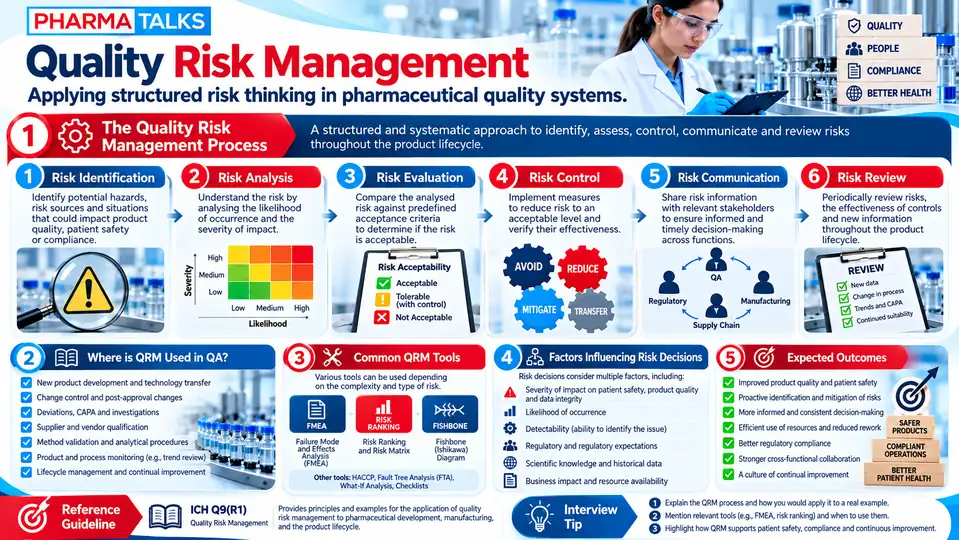
Risk Assessment: Identification, Analysis and Evaluation
Risk identification asks what might go wrong. Risk analysis estimates or characterizes the risk associated with the identified hazards, considering available knowledge and uncertainty. Risk evaluation compares the analyzed risk with defined criteria or decision needs. The method can be qualitative, semi-quantitative or quantitative depending on the problem.
Before assigning numbers, define the decision the assessment must support. Poorly defined scoring models can create false precision. ICH Q9(R1) specifically addresses subjectivity and the importance of controlling bias in risk-based decision-making.
Risk Control and Risk Acceptance
Risk control includes deciding whether risk should be reduced and what controls are appropriate. Risk reduction should focus on the drivers of risk and may involve technical, procedural, monitoring or detection controls. After controls are selected, reassess residual risk and determine whether it is acceptable under the defined decision criteria.
Risk acceptance does not mean “zero risk.” Pharmaceutical operations involve residual uncertainty. Acceptance should be justified, documented and consistent with patient protection and applicable requirements.
Risk Communication and Review
Risk information should reach the people who own the decision or operate the control. Communication includes assumptions, uncertainty, significant hazards, selected controls and unresolved issues. A risk assessment that is stored but not used is not effective quality risk management.
Risk review occurs when new knowledge, deviations, complaints, changes, trend data, inspections or lifecycle events alter the original assumptions. Review frequency should be risk-based rather than automatically identical for every assessment.
Selecting a QRM Tool
FMEA is useful when examining failure modes of a process, equipment or system. Risk-ranking and filtering approaches help prioritize multiple risks. Fault-tree analysis can explore combinations of causes leading to a top event. HACCP-style approaches can be useful where hazards and control points are central. Simple decision trees or checklists may be sufficient for lower-complexity questions.
The tool should fit the decision, available data and complexity. Do not select FMEA merely because it is familiar, and do not treat a numerical risk priority number as an objective truth without evaluating the assumptions behind it.
Applying QRM to QA Systems
QRM can support deviation scoping, change-control impact assessment, supplier qualification, validation strategy, audit planning, CAPA prioritization and monitoring. However, risk management should not be used to justify non-compliance with an explicit requirement. It helps determine how to control uncertainty and allocate effort within the applicable regulatory framework.
In an interview, demonstrate that you can explain the risk question, evidence, uncertainty, controls and review trigger. That shows more mature risk thinking than simply naming a tool.
Practical Industry Example
A site considering a supplier change for a critical excipient may use QRM to determine the depth of evaluation. The team first defines the decision and identifies hazards such as variability in material attributes, supply continuity, analytical differences and regulatory impact. Available supplier history, material knowledge and process sensitivity are then used to characterize risk and uncertainty. Controls might include additional qualification testing, a comparability study, tighter incoming monitoring or a staged implementation plan. Residual risk is reviewed before approval, and the assessment is revisited if new trend data or deviations emerge. This example demonstrates that QRM is not the score itself; it is the documented reasoning that connects evidence, uncertainty, controls and review to a quality decision.
Additional control point: Risk assessments should identify uncertainty explicitly. When data are limited, the team may need conservative controls, additional monitoring or staged implementation until evidence improves. Recording uncertainty is more scientifically honest than assigning a precise score unsupported by reliable information.
Technical Tables
Regulatory status note: Numerical or product-specific limits are not generalized. Where a universal numeric criterion is not established by the cited source, the table states that the criterion is risk-based, product-specific or site-specific.
Technical Comparison
| QRM tool | Best fit | Limitation |
|---|---|---|
| FMEA | Failure modes in processes/systems | Can create false precision if scoring is weak |
| Risk matrix | Prioritization / communication | Subjective categories require calibration |
| Fault tree | Top-event causal logic | Needs clear event definitions |
| Checklist / decision tree | Lower-complexity recurring decisions | May miss novel hazards |
Procedure and Parameters
| QRM stage | Key question | Output |
|---|---|---|
| Risk identification | What can go wrong? | Hazard list |
| Risk analysis | How likely/severe/detectable? | Risk characterization |
| Risk control | What reduces risk? | Control plan / residual risk |
| Risk review | What changed? | Updated assessment |
Acceptance Criteria
| Control | Acceptance criterion | Source / status |
|---|---|---|
| Formality | Proportionate to importance, uncertainty, complexity | ICH Q9(R1) |
| Subjectivity | Bias and assumptions considered | ICH Q9(R1) |
| Risk acceptance | Justified within applicable requirements | Risk-based |
| Tool selection | Fit for decision and data | No universal mandatory tool |
Troubleshooting and CAPA
| Problem | Possible Cause | Investigation | Corrective Action | Preventive Action |
|---|---|---|---|---|
| Same risk score for different teams | Criteria inconsistent | Compare scoring rationales | Calibrate definitions | Facilitator / training |
| FMEA overused | Tool chosen by habit | Review decision need | Choose fit-for-purpose tool | QRM tool guide |
| Risk never reviewed | No trigger defined | Check lifecycle events | Update assessment | Review-trigger standard |
GMP Documentation Requirements
Maintain records that demonstrate the approved procedure was followed, the relevant evidence was reviewed, responsibilities were clear, and the final decision was authorized by the appropriate role. The exact record set depends on the process and site system. Examples may include controlled procedures, investigation or assessment forms, approval histories, linked change or CAPA records, training evidence, raw data, trend reports and management-review outputs.
Documentation should distinguish facts, assumptions, decisions and follow-up actions. Where an official requirement is applicable, the record should be traceable to the implemented control. Site-specific scoring schemes, classification labels and due-date conventions should not be presented as universal regulatory requirements.
Related Pharmatalks Resources
Public Pharmatalks internal URLs are intentionally not fabricated. Website-specific links must be resolved against the live existing routes during integration.
Frequently Asked Questions
Does ICH Q9(R1) require FMEA?
No. FMEA is one possible tool. The method should be appropriate to the specific risk and decision.
Is a risk matrix mandatory?
No universal matrix is mandated by ICH Q9(R1). Companies should use a justified approach appropriate to the context.
What does risk-based formality mean?
The amount of structure, documentation and effort should be proportionate to the importance, uncertainty and complexity of the risk decision.
Can risk management justify ignoring a GMP requirement?
No. QRM supports decisions within the regulatory framework; it should not be used to rationalize non-compliance with explicit requirements.
When should a risk assessment be reviewed?
When new information, changes, deviations, trends or other events may affect the assumptions, controls or residual risk.
How can subjectivity be reduced?
Define criteria, use appropriate expertise and data, challenge assumptions, document uncertainty and apply structured review where warranted.
Conclusion
Quality Risk Management Under ICH Q9(R1) is best understood as part of a connected pharmaceutical quality system rather than an isolated checklist. Effective practice combines clear responsibilities, current procedures, reliable evidence, risk-based decisions and review of outcomes. For interview preparation, use the same logic: explain the governing principle, the operational control, the evidence you would review, and the way the result protects product quality and patients.