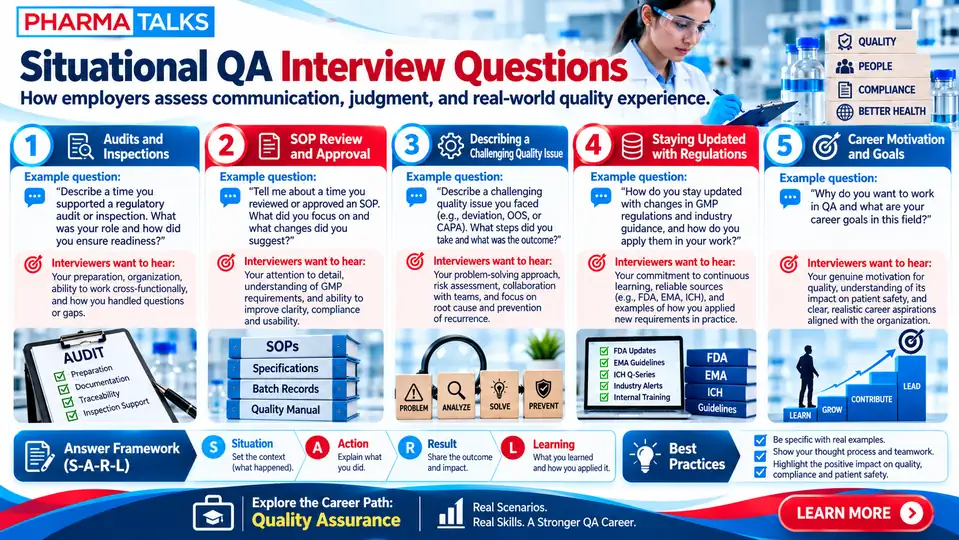
Use a Quality-Focused Situation Framework
A useful structure is Situation, Action, Result and Learning, expanded with quality rationale. Briefly define what happened, then describe the immediate control and the evidence you reviewed. Explain which procedure or quality-system principle guided the decision, who needed to be involved, and what outcome was achieved. Finish with what was learned or improved.
Avoid long background stories. Interviewers want to understand your judgment, not every historical detail of the event.
Audit and Inspection Scenarios
For an audit question, explain preparation, document availability, subject-matter-expert coordination, truthful responses and follow-up. Do not suggest hiding records or answering beyond your knowledge. If you do not know the answer, explain that you would verify the information with the appropriate record or expert rather than speculate.
When discussing an observation, show how you would understand the evidence, assess impact, document the response, determine whether CAPA is required and track commitments to completion.
Deviation, OOS and CAPA Scenarios
When presented with a deviation, begin with immediate control and impact assessment before jumping to root cause. For OOS results, preserve original data and follow the laboratory investigation process rather than assuming analyst error. For CAPA, show that actions must be linked to evidence-supported causes and that effectiveness should be measured.
These distinctions demonstrate mature quality thinking and prevent common interview mistakes such as “retest until it passes” or “retrain the operator” without investigation.
SOP Review and Documentation Scenarios
If asked how you review an SOP, consider purpose, scope, responsibilities, sequence, clarity, interfaces with other procedures, required records, training impact and consistency with applicable requirements. Look for ambiguous instructions, uncontrolled choices and missing decision points.
For documentation errors, preserve the original entry, follow the approved correction process and consider whether the error indicates a broader data-integrity or training issue. Never suggest backdating or obscuring the original record.
Conflict, Escalation and Career Judgment
Quality work frequently requires respectful disagreement. Explain the evidence, identify the applicable requirement or risk, listen to operational constraints and escalate through the defined governance path when agreement cannot be reached. QA should be collaborative without compromising required controls.
Career-motivation questions should connect personal goals with the real responsibilities of QA: patient protection, process reliability, data integrity, cross-functional problem solving and continual improvement. Avoid generic statements that could apply to any job.
Practical Industry Example
An interviewer may ask what you would do if Production wants to continue a batch after an unexpected event while QA believes more assessment is needed. A strong answer begins by clarifying the facts, the affected process step and any immediate risk to product or data. The candidate would review the relevant procedure and available evidence, explain the quality concern to the operational team, and identify whether a hold, deviation or formal escalation is required. If disagreement remains, the defined governance or Quality Unit authority should be used rather than informal compromise. The answer should also explain how the final decision would be documented. This scenario demonstrates judgment, collaboration and integrity without suggesting that QA should obstruct operations or ignore a significant unresolved quality risk.
Additional interview practice: Prepare one scenario in which you escalated a concern and one in which evidence showed that escalation was unnecessary. This demonstrates balanced judgment: QA should neither minimize legitimate risk nor create unnecessary barriers when the data support controlled continuation responsibly and transparently.
Technical Tables
Regulatory status note: Numerical or product-specific limits are not generalized. Where a universal numeric criterion is not established by the cited source, the table states that the criterion is risk-based, product-specific or site-specific.
Technical Comparison
| Scenario type | What interviewer tests | Strong answer signal |
|---|---|---|
| Audit observation | Readiness and integrity | Truthful evidence-based response |
| Deviation / OOS | Investigation judgment | Contain → assess → investigate |
| SOP issue | Documentation thinking | Clarity, controls, interfaces |
| Conflict with operations | Communication and escalation | Risk-based respectful governance |
Procedure and Parameters
| Answer step | Parameter | Output |
|---|---|---|
| Situation | Relevant context only | Clear problem statement |
| Action | Evidence and responsibilities | What you actually did |
| Quality rationale | GMP / risk basis | Why the action was appropriate |
| Result / learning | Objective outcome | Improvement and follow-up |
Acceptance Criteria
| Interview behavior | Acceptance criterion | Source / status |
|---|---|---|
| Technical claim | Supported by applicable framework | Official source |
| Role statement | Matches actual authority | Site/experience-specific |
| Scenario response | No concealment or data manipulation | GMP/data integrity principle |
| Numerical limit | Used only when verified | No invented criterion |
Troubleshooting and CAPA
| Problem | Possible Cause | Investigation | Corrective Action | Preventive Action |
|---|---|---|---|---|
| Answer sounds scripted | Memorized wording | Mock interview review | Use real evidence | Practice variants |
| Authority overstated | Role confusion | Compare actual RACI | Clarify responsibility | Prepare role boundaries |
| No quality rationale | Focus only on action | Ask “why did it matter?” | Add risk/GMP link | Answer checklist |
GMP Documentation Requirements
Maintain records that demonstrate the approved procedure was followed, the relevant evidence was reviewed, responsibilities were clear, and the final decision was authorized by the appropriate role. The exact record set depends on the process and site system. Examples may include controlled procedures, investigation or assessment forms, approval histories, linked change or CAPA records, training evidence, raw data, trend reports and management-review outputs.
Documentation should distinguish facts, assumptions, decisions and follow-up actions. Where an official requirement is applicable, the record should be traceable to the implemented control. Site-specific scoring schemes, classification labels and due-date conventions should not be presented as universal regulatory requirements.
Related Pharmatalks Resources
Public Pharmatalks internal URLs are intentionally not fabricated. Website-specific links must be resolved against the live existing routes during integration.
Frequently Asked Questions
What is the best structure for a situational QA answer?
State the situation briefly, explain your action and quality rationale, describe the result, and finish with the learning or improvement.
What should I say if Production disagrees with QA?
Describe how you would review evidence and requirements, discuss risk openly, document the decision and use the defined escalation path when necessary.
How do I answer an audit question if I lack direct inspection experience?
Use internal audit, mock inspection, document-review or readiness examples and be transparent about the scope of your experience.
Should I quote regulations in situational answers?
Only when confident and relevant. It is more important to explain the correct control and how you would verify the applicable requirement.
What is a bad OOS interview answer?
Saying that you would simply repeat the test until it passes. A scientifically justified investigation must evaluate the original result and any retesting.
How can I make answers less generic?
Include the evidence you reviewed, the decision owner, the risk considered, the record created and the measurable outcome.
Conclusion
Situational QA Interview Questions for Pharmaceutical Roles is best understood as part of a connected pharmaceutical quality system rather than an isolated checklist. Effective practice combines clear responsibilities, current procedures, reliable evidence, risk-based decisions and review of outcomes. For interview preparation, use the same logic: explain the governing principle, the operational control, the evidence you would review, and the way the result protects product quality and patients.