Injection Routes Explained: ID, SC, IM and IV
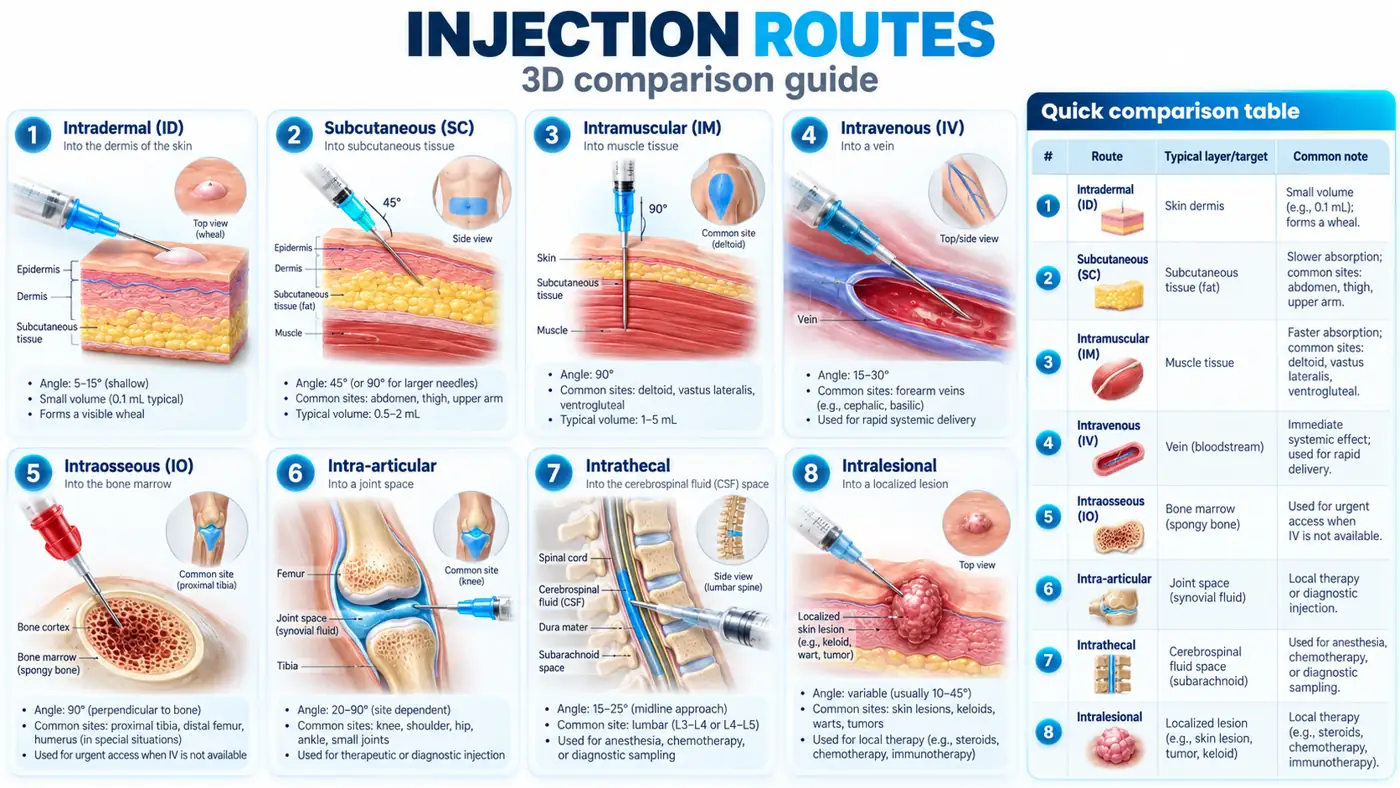
Injection routes describe where a medicine enters the body, not merely where a needle touches the skin. Intradermal (ID) delivery targets the dermis, subcutaneous (SC) delivery targets fat, intramuscular (IM) delivery targets muscle, and intravenous (IV) delivery enters a vein. Intraosseous, intra-articular, intrathecal and intralesional routes serve specific clinical purposes. Route selection depends on the product label, formulation, intended effect and trained clinical judgment. This article explains differences for pharmaceutical learners; it is not a procedure manual for unsupervised injections.
What Are the Main Injection Routes?
Each parenteral route crosses a different anatomical barrier. Tissue perfusion, formulation volume, viscosity, local tolerance, deposition depth and systemic availability all influence the therapeutic outcome. The approved labeling and relevant clinical protocol take precedence over generic teaching diagrams.
Intradermal and Subcutaneous Delivery
The intradermal route places a small quantity in the dermis, where a visible local response can sometimes be assessed. The subcutaneous route deposits medication below the dermis into adipose tissue. Subcutaneous absorption often differs from intramuscular absorption because regional blood flow and tissue composition differ. Common SC products include some insulin formulations and biologics, but their approved device instructions may prescribe different needle lengths and angles.
Route and Target-Tissue Comparison
| Route | Target | Representative context | Key distinction |
|---|---|---|---|
| Intradermal (ID) | Dermis | Selected diagnostics or immunization contexts | Primarily superficial deposition |
| Subcutaneous (SC) | Subcutaneous adipose tissue | Insulin and selected biologics | Product/device-specific absorption |
| Intramuscular (IM) | Muscle | Vaccines and approved IM medicines | Deltoid or thigh for vaccines |
| Intravenous (IV) | Vein | Infusions and certain injections | Direct intravascular delivery |
| Intraosseous (IO) | Vascular marrow space | Protocol-defined emergencies | Alternative emergency access |
| Intra-articular | Joint space | Selected joint therapies | Specialist procedure |
| Intrathecal | CSF space | Selected spinal therapies | High-consequence route |
| Intralesional | Local lesion | Localized therapies | Targeted site-specific treatment |
Intramuscular and Intravenous Delivery
Intramuscular injection crosses the subcutaneous tissue into a muscle such as the deltoid or vastus lateralis. CDC vaccination guidance specifies an intramuscular angle of 90 degrees and selection of needle length according to patient and site factors. This vaccination-specific guidance must not be generalized to every injectable medicine. Intravenous administration delivers a product directly into vascular access, removing a tissue absorption step. It requires suitable formulation properties, verified vascular access, professional monitoring and strict compatibility controls; an IV product is not automatically safe by other routes.
Specialized Routes: IO, Joint, CSF and Lesion
Intraosseous access reaches vascular marrow spaces in selected emergencies when obtaining IV access is difficult. Intra-articular injection targets a joint compartment, usually under a defined specialist pathway. Intrathecal delivery enters cerebrospinal fluid pathways and presents high-consequence medication-error risks. Intralesional injection is directed into a localized lesion. The required sterile preparation, monitoring, documentation and specialist competence vary markedly with the procedure.
Workflow and Parameters
| Checkpoint | Equipment or parameter | Purpose | Source scope |
|---|---|---|---|
| Product identification | Label and prescription | Confirm approved route | Product-specific |
| Preparation | Sterile device; aseptic workspace | Prevent contamination | CDC injection safety |
| Tissue target | Anatomy and suitable device | Avoid wrong-layer administration | CDC/NIH |
| Administration | Trained operator and monitoring | Identify immediate reaction | Local clinical policy |
| Traceability | Lot, dose, time, route, site as applicable | Reconstruct medication use | Site-specific documentation |
Equipment, Formulation and Administration Checks
Selection begins with the authorized product and its route-specific labeling, followed by verification of identity, intended dose, concentration, container integrity, expiry and aseptic preparation. A trained clinician checks patient-specific contraindications, relevant anatomy, device suitability and medication compatibility. Autoinjectors, prefilled syringes, cannulas and spinal-purpose devices are not interchangeable. The healthcare workflow must also address safe sharps disposal, error escalation and observation for immediate adverse events.
Safety Criteria and Regulatory Scope
There is no single global regulatory injection angle, needle length or volume that applies to all parenteral products. CDC gives route-specific parameters for vaccination, while medicinal-product labeling and local procedures govern other uses. Aseptic-processing GMP requirements apply to manufacturing injectable medicines, not as a replacement for bedside administration protocols. Manufacturing batch-release tests can include sterility, particles, endotoxins and product-specific specifications as applicable, but actual limits must be taken from the relevant current compendial standard and approved specification.
Verified Requirements Versus Local Criteria
| Item | What can be verified | Applicability | Reference |
|---|---|---|---|
| Vaccination IM angle | 90° for CDC vaccine guidance | Vaccines only; assess patient/site | CDC-DURING |
| Vaccination SC angle | 45° in CDC vaccine guidance | Vaccines only | CDC-BEST |
| Single-use needles and syringes | Do not reuse between patients | Injection safety | CDC-SAFE |
| IV/IO/intrathecal numerical limits | No universal figure established here | Check exact product/protocol | Product label |
| Injectable GMP release | Follow applicable approved specifications | Manufacturing, not bedside | FDA-ASEPTIC |
Documentation and Investigation of Errors
Clinical records should link the administered medicine with its authorized route, patient, time, dose, site when applicable, administrator and relevant observations. A wrong-route incident requires immediate patient-safety assessment, incident reporting and an investigation of label readability, order entry, training, storage segregation and device selection.
Route-Related Troubleshooting and CAPA
| Problem | Possible cause | Investigation | Corrective action | Preventive action |
|---|---|---|---|---|
| Unexpected local reaction | Wrong tissue or irritant formulation | Review product, route and technique | Clinical assessment and report | Route-label verification |
| Wrong-route near miss | Look-alike packaging | Trace order, storage and label | Quarantine affected stock as appropriate | Segregation and independent checks |
| Contamination concern | Aseptic breach | Review handling and vial use | Stop use and assess exposure | Competency checks and audits |
| Missing documentation | Workflow design gap | Reconcile records and system logs | Correct traceable record per policy | Structured electronic fields |
Frequently Asked Questions
Does every injection reach the bloodstream?
No. IV injections enter vascular access directly; ID, SC and IM injections deposit in tissue and may be absorbed subsequently.
Is an intramuscular injection always faster than a subcutaneous one?
Not always. Formulation, local blood flow and patient factors affect the rate; do not assume a universal ranking.
Are injection angles identical for all medicines?
No. CDC vaccine instructions provide examples, but product labeling and device instructions control specific medicines.
What is intraosseous access used for?
It provides emergency vascular access under an applicable clinical protocol when standard access cannot be obtained rapidly.
Can an intrathecal drug be given intravenously instead?
No. Routes are not interchangeable; wrong-route administration can cause catastrophic harm.
How do GMP specifications relate to injecting a medicine?
GMP governs reliable manufacturing and release of sterile products, while clinical protocols govern patient administration.
Related Pharmatalks Resources
Explore the other verified educational pages in this downloadable Pharmatalks series. These are working links within the package, not claims of existing public website URLs.
Official and Reference Sources
- CDC-DURING CDC — Vaccine Administration: During Vaccination — official clinical guidance
- CDC-BEST CDC — Vaccine Administration General Best Practices — official clinical guidance
- CDC-SAFE CDC — Preventing Unsafe Injection Practices — official infection prevention guidance
- NIH-PAREN NLM — Nursing Skills: Administering Parenteral Medications — educational clinical textbook
- NIH-ROUTES NLM — Medication Routes of Administration — clinical reference
- FDA-ASEPTIC FDA — Sterile Drug Products Produced by Aseptic Processing — official nonbinding manufacturing guidance
- EMS-IO Maryland EMS — 2025 Intraosseous Infusion Protocol — official local clinical protocol (not generalizable)
Reviewed by Pharmatalks editorial research workflow; no individual clinical sign-off is represented. Medical guidance and product labels may change. Source access checked during drafting on 6 November 2026.
Conclusion
Injection routes should be understood as distinct tissue targets with different safety and product requirements. Always separate general anatomical teaching from the approved instructions governing a specific medicine.
Author / educational publisher: Pharmatalks · Editorial review date: 2026-11-06