Injection Sites: Deltoid, Thigh and Gluteal
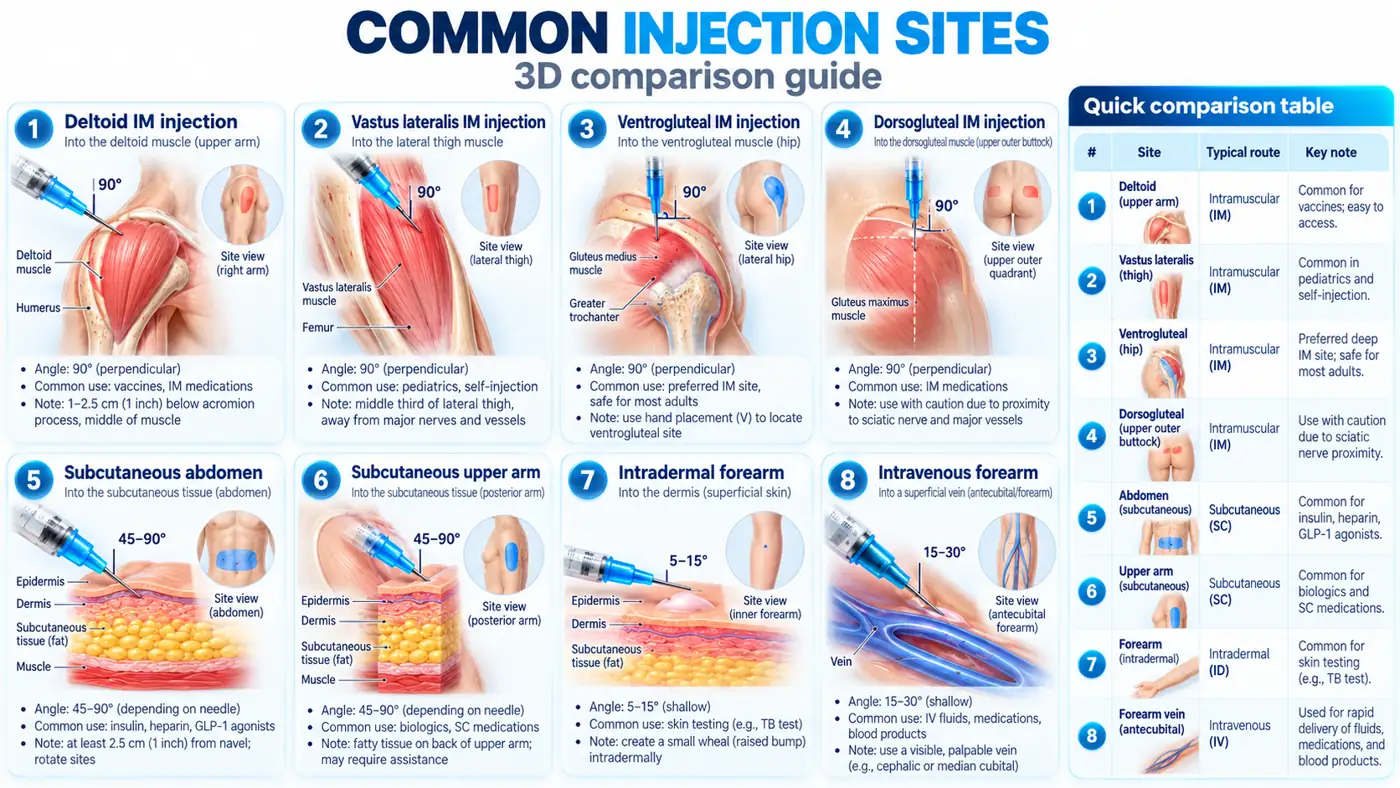
An injection site is an anatomical location chosen to deliver a medicine into its intended tissue safely. The deltoid and vastus lateralis are prominent intramuscular vaccination sites, while the abdomen, thigh and upper arm may be used for selected subcutaneous medicines. Ventrogluteal and dorsogluteal landmarks concern other intramuscular procedures; the latter raises particular neurovascular concerns. Site suitability changes with age, body composition, product instructions and the intended route. This Pharmatalks guide compares common sites without substituting for supervised clinical training.
Why Does Injection Site Matter?
Anatomical location affects the likelihood of the medicine reaching the target tissue and the risk of damaging nearby nerves, vessels or bone. A correct product administered at an unsuitable site may have altered performance or cause a preventable adverse event. Site assessment includes visible skin condition, infection, bruising, scarring, tissue thickness, patient positioning and the available muscle mass.
Deltoid and Vastus Lateralis Muscles
The upper-arm deltoid is a recommended vaccination site for many older children and adults. The vastus lateralis of the anterolateral thigh is a key site for infants and an option at other ages. CDC guidance bases needle length and recommended location on patient age and, in adults, weight and body characteristics. The intended product and vaccine schedule also matter. The injection must avoid a position too high in the shoulder region, where inadvertent involvement of bursae and other structures can cause injury.
Site Comparison
| Site | Route context | Typical example | Important caveat |
|---|---|---|---|
| Deltoid | IM | Many vaccines in older children/adults | Correct landmark avoids shoulder injury |
| Vastus lateralis | IM | Infant vaccination | Anterolateral thigh |
| Ventrogluteal | IM | Selected non-vaccine medication | Specialist landmarking |
| Dorsogluteal | IM | Historically used for some medicines | Neurovascular proximity; avoid for vaccines |
| Abdomen | SC | Selected insulin/biologics | Follow product rotation instructions |
| Posterior/lateral upper arm | SC | Certain SC medicines or vaccines | Age/product-specific site |
| Inner forearm | ID | Certain diagnostic tests | Dermis, not a vein |
| Forearm vein | IV | Venous access | Professional cannulation |
Ventrogluteal Versus Dorsogluteal
The ventrogluteal region corresponds to muscle around the lateral hip and is described in nursing references as an intramuscular medication site. The dorsogluteal region of the posterior buttock is not a preferred vaccine site and poses concern because of proximity to the sciatic nerve and large vessels.
Subcutaneous Abdomen and Upper Arm
Many subcutaneous products use abdominal or thigh regions, and some also permit upper-arm areas. Absorption can vary with local tissue, injection depth and formulation. Some medicines require site rotation to reduce repeated-tissue injury or lipohypertrophy. The correct distance from the umbilicus, whether skin is lifted, and whether the patient may self-administer are determined by the specific product/device instructions, not by a single cross-product rule. Inspect the skin and document site-related reactions when clinically relevant.
Assessment and Parameters
| Assessment stage | Check | Reason | Document as appropriate |
|---|---|---|---|
| Before preparation | Product label and route | Prevent wrong-route error | Order/route |
| Before site choice | Age, body habitus and anatomy | Match target tissue | Chosen site |
| Before injection | Skin condition and landmarks | Reduce avoidable injury | Inspection findings |
| During procedure | Aseptic technique and device | Reduce contamination | Device/lot if required |
| After procedure | Reaction and incident assessment | Identify safety signals | Observation and follow-up |
Intradermal Forearm and Intravenous Forearm
The inner forearm is commonly illustrated for intradermal diagnostic tests because a small local skin response can be observed. Intradermal technique is specialized and should be performed only by trained staff following the protocol for the test or vaccine. Forearm veins are widely used for selected peripheral IV access, but vein selection depends on assessment, treatment duration, infusion properties and device policy. An intradermal injection on the forearm and an IV cannula in the forearm have entirely different target tissues and risks.
Equipment, Observations and Selection Criteria
Staff must verify medicine, route, patient characteristics, needle or device specifications, skin condition, allergy history and availability of resuscitation resources as appropriate. For vaccines, CDC publishes site- and age-specific needle guidance; those tables should not be repurposed as dosing instructions for non-vaccine therapies.
Authoritative Guidance and Limits
| Clinical question | Verified guidance | What is NOT universal | Reference |
|---|---|---|---|
| Routine vaccine IM sites | Deltoid and vastus lateralis | Not every IM medicine | CDC-PINK |
| Adult vaccine needle length | Depends on patient and site | No single length for all adults | CDC-DURING |
| Vaccine SC method | 45° into subcutaneous fat | Do not extrapolate to autoinjectors | CDC-BEST |
| Dorsogluteal vaccination | Not one of the recommended routine IM vaccine sites | Other procedures require local policy | CDC-PINK |
| Universal site-based volume limits | Not established for all injectables | Check label and protocol | NIH-PAREN |
Documentation, Deviations and Prevention
Records should capture medication, intended route, anatomical site when relevant, date, administered dose, lot where required, clinician and any reaction. Investigations should examine procedure clarity, staff competency, labeling, site diagrams, and whether clinical systems capture sufficient details. Correction might involve immediate clinical evaluation and record reconciliation; preventive actions may require a revised checklist, improved training and targeted audits of performance.
Site Problems and CAPA
| Problem | Possible cause | Investigation | Corrective action | Preventive action |
|---|---|---|---|---|
| Unexpected shoulder pain | Site located too high | Check landmarks and record | Assess clinically | Observed competency review |
| Subcutaneous tissue injury | Repeated same location | Examine site rotation history | Clinical management | Product-specific rotation education |
| Wrong-site documentation | Ambiguous chart field | Review medication record | Correct audit-traceable record | Standardized site list |
| Contamination concern | Aseptic practice breach | Review supplies and technique | Escalate and manage exposure | Targeted aseptic audits |
Frequently Asked Questions
Which injection site is used for routine adult vaccination?
The deltoid is a preferred IM site for many adult vaccines when clinically appropriate; consult current CDC guidance.
Why is the thigh used for infants?
The anterolateral thigh contains a well-developed vastus lateralis muscle and is an established infant vaccine site.
Is the buttock recommended for routine vaccines?
No. CDC routine IM vaccine guidance specifies deltoid and vastus lateralis rather than dorsogluteal delivery.
Can all SC medicines use the abdomen?
No. Products and devices have different approved sites; follow their specific instructions.
Is a forearm intradermal test the same as an IV injection?
No. ID targets superficial dermis, while IV administration uses a vein.
Should injection sites be rotated?
Certain repeated SC medicines recommend rotation, but the pattern must follow product-specific instructions.
Related Pharmatalks Resources
Explore the other verified educational pages in this downloadable Pharmatalks series. These are working links within the package, not claims of existing public website URLs.
Official and Reference Sources
- CDC-DURING CDC — Vaccine Administration: During Vaccination — official clinical guidance
- CDC-BEST CDC — Vaccine Administration General Best Practices — official clinical guidance
- CDC-PINK CDC — Pink Book Chapter 6: Vaccine Administration — official clinical reference
- CDC-SAFE CDC — Preventing Unsafe Injection Practices — official infection prevention guidance
- NIH-PAREN NLM — Nursing Skills: Administering Parenteral Medications — educational clinical textbook
- NIH-ROUTES NLM — Medication Routes of Administration — clinical reference
Reviewed by Pharmatalks editorial research workflow; no individual clinical sign-off is represented. Medical guidance and product labels may change. Source access checked during drafting on 6 November 2026.
Conclusion
Safe injection-site choice depends on correct anatomy, route, patient factors and the drug product. Use professionally approved procedures and record the selected site and any reaction when required.
Author / educational publisher: Pharmatalks · Editorial review date: 2026-11-06