Pharmaceutical Environmental Monitoring
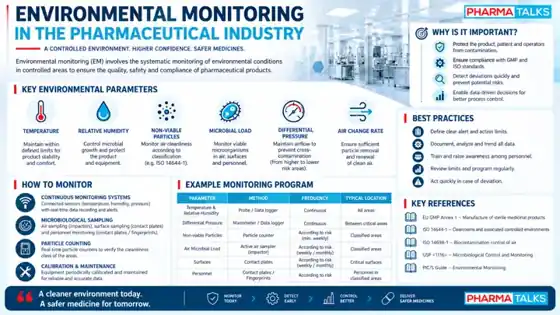
Pharmaceutical environmental monitoring (EM) is the structured collection and review of physical, particulate and microbiological data used to demonstrate that controlled manufacturing areas remain suitable for their intended operations. In sterile manufacture, EM is part of the contamination control strategy (CCS): it should detect loss of control, support batch and process review, and trigger investigation when limits or adverse trends occur. A sound program is risk-based, linked to cleanroom qualification, and designed around the product, process, facility, equipment, personnel and typical microbial flora rather than around a generic sampling calendar.
What Is an Environmental Monitoring Program?
An EM program combines monitoring of non-viable particles, viable airborne contamination, surfaces, personnel and selected physical parameters such as pressure differentials, temperature and relative humidity. EU GMP Annex 1 expects the program to be established and documented, with sampling locations, frequency, methods and incubation conditions justified through risk assessment. Qualification establishes whether the room can meet its intended classification; routine monitoring then demonstrates that the state of control is maintained during real operation. These are related activities, but they are not interchangeable.
Technical Comparison
| Data stream | What it shows | Typical tool | Primary use |
|---|---|---|---|
| Non-viable particles | Airborne particulate cleanliness | Laser particle counter | Classification support and routine trend detection |
| Viable air | Airborne recoverable microorganisms | Active air sampler / settle plates | Aseptic contamination surveillance |
| Surfaces | Microbial recovery from equipment/rooms/gowns | Contact plates / swabs | Cleaning, transfer and personnel control |
| Physical parameters | Environmental/HVAC stability | BMS/EMS sensors | Pressure, temperature, RH and airflow-related control |
Why EM Matters to Product Quality
Aseptic and other contamination-sensitive processes cannot rely on finished-product testing alone. Monitoring gives indirect but essential evidence about the environment in which critical operations occur. A robust program looks for patterns rather than only isolated failures: repeated alerts, consecutive excursions, shifts in microbial flora, deterioration after maintenance, or relationships between HVAC performance and particle counts can reveal weakening control before a major event. The strongest programs therefore integrate EM review with process events, interventions, alarms, cleaning, maintenance and batch records.
Procedure and Parameters
| Step | Key activity | Critical parameter | Evidence |
|---|---|---|---|
| 1 | Risk assessment | Product exposure, interventions, airflow | Approved EM rationale |
| 2 | Select locations | Highest-risk and representative points | Sampling map |
| 3 | Define methods | Volume, duration, media, recovery | Approved SOP/method |
| 4 | Trend and review | Alerts, actions, flora, recurrence | Periodic trend report |
How to Design the Program
Start with process mapping and a contamination-risk assessment. Identify where exposed sterile product, sterile product-contact surfaces, open containers or critical interventions create the highest risk. Use airflow visualization, cleanroom qualification results and historical data to select representative locations. Define methods, sample volumes, frequencies and response rules before routine use. For sterile operations, Grade A monitoring should focus on the highest-risk locations and should not itself introduce contamination. Grade C and D frequencies and limits are more risk-based and should be supported by qualification and historical data.
Acceptance Criteria
| Parameter | Official / site basis | Interpretation | Source |
|---|---|---|---|
| Non-viable particles | Annex 1 Table 5 for sterile grades | Use grade/state-specific limits; Grade D in-operation is site-defined | EU GMP Annex 1 |
| Viable monitoring | Annex 1 Table 6 for sterile grades | Grade A: any growth requires investigation; other grades have defined maximum action limits | EU GMP Annex 1 |
| Alert levels | Qualification and trend data | Site-defined early-warning levels, periodically reviewed | EU GMP Annex 1 |
| Temperature/RH | Product/process need | No universal Annex 1 numeric limit; define and justify locally | WHO HVAC / site validation |
GMP Documentation and Review
The controlled program should define responsibilities, equipment IDs, calibration status, methods, media, incubation conditions, sampling maps, alert levels, action limits, escalation, organism identification rules, data review and periodic program review. Raw data and metadata should be retained so an investigation can reconstruct what happened. Management review should connect trends to CAPA, change control, maintenance and CCS updates. Site-specific limits must be scientifically justified; where official limits exist, they should be applied in the correct context rather than copied into unrelated operations.
Troubleshooting and CAPA
| Problem | Possible cause | Investigation | Corrective action | Preventive action |
|---|---|---|---|---|
| Repeated particle alerts | Intervention, airflow disturbance, filter issue | Correlate particle trace with activities and HVAC | Contain affected operation and correct cause | Revise controls or maintenance based on trend |
| Microbial recovery increase | Cleaning, gowning, transfer or flora shift | Identify organisms; review locations and events | Targeted cleaning/retraining | Update CCS and sampling rationale |
| Pressure instability | Door opening, HVAC imbalance, sensor drift | Review BMS trend, door events, calibration | Restore airflow/pressure control | Alarm review and preventive maintenance |
GMP Documentation Requirements
Document the approved monitoring or control strategy, responsible functions, equipment and calibration status, applicable methods, sampling or measurement locations, limits, alarm logic, data-review frequency, deviation workflow, CAPA linkage and change-control triggers. Records should permit an independent reviewer to reconstruct the event and understand why the final quality decision was made. Where regulatory guidance provides a numeric limit, apply it only within the stated scope; where no universal limit exists, use product/process knowledge, qualification and risk management to establish the site-specific criterion.
Related Pharmatalks Resources
Related articles in this series
Frequently Asked Questions
Is cleanroom qualification the same as routine environmental monitoring?
No. Qualification demonstrates that the room or clean-air equipment meets its intended specification under defined conditions; routine monitoring provides ongoing evidence of control during actual operations.
Should every monitoring point be sampled at the same frequency?
No. Frequency should reflect risk, cleanroom grade, process exposure, historical data and qualification evidence.
Are alert levels the same as action limits?
No. Alert levels provide early warning of drift; action limits require a defined response and, in sterile operations, normally trigger investigation and product-impact assessment.
Can ISO 14644 replace microbiological monitoring?
No. ISO 14644 particle standards are useful for particle cleanliness, but FDA explicitly notes that sterile aseptic facilities should not rely on ISO particle standards alone.
What should trigger program review?
Significant facility or process changes, adverse trends, recurring excursions, new organisms, HVAC changes, CAPA findings and periodic lifecycle review.
Who should own EM data review?
Responsibilities may be shared among Microbiology, Quality, Production and Engineering, but quality oversight and documented decision-making are essential.
Conclusion
Pharmaceutical Environmental Monitoring should be managed as part of a connected pharmaceutical quality and contamination-control system. The practical objective is not simply to collect passing results: it is to establish scientifically justified controls, detect drift early, investigate credible signals, protect product and patient, and use trend knowledge to continuously improve the program.
Official References
- EU GMP Annex 1 — Manufacture of Sterile Medicinal Products
- PIC/S GMP Guide — Annexes / Annex 1
- FDA — Sterile Drug Products Produced by Aseptic Processing — CGMP
- ICH Q9(R1) — Quality Risk Management
- ISO 14644-2:2015 — Monitoring cleanroom performance
- USP <1116> — Microbiological Control and Monitoring of Aseptic Processing Environments