Temperature and RH Control in GMP Areas
Temperature and relative humidity (RH) are basic environmental parameters, but their GMP significance is product- and process-dependent. Regulators do not provide one universal cleanroom temperature or RH range for every pharmaceutical operation. Instead, the site should define conditions that protect product quality, support equipment performance, minimize condensation or electrostatic risk, and remain compatible with gowning and operator needs. The monitoring strategy should therefore be based on product knowledge, process requirements, qualification data, seasonal effects and a documented risk assessment.
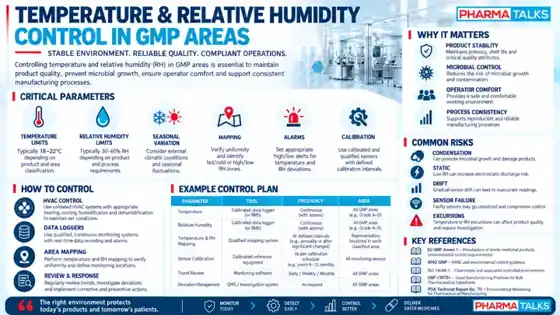
Why Temperature and RH Matter
Temperature can affect material properties, process kinetics, equipment behavior, stability and operator comfort. RH can influence hygroscopic materials, powder flow, static charge, microbial growth potential and condensation. In sterile areas, these parameters are also part of the qualified room condition even though Annex 1 does not prescribe a single numeric setpoint. WHO HVAC guidance similarly states that temperature and RH should be appropriate and should not adversely affect product quality or instrument performance. The practical requirement is control within justified, approved operating ranges.
Technical Comparison
| Parameter | Primary quality concern | Typical monitoring | Common risk |
|---|---|---|---|
| Temperature | Product/process stability and equipment performance | Calibrated probe / data logger / BMS | Hot/cold spots or prolonged excursion |
| Relative humidity | Moisture uptake, static, condensation | Calibrated RH sensor / BMS | High-RH microbial/condensation risk or low-RH electrostatics |
| Dew point | Condensation margin | Calculated or dedicated sensor | Surface condensation |
| Room-to-room profile | Uniformity and zoning | Mapping study | Unrepresentative fixed sensor |
Monitoring and Mapping Strategy
Use calibrated sensors connected to a building or environmental monitoring system where continuous oversight is justified. Mapping studies help locate hot, cold, high-RH or low-RH zones and determine representative routine sensor locations. Mapping should consider room geometry, supply and return air, equipment heat loads, doorways, occupancy and seasonal extremes. Significant changes—such as HVAC modifications, room reconfiguration or new heat-generating equipment—should trigger assessment of mapping or requalification needs.
Procedure and Parameters
| Activity | Parameter | When | Output |
|---|---|---|---|
| Initial mapping | Temperature/RH distribution | Qualification or commissioning | Representative sensor locations |
| Routine monitoring | Actual T/RH values | Continuous or justified periodic | Trend and alarms |
| Calibration | Sensor accuracy | Approved interval | Calibration record |
| Review | Seasonal and excursion patterns | Periodic | Trend report / CAPA input |
Alarm and Excursion Management
Set alert and action thresholds around the approved operating range so the team can respond before a critical exposure develops. Alarm delays should be justified to avoid masking meaningful events. An excursion investigation should evaluate magnitude, duration, affected area, product exposure, material sensitivity, concurrent HVAC alarms, sensor status and historical trends. A single out-of-range reading should not automatically be treated as a product failure, but neither should it be dismissed without documented assessment.
Acceptance Criteria
| Item | Regulatory position | Site action | Source |
|---|---|---|---|
| Temperature range | No universal Annex 1 range | Define from product/process and qualification needs | WHO HVAC / site validation |
| RH range | No universal Annex 1 range | Define based on material/process/condensation/static risks | WHO HVAC / site validation |
| Sensor accuracy | Must be suitable for intended use | Specify and calibrate through metrology program | Site quality system |
| Excursion duration | Not universally fixed | Assess duration plus product sensitivity and exposure | QRM / stability knowledge |
GMP Documentation Requirements
Controlled records should identify the sensor, location, calibration status, data acquisition interval, approved limits, alarm logic, maintenance and response procedure. Trend reports should detect seasonal drift, recurring excursions and sensor-to-sensor disagreement. Changes to limits must be managed through change control and supported by process, stability, engineering or validation evidence. Avoid copying “typical” temperature or RH ranges from training material into site specifications without product-specific justification.
Troubleshooting and CAPA
| Problem | Possible cause | Investigation | Corrective action | Preventive action |
|---|---|---|---|---|
| Recurring high RH | Dehumidification capacity or infiltration | Review AHU, doors, weather and load | Restore HVAC capacity | Seasonal capacity review |
| Local hot spot | Equipment heat load or poor air distribution | Map area and correlate with equipment operation | Rebalance airflow or relocate sensor/equipment | Heat-load assessment in change control |
| Sensor disagreement | Calibration drift or poor placement | Cross-check against reference and mapping | Recalibrate/replace sensor | Improve sensor lifecycle controls |
GMP Documentation Requirements
Document the approved monitoring or control strategy, responsible functions, equipment and calibration status, applicable methods, sampling or measurement locations, limits, alarm logic, data-review frequency, deviation workflow, CAPA linkage and change-control triggers. Records should permit an independent reviewer to reconstruct the event and understand why the final quality decision was made. Where regulatory guidance provides a numeric limit, apply it only within the stated scope; where no universal limit exists, use product/process knowledge, qualification and risk management to establish the site-specific criterion.
Related Pharmatalks Resources
Related articles in this series
Frequently Asked Questions
Does EU GMP Annex 1 require 18–22°C?
No. The current Annex 1 does not set a universal 18–22°C requirement. Temperature should be appropriate for the product, process and qualified facility.
Is 40–60% RH always a GMP requirement?
No. It is commonly used in some facilities, but it is not a universal GMP acceptance criterion. The site must justify its range.
Why perform temperature and RH mapping?
Mapping demonstrates spatial uniformity and helps locate representative routine sensors and worst-case zones.
Should alarms be immediate?
Alarm logic should be risk-based. Delays may be used only when justified so that nuisance alarms are controlled without masking significant events.
What should be assessed during an excursion?
Magnitude, duration, location, product sensitivity, process stage, sensor validity, HVAC status and historical trend.
When should remapping be considered?
After significant HVAC, layout, load or equipment changes, or when trends suggest the existing map no longer represents actual conditions.
Conclusion
Temperature and RH Control in GMP Areas should be managed as part of a connected pharmaceutical quality and contamination-control system. The practical objective is not simply to collect passing results: it is to establish scientifically justified controls, detect drift early, investigate credible signals, protect product and patient, and use trend knowledge to continuously improve the program.
Official References
- EU GMP Annex 1 — Manufacture of Sterile Medicinal Products
- WHO TRS 1010 Annex 8 — HVAC systems for non-sterile pharmaceutical products
- ICH Q9(R1) — Quality Risk Management