CAPA for Environmental Monitoring Excursions
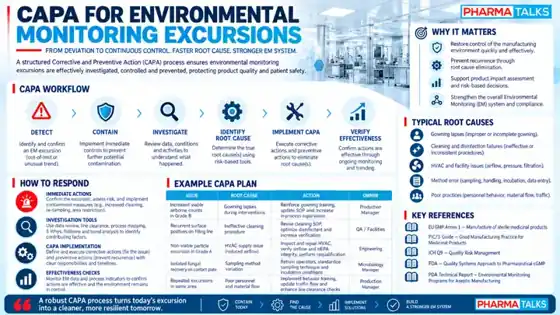
Corrective and Preventive Action (CAPA) for an environmental monitoring excursion should restore control, protect potentially affected product and reduce the probability of recurrence. CAPA starts only after the event has been properly confirmed, contained and investigated. EU GMP Annex 1 expects action-limit excursions to trigger root-cause investigation, assessment of potential product impact and corrective/preventive actions. ICH Q9(R1) provides the quality-risk framework for making proportionate decisions. Effective CAPA therefore connects evidence, risk, root cause, implementation and verification rather than treating retraining or resampling as automatic solutions.
Contain and Define the Event
First confirm the result and preserve the original evidence. Identify the room, time, sample, organism or particle trace, instrument, operator, process stage and potentially affected batch or material. Apply proportionate containment—such as process hold, restricted access, enhanced cleaning or additional monitoring—without destroying evidence needed for investigation. Determine whether related rooms, shifts or batches may share the same exposure window.
Technical Comparison
| CAPA element | Purpose | Good evidence | Weak practice |
|---|---|---|---|
| Containment | Protect process/product now | Documented hold, restriction or control | Immediate cleaning without preserving evidence |
| Root cause | Explain why event occurred | Fact-based causal chain | “Operator error” without system analysis |
| Corrective action | Fix current cause | Repair/revise/restore control | Resampling only |
| Preventive action | Reduce recurrence | Systemic design/process improvement | Generic reminder email |
Root Cause and Product Impact
Use process reconstruction before selecting a root-cause tool. Build a timeline from EM, BMS/EMS, interventions, cleaning, maintenance, material movement and personnel records. Methods such as 5 Whys or fishbone diagrams are useful only when based on verified facts. Product-impact assessment should consider exposure, process barriers, duration, organism characteristics, location and the state of aseptic control. A passing finished-product test should not be used to erase evidence of a serious process-control failure.
Procedure and Parameters
| Stage | Key question | Required data | Output |
|---|---|---|---|
| Confirm/contain | Is the event real and what is at risk? | Raw EM, method/instrument status | Defined event and containment |
| Investigate | Why did it happen? | Timeline, BMS, cleaning, interventions | Root cause/contributors |
| Assess impact | Could product quality be affected? | Exposure and barrier evidence | Documented risk decision |
| Implement/verify | Did actions restore control? | CAPA evidence and trend data | Effectiveness conclusion |
Corrective and Preventive Actions
Corrective actions remove or control the identified cause of the current event; preventive actions strengthen the system against recurrence. Actions can involve HVAC repair, cleaning/disinfection revision, intervention redesign, training/requalification, maintenance changes, sampling-plan updates or facility modification. Avoid weak CAPAs such as “retrain operator” unless the investigation demonstrates a genuine competency gap. Every action should have an owner, due date, acceptance evidence and change-control link where applicable.
Acceptance Criteria
| Decision point | Criterion basis | Example of acceptable evidence | Source |
|---|---|---|---|
| CAPA required | Action limit or significant adverse trend | Documented investigation and risk assessment | EU GMP Annex 1 |
| Risk control | Risk reduced to acceptable level | Defined controls with rationale | ICH Q9(R1) |
| Effectiveness | Predetermined success criterion met | Sustained trend or requalification evidence | Site PQS / QRM |
| Closure | All actions and impact decisions complete | Quality approval and traceable records | Site PQS / GMP documentation |
Effectiveness Checks and Closure
CAPA is not complete when actions are implemented. Define an effectiveness check that can show the problem has been controlled—for example a defined period without recurrence, improved trend, successful requalification, verified airflow performance or sustained personnel-monitoring improvement. The monitoring window should be long enough to observe the failure mode. If effectiveness is not demonstrated, reopen the risk assessment and investigate why the chosen actions did not control the real cause.
Troubleshooting and CAPA
| Problem | Possible cause | Investigation | Corrective action | Preventive action |
|---|---|---|---|---|
| CAPA recurs | Root cause not identified | Compare repeated events and prior assumptions | Reopen investigation | Strengthen causal analysis and effectiveness criteria |
| Only retraining assigned | System design/procedure issue missed | Observe work and review ergonomics/process | Fix system condition | Human-factors review in CAPA |
| No measurable effectiveness | Vague closure criterion | Review CAPA plan and trend window | Define measurable check | Require effectiveness criteria at approval |
GMP Documentation Requirements
Document the approved monitoring or control strategy, responsible functions, equipment and calibration status, applicable methods, sampling or measurement locations, limits, alarm logic, data-review frequency, deviation workflow, CAPA linkage and change-control triggers. Records should permit an independent reviewer to reconstruct the event and understand why the final quality decision was made. Where regulatory guidance provides a numeric limit, apply it only within the stated scope; where no universal limit exists, use product/process knowledge, qualification and risk management to establish the site-specific criterion.
Related Pharmatalks Resources
Related articles in this series
Frequently Asked Questions
What is the first step after an EM action-limit excursion?
Confirm the event, protect the process and define containment while preserving the evidence needed for investigation.
Is resampling a CAPA?
No. Resampling may provide additional information, but it does not correct the cause of the original event.
Is retraining always an acceptable corrective action?
Only when evidence shows a real knowledge or competency gap. System or design causes require system-level action.
How should product impact be assessed?
Use process exposure, contamination barriers, duration, location, organism or particle characteristics and related process data.
What makes an effectiveness check meaningful?
It has a predefined success criterion, adequate observation period and data directly linked to the original failure mode.
When should a CAPA be reopened?
When effectiveness is not demonstrated, recurrence occurs, or new evidence shows that the original root cause or impact assessment was incomplete.
Conclusion
CAPA for Environmental Monitoring Excursions should be managed as part of a connected pharmaceutical quality and contamination-control system. The practical objective is not simply to collect passing results: it is to establish scientifically justified controls, detect drift early, investigate credible signals, protect product and patient, and use trend knowledge to continuously improve the program.
Official References
- EU GMP Annex 1 — Manufacture of Sterile Medicinal Products
- ICH Q9(R1) — Quality Risk Management
- FDA — Sterile Drug Products Produced by Aseptic Processing — CGMP
- PIC/S GMP Guide — Annexes / Annex 1