Differential Pressure Monitoring in Cleanrooms
Differential pressure is a core engineering control used to maintain the intended direction of airflow between adjacent pharmaceutical spaces. In sterile manufacturing, EU GMP Annex 1 states that adjacent rooms of different grades should have an air pressure difference of at least 10 Pa as a guidance value, while recognizing that containment needs may require a different pressure concept. The critical GMP requirement is not simply a number: the pressure cascade, airflow direction, alarm strategy and response procedure must be justified within the contamination control strategy and demonstrated under operational conditions.
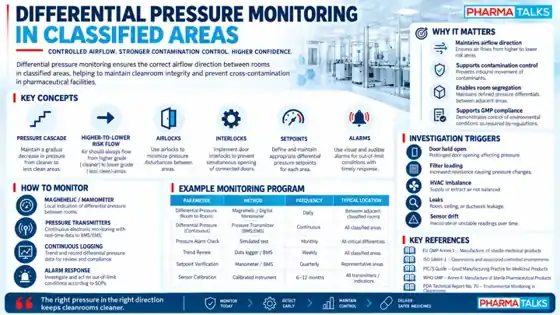
Pressure Cascades and Airflow Direction
A positive pressure cascade normally protects cleaner rooms by directing air toward areas of lower cleanliness. Negative pressure concepts may be needed for hazardous or biologically active materials, but then the source and quality of replacement air must be controlled. Pressure alone does not prove good airflow; airflow visualization should confirm that air does not travel from lower-grade areas or contamination sources into critical zones. Door openings, airlocks and pass-through hatches must be considered because they can temporarily disturb the cascade.
Technical Comparison
| Pressure concept | Typical use | Airflow intent | Key risk |
|---|---|---|---|
| Positive cascade | Sterile/cleaner protection | Cleaner to less-clean | Loss of product protection |
| Negative cascade | Hazard containment | Into contained room | Ingress must still be controlled |
| Airlock differential | Personnel/material transition | Maintain segregation | Simultaneous door opening |
| Filter differential | HEPA/prefilter condition | Indicates loading/resistance | Misread as room pressure if confused |
Monitoring, Alarms and Instrumentation
Critical pressure differentials should be continuously monitored and recorded according to Annex 1, with a warning system that alerts operators to air-supply failure or reduction below defined limits. Typical instruments include differential-pressure transmitters connected to the BMS/EMS and local magnehelic or digital indicators. Instrument range, accuracy, location, tubing configuration, zero checks and calibration must be suitable for the intended differential. Alarm delays and deadbands should be assessed and justified rather than configured only to reduce nuisance alarms.
Procedure and Parameters
| Step | Parameter | Method | Evidence |
|---|---|---|---|
| Qualification | Room-to-room differential | Calibrated pressure instrument | Qualification report |
| Routine | Critical differential | Continuous transmitter/BMS | Trend and alarms |
| Verification | Airflow direction | Smoke/visualization study | Video and report |
| Maintenance | Sensor and HVAC condition | Calibration/PM | Calibration and PM record |
Investigation of Pressure Excursions
Investigate the complete pressure event: magnitude, duration, affected rooms, door status, AHU operation, fan speed, filter loading, damper position, maintenance activities and sensor calibration. Correlate the event with particle and microbial monitoring, critical processing and open product exposure. A brief transient associated with a qualified door opening may have a different risk profile from sustained loss of cascade during aseptic exposure. The investigation should document product impact and any required additional monitoring or batch controls.
Acceptance Criteria
| Item | Criterion | Status | Source |
|---|---|---|---|
| Different-grade adjacent rooms | Minimum 10 Pa pressure difference — guidance value | Official guidance for sterile cleanrooms; may be modified for containment | EU GMP Annex 1 §4.14 |
| Critical differential monitoring | Continuous monitoring and recording | Expected where differential is identified as critical | EU GMP Annex 1 §4.16 |
| Alarm delay | Site-defined and justified | No universal time value | CCS / QRM |
| Containment rooms | May require modified pressure concept | Risk- and hazard-dependent | EU GMP Annex 1 / site EHS-GMP design |
Lifecycle Control and Documentation
The CCS should identify critical differentials, setpoints, alarm limits and response actions. Qualification should include pressure difference measurement and airflow visualization, and change control should assess modifications to doors, airlocks, AHUs, filters and room use. Trend review can reveal gradual filter loading, balancing drift or recurring operator-related disturbances. Preventive maintenance should address the HVAC and the monitoring loop, because a stable display is not reliable if the transmitter itself is drifting.
Troubleshooting and CAPA
| Problem | Possible cause | Investigation | Corrective action | Preventive action |
|---|---|---|---|---|
| Low room differential | Door open, fan issue, damper drift | Review BMS, doors, fan/damper status | Restore balance and control | Door discipline and HVAC PM |
| Slow pressure recovery | Filter loading or insufficient air volume | Trend filter DP and airflow | Replace filter/rebalance | Capacity and filter lifecycle review |
| False alarm | Sensor drift or tubing issue | Reference check and inspection | Recalibrate/repair loop | Metrology and tubing inspection plan |
GMP Documentation Requirements
Document the approved monitoring or control strategy, responsible functions, equipment and calibration status, applicable methods, sampling or measurement locations, limits, alarm logic, data-review frequency, deviation workflow, CAPA linkage and change-control triggers. Records should permit an independent reviewer to reconstruct the event and understand why the final quality decision was made. Where regulatory guidance provides a numeric limit, apply it only within the stated scope; where no universal limit exists, use product/process knowledge, qualification and risk management to establish the site-specific criterion.
Related Pharmatalks Resources
Related articles in this series
Frequently Asked Questions
Is 10 Pa an absolute requirement for every pharmaceutical room?
No. Annex 1 gives 10 Pa between adjacent rooms of different grades as a guidance value. Containment and process needs can justify a different pressure concept.
Should pressure be continuously monitored?
Annex 1 expects continuous monitoring and recording for pressure differentials identified as critical.
Can pressure readings replace smoke studies?
No. Pressure indicates a driving force; airflow visualization demonstrates the actual direction and pattern of air movement.
What is a pressure cascade?
A planned sequence of pressure relationships that directs airflow in a way that supports cleanliness or containment objectives.
Why do door openings matter?
Open doors can temporarily collapse or reverse a differential and change the contamination pathway.
What should be trended?
Actual differential, alarm frequency/duration, recovery time, filter loading, door events and correlated environmental monitoring results.
Conclusion
Differential Pressure Monitoring in Cleanrooms should be managed as part of a connected pharmaceutical quality and contamination-control system. The practical objective is not simply to collect passing results: it is to establish scientifically justified controls, detect drift early, investigate credible signals, protect product and patient, and use trend knowledge to continuously improve the program.
Official References
- EU GMP Annex 1 — Manufacture of Sterile Medicinal Products
- WHO TRS 1010 Annex 8 — HVAC systems for non-sterile pharmaceutical products
- ICH Q9(R1) — Quality Risk Management