Non-Viable Particle Monitoring in Cleanrooms
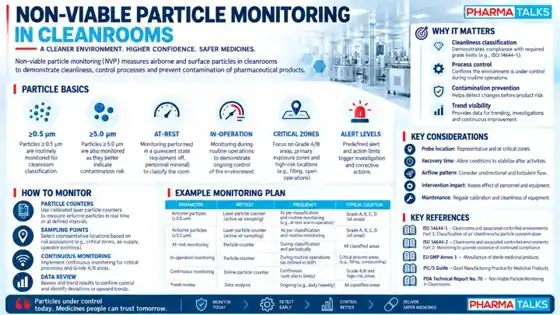
Non-viable particle monitoring measures airborne particle concentrations to demonstrate cleanroom performance and detect deterioration of contamination control. For sterile manufacturing, EU GMP Annex 1 provides maximum monitoring limits for ≥0.5 µm and ≥5 µm particles by grade and operational state. ISO 14644-1 supports classification by particle concentration, while ISO 14644-2 addresses monitoring plans that provide continuing evidence of cleanroom performance. Routine monitoring should be risk-based, linked to qualification and focused on locations and operations where particulate contamination could signal a threat to sterile processing.
Classification Versus Routine Monitoring
Classification is a formal demonstration of air cleanliness against a specified class at defined locations and states. Routine monitoring is a continuing activity intended to detect operational drift. A room can have passed classification yet later develop adverse trends caused by interventions, equipment, filter deterioration or airflow changes. Monitoring locations should therefore reflect critical processing, not merely the locations used during classification. For Grade A, Annex 1 expects particle monitoring for the full duration of critical processing, including equipment assembly.
Technical Comparison
| Particle size | Why monitored | Typical significance | Method |
|---|---|---|---|
| ≥0.5 µm | Primary classification/monitoring size | General airborne particulate cleanliness | LSAPC |
| ≥5 µm | Larger-particle signal in sterile areas | May indicate practices, equipment or filtration issues | LSAPC |
| Ultrafine <0.1 µm | Outside ISO 14644-1 scope | Specialized applications | Separate approach |
| Surface particles | Not the same as airborne classification | May support specific investigations | Surface-specific methods |
Particle Counter Setup and Sampling
Light-scattering airborne particle counters are the standard technology used for ISO classification and pharmaceutical monitoring. The sampling probe should be positioned and oriented to obtain representative data without interfering with aseptic operations. Tubing length and bends can affect transport of larger particles; the configuration should be understood and qualified. Annex 1 specifies a suitable Grade A sample flow of at least 28 L/min (1 ft³/min) and continuous monitoring of particles ≥0.5 and ≥5 µm so interventions and transient events can be captured.
Procedure and Parameters
| Step | Parameter | Critical point | Evidence |
|---|---|---|---|
| Select location | Risk to exposed product | Critical zone representation | Sampling rationale |
| Configure counter | Flow, tubing, probe | Qualified transport and placement | Method setup record |
| Monitor | Counts by size/time | Capture interventions and transients | Electronic raw data |
| Review | Alerts/actions/trends | Correlate with operations | Trend/investigation report |
Limits, Alerts and Trending
Annex 1 Table 5 provides maximum permitted total particle concentrations for routine monitoring. Alert levels are different: they are site-defined early-warning thresholds based on qualification and trend data. Trend review should detect increasing alerts, consecutive alerts or recurring events after specific activities. An isolated low-level ≥5 µm event in Grade A can sometimes be caused by electronic noise or coincidence, but repeated or regular counts should be investigated because they may indicate filter, equipment or practice problems.
Acceptance Criteria
| Grade | ≥0.5 µm/m³ at rest / in operation | ≥5 µm/m³ at rest / in operation | Source |
|---|---|---|---|
| A | 3,520 / 3,520 | 29 / 29 | EU GMP Annex 1 Table 5 |
| B | 3,520 / 352,000 | 29 / 2,930 | EU GMP Annex 1 Table 5 |
| C | 352,000 / 3,520,000 | 2,930 / 29,300 | EU GMP Annex 1 Table 5 |
| D | 3,520,000 / site-defined in operation | 29,300 / site-defined in operation | EU GMP Annex 1 Table 5 |
Investigation and Data Integrity
When a particle excursion occurs, preserve the time-resolved data and correlate it with interventions, machine events, doors, airflow alarms and personnel activity. Verify counter status, calibration, sampling flow and probe configuration before concluding that the result is a process event. Evaluate product exposure and the duration of the abnormal condition. Do not “average away” short peaks that may correspond to a critical intervention. The investigation should explain the event and define CAPA or monitoring changes where needed.
Troubleshooting and CAPA
| Problem | Possible cause | Investigation | Corrective action | Preventive action |
|---|---|---|---|---|
| Short particle spike | Intervention or door event | Align timestamp with video/event log | Control activity if unjustified | Procedure/intervention optimization |
| Recurring ≥5 µm counts | Sampling artifact, filter or practice issue | Check counter, tubing, HVAC and activity pattern | Repair/correct identified cause | Trend by event type |
| Rising baseline | Filter loading or room deterioration | Review HVAC and historical data | Restore room performance | PM and periodic monitoring-plan review |
GMP Documentation Requirements
Document the approved monitoring or control strategy, responsible functions, equipment and calibration status, applicable methods, sampling or measurement locations, limits, alarm logic, data-review frequency, deviation workflow, CAPA linkage and change-control triggers. Records should permit an independent reviewer to reconstruct the event and understand why the final quality decision was made. Where regulatory guidance provides a numeric limit, apply it only within the stated scope; where no universal limit exists, use product/process knowledge, qualification and risk management to establish the site-specific criterion.
Related Pharmatalks Resources
Related articles in this series
Frequently Asked Questions
What sizes are routinely monitored under Annex 1?
For sterile graded areas, Annex 1 Table 5 uses particles ≥0.5 µm and ≥5 µm for routine monitoring limits.
Must Grade A be monitored continuously?
Yes. Annex 1 expects continuous Grade A particle monitoring during the full duration of critical processing, including equipment assembly.
Is the Grade A sample flow specified?
Annex 1 states a suitable sample flow of at least 28 L/min (1 ft³/min).
Are alert levels the same as Table 5 limits?
No. Alert levels are site-defined early-warning thresholds based on qualification and trend data.
Why investigate repeated ≥5 µm counts in Grade A?
Repeated or regular counts may indicate filtration, equipment or operational practice problems even when occasional counts could be instrument-related.
Does ISO 14644-1 cover viable microorganisms?
No. It classifies air cleanliness by particle concentration and does not characterize the viable nature of particles.
Conclusion
Non-Viable Particle Monitoring in Cleanrooms should be managed as part of a connected pharmaceutical quality and contamination-control system. The practical objective is not simply to collect passing results: it is to establish scientifically justified controls, detect drift early, investigate credible signals, protect product and patient, and use trend knowledge to continuously improve the program.
Official References
- EU GMP Annex 1 — Manufacture of Sterile Medicinal Products
- ISO 14644-1:2015 — Classification by particle concentration
- ISO 14644-2:2015 — Monitoring cleanroom performance
- FDA — Sterile Drug Products Produced by Aseptic Processing — CGMP