Microbiological Air Monitoring in Aseptic Areas
Microbiological air monitoring is used to detect recoverable viable contamination in controlled environments and to provide evidence about the microbiological state of aseptic processing areas. It complements non-viable particle monitoring; the two data streams answer different questions. EU GMP Annex 1 expects risk-based viable monitoring throughout critical stages and provides maximum action limits for graded sterile areas. USP <1116> provides additional information and recommendations for microbiological control of aseptic processing environments. Results should be interpreted as part of a broader contamination-control system rather than as a standalone sterility test for the batch.
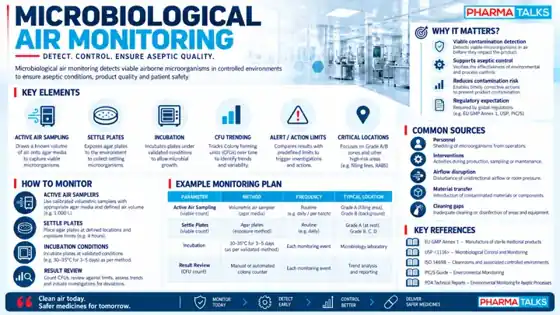
Active Air Sampling and Settle Plates
Active air samplers draw a known volume of air onto or through suitable growth media and provide a quantitative CFU/m³ result. Settle plates are passive and collect microorganisms that settle onto an exposed agar surface over time. They provide different information and have different recovery characteristics. Annex 1 allows a range of methods provided they deliver meaningful information across the critical process. Sampling equipment, media, exposure duration and placement must be chosen so the monitoring itself does not create contamination risk.
Technical Comparison
| Method | Output | Strength | Limitation |
|---|---|---|---|
| Active air sampler | CFU/m³ | Known sampled volume | Equipment can disturb airflow if poorly placed |
| Settle plate | CFU per exposure period | Simple passive deposition signal | Not volumetric |
| Rapid microbial method | Technology-specific signal | Potential faster detection | Requires validation/equivalence justification |
| Non-viable counter | Particles/m³ | Real-time particle data | Does not identify viable microorganisms |
Incubation and Method Suitability
The method should demonstrate appropriate recovery for the expected environmental flora. Media suitability, growth promotion, incubation conditions, neutralizers where applicable and sampler recovery should be controlled. Annex 1 requires sampling methods and equipment to be fully understood and supporting data for recovery efficiency to be available. Alternative or rapid microbiological methods may be used after validation demonstrates equivalence or superiority to the established method. Incubation conditions should be scientifically justified and defined in the program.
Procedure and Parameters
| Step | Parameter | Control | Record |
|---|---|---|---|
| Prepare | Media and sampler status | Released media; calibrated/qualified sampler | Pre-use check |
| Sample | Location, volume or duration | Risk-based placement | Sample record |
| Incubate | Time/temperature sequence | Validated procedure | Incubator log |
| Review | Count and identification | Limits plus trend context | EM result/trend report |
Action Limits and Interpretation
Annex 1 Table 6 sets maximum viable action limits: Grade A requires no growth and any recovery should trigger investigation; Grades B, C and D have defined limits for air samples and other methods. These are action limits, not a substitute for trend analysis. A recurring organism or shift in flora may be significant even below the numeric action limit. Identification depth should be risk-based, with particular attention to objectionable, spore-forming or difficult-to-control organisms.
Acceptance Criteria
| Grade | Air sample CFU/m³ | Settle plate CFU/4 h | Source |
|---|---|---|---|
| A | No growth | No growth | EU GMP Annex 1 Table 6 |
| B | 10 | 5 | EU GMP Annex 1 Table 6 |
| C | 100 | 50 | EU GMP Annex 1 Table 6 |
| D | 200 | 100 | EU GMP Annex 1 Table 6 |
Investigation and Trending
When a viable result is atypical, evaluate sampler performance, media, incubation, operator technique, room activities, cleaning, disinfectants, interventions, material transfer and concurrent EM/HVAC data. Map organism identity and location across time to determine whether the pattern is local or systemic. Product impact depends on process stage, exposure, organism characteristics and control barriers. CAPA may include cleaning changes, training, airflow or transfer improvements, increased monitoring or broader CCS revision.
Troubleshooting and CAPA
| Problem | Possible cause | Investigation | Corrective action | Preventive action |
|---|---|---|---|---|
| Single Grade A recovery | Intervention, operator or material contamination | Identify organism; reconstruct critical activity | Contain and investigate product/process impact | Targeted aseptic-practice control |
| Recurring mold | Facility/moisture or cleaning weakness | Map locations; inspect HVAC/building envelope | Remediate source and clean | Moisture/maintenance surveillance |
| High background counts | Sampling, cleaning or airflow issue | Compare methods, rooms and shifts | Correct method or environmental cause | Program trend review and periodic requalification |
GMP Documentation Requirements
Document the approved monitoring or control strategy, responsible functions, equipment and calibration status, applicable methods, sampling or measurement locations, limits, alarm logic, data-review frequency, deviation workflow, CAPA linkage and change-control triggers. Records should permit an independent reviewer to reconstruct the event and understand why the final quality decision was made. Where regulatory guidance provides a numeric limit, apply it only within the stated scope; where no universal limit exists, use product/process knowledge, qualification and risk management to establish the site-specific criterion.
Related Pharmatalks Resources
Related articles in this series
Frequently Asked Questions
Is any microbial growth acceptable in Grade A?
Annex 1 states that any growth in Grade A should result in an investigation.
Are settle plates equivalent to active air sampling?
No. They measure different aspects of airborne contamination and have different recovery characteristics.
Can rapid microbial methods be used?
Yes, after suitable validation demonstrates equivalence or superiority to the established method and the limits/interpretation are scientifically justified.
Should every isolate be identified to species?
Identification depth should be risk-based. Greater characterization is expected for critical areas, unusual organisms, adverse trends or investigation needs.
Do passing viable counts prove batch sterility?
No. EM is indirect evidence of environmental control and must be combined with the full sterility-assurance system.
What makes a trend significant?
Recurrence, location clustering, changes in flora, increasing counts, relationship to interventions and product-risk context can all make a trend significant.
Conclusion
Microbiological Air Monitoring in Aseptic Areas should be managed as part of a connected pharmaceutical quality and contamination-control system. The practical objective is not simply to collect passing results: it is to establish scientifically justified controls, detect drift early, investigate credible signals, protect product and patient, and use trend knowledge to continuously improve the program.
Official References
- EU GMP Annex 1 — Manufacture of Sterile Medicinal Products
- USP <1116> — Microbiological Control and Monitoring of Aseptic Processing Environments
- PIC/S GMP Guide — Annexes / Annex 1
- FDA — Sterile Drug Products Produced by Aseptic Processing — CGMP