Surface Monitoring with Contact Plates and Swabs
Surface monitoring evaluates recoverable microbiological contamination on room, equipment, gown and other relevant surfaces. Contact plates are efficient for flat accessible areas, while swabs are useful for irregular, recessed or difficult-to-contact surfaces. In sterile manufacturing, surface monitoring supports assessment of cleaning, disinfection, material transfer and personnel practices. EU GMP Annex 1 Table 6 provides maximum action limits for contact plates in Grades A–D, with specific applicability notes for equipment, room and gown surfaces. Sampling should be risk-based and designed so it does not compromise the aseptic process.
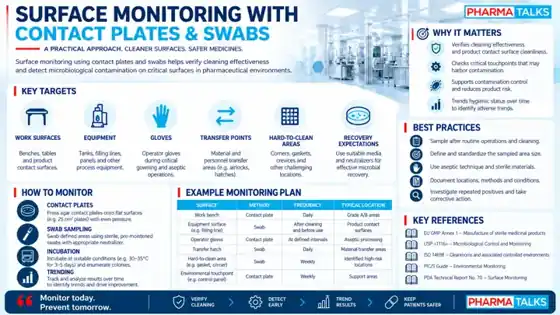
Selecting Contact Plates or Swabs
Contact plates provide a standardized sampled area and direct recovery onto agar, making them practical for smooth flat surfaces. Swabs are more flexible but recovery depends strongly on swab material, wetting solution, neutralizer, technique and the defined sampled area. The method should be qualified or scientifically supported for the intended surface. If disinfectant residues are expected, the recovery system should include suitable neutralizers so residual antimicrobial activity does not create falsely low results.
Technical Comparison
| Method | Best suited to | Key variable | Main limitation |
|---|---|---|---|
| Contact plate | Flat accessible surfaces | Defined plate area and neutralizer | Poor fit on irregular geometry |
| Swab | Irregular/recessed surfaces | Sampled area and recovery technique | Higher operator variability |
| Rinse method | Small components | Rinse volume/recovery | Not suitable for installed surfaces |
| Visual inspection | Gross cleanliness | Lighting/visibility | Does not measure microbiological contamination |
Where and When to Sample
Prioritize product-contact-adjacent surfaces, work benches, equipment touchpoints, transfer hatches, gloves and locations identified by the CCS. Sampling timing matters: post-operation sampling can reveal contamination generated during the process, while sampling immediately after disinfection may only demonstrate residual disinfectant effect. For Grade A/B operations, the sampling plan should capture critical exposure without adding contamination risk. Locations and timing should be linked to interventions, cleaning and routine process flow.
Procedure and Parameters
| Step | Parameter | Control | Evidence |
|---|---|---|---|
| Plan | Location and timing | Risk-based sampling map | Approved EM plan |
| Collect | Area/pressure or swab strokes | Standardized technique | Sample record |
| Recover | Neutralizer/media | Method suitability | Media/method record |
| Interpret | CFU and organism | Limits plus trends | Trend/investigation |
Limits and Trend Interpretation
Annex 1 Table 6 gives maximum action limits for contact plates: Grade A requires no growth; Grade B 5 CFU/plate; Grade C 25; Grade D 50. These values do not eliminate the need for alert levels or trend analysis. A recurring recovery at the same equipment location, repeated detection of a particular organism or increasing frequency of low-level positives may indicate a cleaning or design problem even before the action limit is exceeded.
Acceptance Criteria
| Grade | Contact plate CFU/plate | Interpretation | Source |
|---|---|---|---|
| A | No growth | Any growth triggers investigation | EU GMP Annex 1 Table 6 |
| B | 5 | Maximum action limit | EU GMP Annex 1 Table 6 |
| C | 25 | Maximum action limit | EU GMP Annex 1 Table 6 |
| D | 50 | Maximum action limit | EU GMP Annex 1 Table 6 |
Investigation and CAPA
Investigate method performance as well as the environment. Confirm the sampled area, media, neutralizer, incubation and sampler technique. Review cleaning/disinfection records, disinfectant preparation, contact time, surface condition, maintenance, transfer events and operator interventions. Corrective actions may include targeted cleaning, repair of damaged surfaces, procedure changes or retraining. Preventive actions should address the system cause, such as hard-to-clean design or an ineffective transfer practice.
Troubleshooting and CAPA
| Problem | Possible cause | Investigation | Corrective action | Preventive action |
|---|---|---|---|---|
| Recurring same-site positive | Cleaning gap or damaged surface | Inspect design and cleaning coverage | Deep clean/repair | Redesign or revised cleaning method |
| Unexpected zero recovery | Residual disinfectant suppressing growth | Review neutralizer and timing | Correct method/media | Method-suitability study |
| Variable swab results | Technique or area inconsistency | Observe sampling and review training | Retrain and standardize | Competency qualification |
GMP Documentation Requirements
Document the approved monitoring or control strategy, responsible functions, equipment and calibration status, applicable methods, sampling or measurement locations, limits, alarm logic, data-review frequency, deviation workflow, CAPA linkage and change-control triggers. Records should permit an independent reviewer to reconstruct the event and understand why the final quality decision was made. Where regulatory guidance provides a numeric limit, apply it only within the stated scope; where no universal limit exists, use product/process knowledge, qualification and risk management to establish the site-specific criterion.
Related Pharmatalks Resources
Related articles in this series
Frequently Asked Questions
When should contact plates be used instead of swabs?
Use contact plates on suitable flat surfaces and swabs where geometry prevents consistent plate contact.
Does Annex 1 provide contact-plate limits?
Yes. Table 6 provides maximum action limits for sterile grades and notes their applicability to equipment, room and gown surfaces.
Why are neutralizers important?
They reduce carryover of disinfectant activity that could suppress microbial recovery and create misleadingly low results.
Should sampling be performed immediately after cleaning?
Timing should match the monitoring objective. Post-operation sampling often provides more information about contamination generated during processing.
What does repeated low-level recovery mean?
Recurrence can indicate an adverse trend even if each individual result is below the formal action limit.
Can a surface result be assessed without organism identification?
Sometimes, but identification is often important for critical areas, recurrent positives, unusual organisms and investigations.
Conclusion
Surface Monitoring with Contact Plates and Swabs should be managed as part of a connected pharmaceutical quality and contamination-control system. The practical objective is not simply to collect passing results: it is to establish scientifically justified controls, detect drift early, investigate credible signals, protect product and patient, and use trend knowledge to continuously improve the program.
Official References
- EU GMP Annex 1 — Manufacture of Sterile Medicinal Products
- USP <1116> — Microbiological Control and Monitoring of Aseptic Processing Environments
- PIC/S GMP Guide — Annexes / Annex 1