Personnel Monitoring in Classified Areas
People are a major contamination source in cleanrooms because skin, clothing and movement can release particles and microorganisms. Personnel monitoring provides evidence about gowning, aseptic behavior and the effectiveness of procedural controls. In sterile manufacturing, EU GMP Annex 1 requires personnel monitoring to be risk-based and integrated with the contamination control strategy. Glove prints, gown-surface samples and other monitoring should be timed so that results are meaningful without creating additional contamination risk, and recurring failures should feed directly into qualification, training and CAPA.
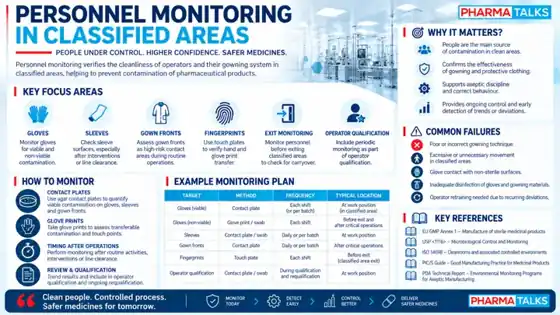
What Personnel Monitoring Evaluates
Monitoring can assess gloves, sleeves, gown fronts and other locations identified by process risk. Glove prints are particularly useful because hands are closely linked to interventions and transfer of contamination. Results should be associated with the operator, activity, location, shift and relevant intervention rather than stored as anonymous counts. This enables meaningful trending and helps distinguish individual competency issues from facility-wide or process-wide problems.
Technical Comparison
| Target | Method | What it assesses | Typical timing |
|---|---|---|---|
| Gloves | Contact plate / glove print | Hand contamination and intervention control | After interventions / exit |
| Sleeves | Contact plate | Contact with equipment or barriers | Risk-based |
| Gown front | Contact plate | Overall gown contamination | Exit / qualification |
| Behavior | Direct observation / video | Aseptic technique | Qualification and routine oversight |
Sampling Timing and Technique
Sampling may be performed after critical interventions, at defined intervals or on exit, depending on the process and CCS. Contact plates are commonly used for gloves and suitable gown surfaces. The technique should avoid spreading contamination or compromising the sterile area. The program should define what happens after sampling—for example, glove disinfection or replacement—so that sampling does not itself become a contamination pathway.
Procedure and Parameters
| Step | Parameter | Control | Evidence |
|---|---|---|---|
| Identify operator | Name/qualification status | Traceable assignment | Monitoring record |
| Sample | Defined body location | Standardized technique | Plate/sample ID |
| Incubate/read | Validated conditions | Media and incubator control | Result record |
| Trend | Operator/activity/location | Recurring pattern analysis | Competency/trend report |
Limits, Qualification and Trend Review
Annex 1 Table 6 sets a Grade B glove-print maximum action limit of 5 CFU per glove and requires no growth in Grade A; routine gown monitoring is not normally required for Grades C/D depending on function. Numeric limits alone are insufficient. Recurrent low-level recovery, repeated recovery of a specific organism or failures linked to particular interventions should trigger review. Personnel qualification should combine training, observed practice, gowning competency and monitoring performance.
Acceptance Criteria
| Area/target | Criterion | Applicability | Source |
|---|---|---|---|
| Grade A personnel sample | No growth | Any growth requires investigation in Grade A monitoring context | EU GMP Annex 1 Table 6 |
| Grade B glove print | 5 CFU/glove maximum action limit | 5 fingers on both hands per glove definition in table | EU GMP Annex 1 Table 6 |
| Grade C/D routine gown monitoring | Normally not required depending on function | Risk-based | EU GMP Annex 1 note |
| Qualification frequency | Site-defined within CCS/training system | Based on role, process and risk | Site quality system / Annex 1 principles |
Investigation and Corrective Actions
When a personnel result is adverse, assess the operator’s actions, glove disinfection, gowning sequence, intervention type, duration in the area, equipment contact and concurrent EM results. Avoid stopping at “operator error.” Determine whether procedures, ergonomics, equipment design or workflow made the behavior likely. CAPA can include retraining, requalification, changes to intervention technique, barrier improvements or process redesign. Effectiveness should be demonstrated through subsequent observations and monitoring data.
Troubleshooting and CAPA
| Problem | Possible cause | Investigation | Corrective action | Preventive action |
|---|---|---|---|---|
| Repeated glove positives | Poor disinfection or touch contamination | Observe intervention and contacts | Retrain/requalify | Improve intervention design |
| Gown-front recovery | Technique or contact with surfaces | Review gowning and movement | Correct gowning/process behavior | Ergonomic/workflow changes |
| Multiple operators affected | Systemic cleaning/material flow issue | Compare location and activity patterns | Address shared cause | CCS update and targeted monitoring |
GMP Documentation Requirements
Document the approved monitoring or control strategy, responsible functions, equipment and calibration status, applicable methods, sampling or measurement locations, limits, alarm logic, data-review frequency, deviation workflow, CAPA linkage and change-control triggers. Records should permit an independent reviewer to reconstruct the event and understand why the final quality decision was made. Where regulatory guidance provides a numeric limit, apply it only within the stated scope; where no universal limit exists, use product/process knowledge, qualification and risk management to establish the site-specific criterion.
Related Pharmatalks Resources
Related articles in this series
Frequently Asked Questions
Why is personnel monitoring important in aseptic processing?
Because operators are a major potential source of particulate and microbial contamination, especially during interventions.
What is the Grade B glove-print action limit in Annex 1?
Annex 1 Table 6 lists 5 CFU per glove as the maximum action limit for Grade B.
What happens if there is growth associated with Grade A?
Any Grade A growth should trigger an investigation.
Should personnel monitoring be anonymous?
No. Traceability to operator, activity and location is important for meaningful trend analysis and competency management.
Is retraining enough after a failure?
Not always. The investigation should determine whether the root cause is individual, procedural, ergonomic, equipment-related or systemic.
Should Grades C and D use routine gown monitoring?
Annex 1 notes that routine gown monitoring is not normally required for Grades C and D, depending on their function; sites should justify their approach.
Conclusion
Personnel Monitoring in Classified Areas should be managed as part of a connected pharmaceutical quality and contamination-control system. The practical objective is not simply to collect passing results: it is to establish scientifically justified controls, detect drift early, investigate credible signals, protect product and patient, and use trend knowledge to continuously improve the program.
Official References
- EU GMP Annex 1 — Manufacture of Sterile Medicinal Products
- USP <1116> — Microbiological Control and Monitoring of Aseptic Processing Environments
- FDA — Sterile Drug Products Produced by Aseptic Processing — CGMP