HVAC Performance and Air Change Rate Monitoring
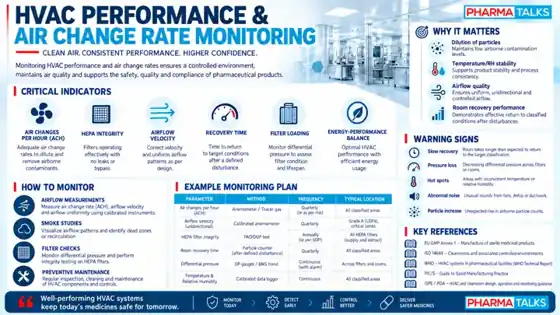
Pharmaceutical HVAC systems support contamination control by supplying filtered air, controlling airflow direction and pressure relationships, and maintaining suitable temperature and relative humidity. Air changes per hour (ACH) are useful, but they are only one indicator of performance. A compliant strategy evaluates the entire air-handling system: supply and extract volumes, HEPA integrity, airflow patterns, room recovery, pressure differentials, temperature/RH and the interaction between the room and the manufacturing process. Limits and test frequencies should be based on design, qualification, process risk and applicable GMP requirements.
ACH Is Not a Universal Acceptance Criterion
There is no single GMP air-change number that applies to every pharmaceutical room. Required ACH depends on heat and contamination loads, room size, air distribution, process, occupancy and cleanliness objective. A room with a high ACH can still perform poorly if supply air bypasses the critical zone or creates turbulent contamination paths. Conversely, an optimized system may achieve control at a lower ACH. Qualification should therefore demonstrate actual room performance rather than relying on a generic ACH target.
Technical Comparison
| HVAC indicator | What it demonstrates | Typical test | Limitation |
|---|---|---|---|
| ACH | Ventilation rate | Supply/extract airflow calculation | Does not prove good airflow pattern |
| HEPA integrity | Filter/seal leakage control | Aerosol challenge and scan | Does not prove room recovery alone |
| Recovery time | Dynamic room cleanup | Particle decay after disturbance | Depends on defined challenge/state |
| Airflow visualization | Actual airflow path | Smoke/visualization study | Qualitative unless combined with measurements |
Critical HVAC Performance Tests
Annex 1 cleanroom qualification includes, where relevant, filter integrity, airflow volume and velocity, pressure differences, airflow direction/visualization, microbial contamination, temperature, RH and recovery testing. HEPA integrity testing demonstrates that installed filters and seals do not leak beyond accepted method criteria. Airflow visualization shows whether the system protects critical zones. Recovery testing measures how quickly a disturbed room returns to its qualified particulate state.
Procedure and Parameters
| Stage | Parameter | Method | Output |
|---|---|---|---|
| Qualification | Air volume/velocity | Calibrated anemometer/balometer | Airflow test report |
| Qualification | HEPA integrity | Approved aerosol leak test | Integrity result |
| Qualification/routine | Pressure | Calibrated DP instrument/BMS | Pressure trend |
| Lifecycle | Recovery and EM performance | Particle counter + trend review | State-of-control evidence |
Monitoring and Maintenance
Critical operational parameters should be monitored at a frequency appropriate to risk; some, such as critical pressure differentials, may be continuous. Trend data from airflow, filter differential pressure, temperature, RH, particles and room recovery can identify gradual degradation. Preventive maintenance should be controlled so that work on filters, dampers, fans or sensors is assessed for requalification impact. Post-maintenance data should confirm the room is back in a qualified state before critical processing resumes.
Acceptance Criteria
| Item | Criterion basis | Regulatory position | Source |
|---|---|---|---|
| ACH | Design/qualification and process need | No universal GMP ACH number | WHO HVAC / site design |
| Pressure between different sterile grades | 10 Pa minimum guidance value | Guidance value; containment may modify concept | EU GMP Annex 1 |
| HEPA integrity | Qualified test method/site acceptance | Must demonstrate installed filter integrity where relevant | EU GMP Annex 1 qualification expectations |
| Temperature/RH | Product/process need | Appropriate, justified and controlled | WHO HVAC / Annex 1 qualification context |
Sterile Versus Non-Sterile Context
EU GMP Annex 1 is the primary sterile-manufacturing reference in this series. WHO TRS 1010 Annex 8 focuses on HVAC for non-sterile pharmaceutical products but provides useful lifecycle principles for design, qualification, management and maintenance. The applicable standard must match the product and regulatory context. Do not transfer sterile-grade particle or pressure expectations directly to non-sterile rooms without a process and contamination-risk rationale.
Troubleshooting and CAPA
| Problem | Possible cause | Investigation | Corrective action | Preventive action |
|---|---|---|---|---|
| Slow room recovery | Low airflow or poor mixing | Measure airflow and particle decay | Rebalance/repair system | Trend recovery after changes |
| Rising filter DP | Filter loading | Review trend and airflow | Replace filter as justified | Predictive filter maintenance |
| Unstable temperature/RH | Capacity or control-loop issue | Review AHU, valves, sensors, loads | Repair/tune controls | Seasonal capacity assessment |
GMP Documentation Requirements
Document the approved monitoring or control strategy, responsible functions, equipment and calibration status, applicable methods, sampling or measurement locations, limits, alarm logic, data-review frequency, deviation workflow, CAPA linkage and change-control triggers. Records should permit an independent reviewer to reconstruct the event and understand why the final quality decision was made. Where regulatory guidance provides a numeric limit, apply it only within the stated scope; where no universal limit exists, use product/process knowledge, qualification and risk management to establish the site-specific criterion.
Related Pharmatalks Resources
Related articles in this series
Frequently Asked Questions
What is the GMP-required air change rate?
There is no universal GMP ACH requirement for all pharmaceutical rooms. The required rate must be justified by design, qualification and process needs.
Does higher ACH always mean a cleaner room?
No. Air distribution, filtration, contamination sources and airflow pattern are equally important.
What HVAC tests are included in Annex 1 cleanroom qualification?
Where relevant: filter integrity, airflow volume/velocity, pressure difference, airflow visualization, microbial contamination, temperature, RH, recovery and containment leak testing.
Why perform airflow visualization?
To demonstrate that air does not move from lower-grade or contamination-generating locations into critical zones.
What does recovery time show?
How quickly a room returns to its qualified particulate condition after a defined disturbance.
When can maintenance trigger requalification?
When the work can affect qualified conditions—for example filter replacement, airflow rebalance, major control changes or room modification.
Conclusion
HVAC Performance and Air Change Rate Monitoring should be managed as part of a connected pharmaceutical quality and contamination-control system. The practical objective is not simply to collect passing results: it is to establish scientifically justified controls, detect drift early, investigate credible signals, protect product and patient, and use trend knowledge to continuously improve the program.
Official References
- EU GMP Annex 1 — Manufacture of Sterile Medicinal Products
- WHO TRS 1010 Annex 8 — HVAC systems for non-sterile pharmaceutical products
- ISO 14644-2:2015 — Monitoring cleanroom performance
- ICH Q9(R1) — Quality Risk Management