EM Alert and Action Limits: Trending and Investigation
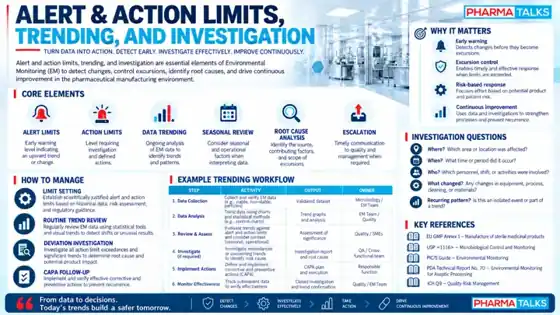
Alert levels, action limits and trend review turn environmental monitoring data into a quality decision system. EU GMP Annex 1 requires appropriate alert levels and action limits for viable and non-viable monitoring and explicitly describes adverse trend patterns that should be detected. Alert levels are early-warning tools, normally based on qualification and trend data. Action-limit excursions require a defined investigation, assessment of potential product impact and corrective/preventive action. A mature program also investigates recurring or worsening patterns that may remain numerically below formal action limits.
Alert Level Versus Action Limit
An alert level indicates drift from normal performance and should trigger increased attention, assessment or preventive action. It is usually site-defined and may evolve as more reliable historical data become available. An action limit represents a threshold at which immediate response and investigation are required. For sterile viable monitoring, Annex 1 provides maximum action limits in Table 6; for non-viable monitoring, Table 5 provides grade/state limits. Site limits may be more stringent when justified by the operation or CCS.
Technical Comparison
| Concept | Purpose | Typical trigger | Expected response |
|---|---|---|---|
| Alert level | Early warning | Site-defined drift threshold | Assess and increase attention |
| Action limit | Loss-of-control threshold | Regulatory/site action threshold | Investigate and assess product impact |
| Adverse trend | Pattern over time | Recurrence or deterioration | Trend investigation/CAPA as justified |
| Specification | Product/material requirement | Approved specification | Disposition under quality system |
What Counts as an Adverse Trend?
Annex 1 gives useful examples: increasing numbers of alert/action breaches, consecutive alert breaches, regular isolated action-limit events with a common cause, and changes in microbial flora or predominance of specific organisms. This means trend analysis should not be limited to monthly averages. Review the frequency, timing, location, organism, event type and relationship to maintenance, interventions, cleaning and HVAC behavior. Statistical tools can support interpretation but should not replace process understanding.
Procedure and Parameters
| Step | Question | Data sources | Output |
|---|---|---|---|
| Confirm | Is the result valid? | Raw data, calibration, method checks | Confirmed event |
| Scope | What operations/areas are affected? | Batch, room, time, activity | Impact boundary |
| Analyze | What changed? | BMS/EMS, cleaning, interventions, flora | Root-cause hypothesis |
| Act | How will control be restored? | Risk assessment and CAPA | Actions + effectiveness plan |
Investigation Workflow
Start by confirming the data and protecting the process. Verify instrument or method status, preserve raw data, define the time window and identify potentially affected operations. Reconstruct events from production records, interventions, BMS/EMS trends, cleaning, personnel and maintenance. Evaluate product impact based on exposure and contamination barriers. Root-cause analysis should separate direct cause, contributing conditions and systemic weaknesses. Corrective actions must address the event; preventive actions should reduce recurrence.
Acceptance Criteria
| Item | Basis | Interpretation | Source |
|---|---|---|---|
| Alert levels | Qualification and trend data | Site-defined; periodically reviewed | EU GMP Annex 1 §9.8–9.10 |
| Viable action limits | Annex 1 Table 6 | Maximum action limits by grade/method | EU GMP Annex 1 |
| Non-viable monitoring limits | Annex 1 Table 5 | Grade/state limits | EU GMP Annex 1 |
| More stringent site limits | Process/CCS risk | Permitted when justified | EU GMP Annex 1 risk-based approach |
Governance and Periodic Review
Trend reports should have defined owners, review frequency and escalation rules. Quality oversight is important because recurring low-level signals can become normalized if no one is responsible for cross-functional interpretation. Review alert levels periodically to ensure they remain sensitive enough to detect drift without generating meaningless noise. Significant EM trends should feed CAPA, CCS review, preventive maintenance, training and change control. Decisions should be documented with rationale, not only with “within limit” or “out of limit” labels.
Troubleshooting and CAPA
| Problem | Possible cause | Investigation | Corrective action | Preventive action |
|---|---|---|---|---|
| Repeated alerts below action limit | Gradual process/HVAC drift | Trend by location/time/event | Correct emerging cause | Adjust maintenance/control strategy |
| Recurring post-maintenance excursion | Maintenance contamination or recovery gap | Compare all events after PM | Improve post-PM controls | Qualification/release checklist |
| Flora shift | New source or cleaning weakness | Identify organisms and map locations | Target source and disinfect | CCS/flora surveillance update |
GMP Documentation Requirements
Document the approved monitoring or control strategy, responsible functions, equipment and calibration status, applicable methods, sampling or measurement locations, limits, alarm logic, data-review frequency, deviation workflow, CAPA linkage and change-control triggers. Records should permit an independent reviewer to reconstruct the event and understand why the final quality decision was made. Where regulatory guidance provides a numeric limit, apply it only within the stated scope; where no universal limit exists, use product/process knowledge, qualification and risk management to establish the site-specific criterion.
Related Pharmatalks Resources
Related articles in this series
Frequently Asked Questions
Must every alert-level excursion trigger a full deviation?
Not necessarily. The site procedure should define assessment and follow-up; repeated or significant alerts may warrant investigation or corrective action.
What must happen after an action-limit excursion?
Annex 1 expects root-cause investigation, product-impact assessment and corrective/preventive actions as appropriate.
Can a trend be adverse even when all results are below action limits?
Yes. Recurrence, consecutive alerts, rising frequency or flora changes can indicate deterioration.
How are alert levels set?
They should be based on qualification and/or historical trend data and periodically reviewed.
Can site limits be stricter than Annex 1?
Yes. Risk, process knowledge or historical performance may justify more stringent limits.
What data should be correlated during an EM investigation?
Environmental results, organism ID, production events, interventions, cleaning, maintenance, HVAC/BMS data, personnel and product exposure.
Conclusion
EM Alert and Action Limits: Trending and Investigation should be managed as part of a connected pharmaceutical quality and contamination-control system. The practical objective is not simply to collect passing results: it is to establish scientifically justified controls, detect drift early, investigate credible signals, protect product and patient, and use trend knowledge to continuously improve the program.
Official References
- EU GMP Annex 1 — Manufacture of Sterile Medicinal Products
- ICH Q9(R1) — Quality Risk Management
- PIC/S GMP Guide — Annexes / Annex 1
- FDA — Sterile Drug Products Produced by Aseptic Processing — CGMP