Problem Definition and Source
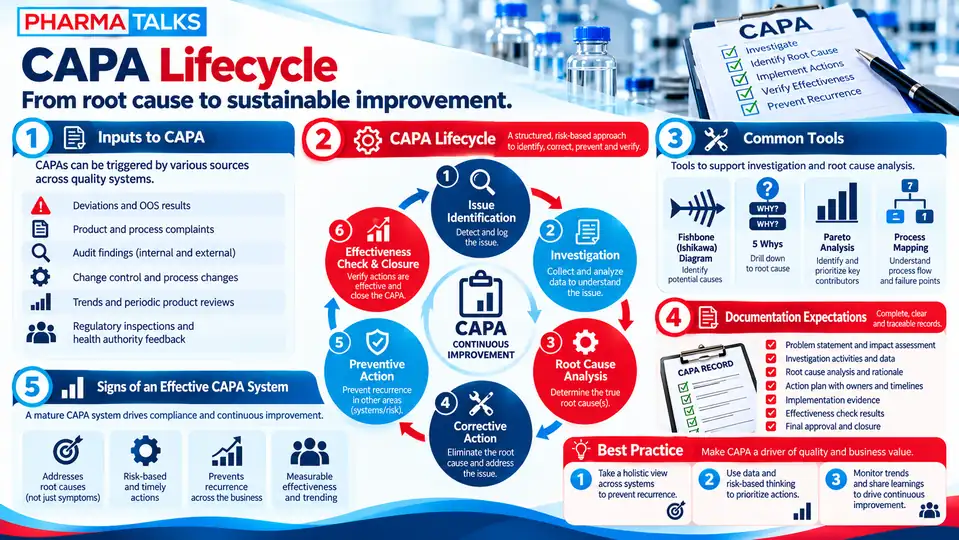
CAPA can originate from many sources, but the problem statement should remain specific and evidence-based. State the condition, scope, affected process or product, timing and known impact. Avoid embedding an assumed cause in the problem statement. “Operator failed to follow procedure” may be a hypothesis; the investigation still needs to determine why the failure occurred and whether system factors contributed.
Prioritize CAPAs using risk, recurrence, detectability, systemic impact and regulatory significance as defined by the site system. A long list of low-value CAPAs can dilute resources from significant problems.
Root-Cause Investigation
Use the investigation method that fits the problem. Five Whys may work for a simple causal chain; fishbone diagrams help structure categories of possible causes; fault-tree or process-mapping methods may be better for complex systems. The selected method is a tool, not evidence. Conclusions should be supported by records, data, observations, interviews, trend history or testing.
If multiple causes contribute, the CAPA plan should address the relevant causal pathways. Do not force every problem into a single “root cause” when the evidence supports interacting causes.
Corrective and Preventive Actions
Corrective action removes or controls a cause of an existing nonconformity or undesirable situation. Preventive action reduces the likelihood of recurrence or similar failures by strengthening the system. In practice, the labels are less important than whether the action is logically linked to the identified cause and the risk.
Weak actions often rely only on retraining. Training can be appropriate, but if the cause is poor design, confusing instructions, inadequate maintenance or weak controls, training alone may not provide sustainable risk reduction.
Implementation and Change Management
Each action should have an owner, due date, required evidence and dependency. Some CAPAs require formal change control when they modify procedures, equipment, software, facilities, methods or other controlled systems. The CAPA record should link to those implementing records rather than duplicating technical detail inconsistently.
Extensions should be justified and risk assessed according to the site procedure. A due-date extension does not reduce the underlying quality risk, so interim controls may be needed while permanent actions are pending.
Effectiveness and Continuous Improvement
Effectiveness criteria should be defined before closure when possible. Examples include absence of recurrence over a justified observation window, improved process capability, reduction in error rate, successful audit verification, or evidence that a new control is consistently used. The metric should match the intended outcome.
Trend CAPAs by source, root-cause category, recurrence, overdue status and effectiveness failure. Repeated ineffective CAPAs indicate a system problem in investigation quality, action design, resource allocation or governance and should be escalated through management review.
Practical Industry Example
Suppose several deviations show incomplete line-clearance checks during packaging. Repeated retraining may temporarily reduce errors but does not demonstrate that training was the true cause. A stronger CAPA investigation reviews the form design, work sequence, staffing, visual controls, equipment layout, competing tasks and prior occurrences. If the evidence shows that the checklist allows steps to be missed, a corrective action may redesign the workflow and controlled record, while preventive action could strengthen similar verification steps across related lines. Effectiveness should then be assessed using a defined period of line-clearance results, deviation recurrence or audit observations. The example illustrates a central CAPA principle: actions should address supported causes and be measured against the intended outcome.
Additional control point: CAPA governance should also evaluate whether similar processes or products are exposed to the same cause. Limiting action to the original event can leave the broader system vulnerable even when the initial deviation is technically closed.
Technical Tables
Regulatory status note: Numerical or product-specific limits are not generalized. Where a universal numeric criterion is not established by the cited source, the table states that the criterion is risk-based, product-specific or site-specific.
Technical Comparison
| Term | Purpose | Example |
|---|---|---|
| Correction | Fix immediate detected condition | Replace incorrect label |
| Corrective action | Address cause of existing issue | Redesign label-control process |
| Preventive action | Reduce recurrence/similar risk | System-wide control improvement |
| Effectiveness check | Verify action achieved outcome | Trend recurrence / audit evidence |
Procedure and Parameters
| CAPA stage | Important parameter | Evidence |
|---|---|---|
| Problem definition | Specificity and scope | Approved statement |
| Investigation | Evidence-supported cause | Investigation report |
| Action design | Cause-action linkage | Action plan |
| Effectiveness | Objective success metric | Effectiveness record |
Acceptance Criteria
| Control | Acceptance criterion | Source / status |
|---|---|---|
| Cause | Supported by evidence | ICH Q10 / site procedure |
| Action | Addresses relevant cause/risk | Risk-based |
| Ownership | Responsible owner and due date | Site-specific |
| Effectiveness | Objective outcome verified | ICH Q10 expectation |
Troubleshooting and CAPA
| Problem | Possible Cause | Investigation | Corrective Action | Preventive Action |
|---|---|---|---|---|
| CAPA only retrains | Cause not addressed | Review causal evidence | Add system control | CAPA design review |
| Effectiveness unclear | Metric not defined | Review intended outcome | Define measurable check | Require criteria at approval |
| Overdue actions | Resource/dependency issue | Assess blockers and risk | Prioritize / interim control | Management aging review |
GMP Documentation Requirements
Maintain records that demonstrate the approved procedure was followed, the relevant evidence was reviewed, responsibilities were clear, and the final decision was authorized by the appropriate role. The exact record set depends on the process and site system. Examples may include controlled procedures, investigation or assessment forms, approval histories, linked change or CAPA records, training evidence, raw data, trend reports and management-review outputs.
Documentation should distinguish facts, assumptions, decisions and follow-up actions. Where an official requirement is applicable, the record should be traceable to the implemented control. Site-specific scoring schemes, classification labels and due-date conventions should not be presented as universal regulatory requirements.
Related Pharmatalks Resources
Public Pharmatalks internal URLs are intentionally not fabricated. Website-specific links must be resolved against the live existing routes during integration.
Frequently Asked Questions
What is the difference between correction and corrective action?
A correction addresses the detected condition; corrective action addresses a cause so the problem is less likely to recur.
Is retraining a sufficient CAPA?
Sometimes, but only when the evidence shows a knowledge or skill gap is a meaningful cause. Retraining should not substitute for fixing weak process or design controls.
Does every deviation require CAPA?
No. CAPA should be based on investigation, recurrence and risk. Immediate correction and documented closure may be sufficient for some isolated low-risk events.
What makes an effectiveness check valid?
It measures the intended outcome using objective evidence and a justified observation period or sample size appropriate to the risk.
Can CAPA actions be managed through change control?
Yes. When CAPA modifies a controlled process or system, formal change management may be the appropriate implementation mechanism.
What should happen when a CAPA is ineffective?
Reassess the investigation, cause, action design and residual risk; determine whether a new or revised CAPA is required and escalate systemic weaknesses as appropriate.
Conclusion
CAPA Lifecycle in Pharmaceutical Quality Systems is best understood as part of a connected pharmaceutical quality system rather than an isolated checklist. Effective practice combines clear responsibilities, current procedures, reliable evidence, risk-based decisions and review of outcomes. For interview preparation, use the same logic: explain the governing principle, the operational control, the evidence you would review, and the way the result protects product quality and patients.