← Back to Cleaning Validation Library / Analytical Testing
Analytical Methods for Cleaning Residues
Select residue-specific or justified non-specific methods able to measure contamination at clinically relevant levels.
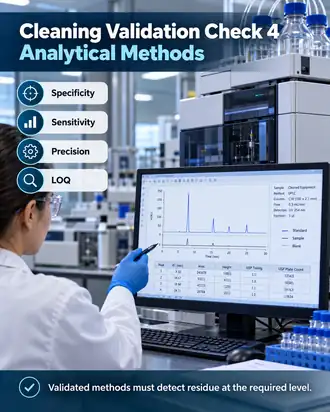
Which Analytical Methods Are Used?
An analytical method for cleaning validation is a defined measurement procedure applied to swab, rinse or other justified extracts to determine a relevant residual contaminant. Chromatographic assays such as HPLC or LC-MS can provide molecular specificity, while TOC, UV or conductivity provide broader signals under suitable circumstances. Instrument sophistication alone is not evidence of fitness for use; the assay must work in the actual sampling matrix.
Why This GMP Control Matters
Choosing a method begins with the question being answered. An API may require discrimination from degradants formed by aggressive cleaning chemicals; detergent residues may demand different chemistry. A TOC signal cannot, without justified assumptions and controls, distinguish the previous product from unrelated organic matter. PIC/S PI 006-4 §7.11 specifically addresses method validation, degradant selectivity, recovery and non-specific assay justification.
Technical Comparison and Method Selection
The distinctions below establish what each approach measures, and which risk it can and cannot support. Choose options using product knowledge, equipment design and intended application.
| Approach / term | Technical role | Interpretation or limitation |
|---|---|---|
| HPLC/UPLC | Specific API or degradant | Requires suitable separation and matrix controls |
| LC-MS | Highly sensitive target residue | Ion suppression and contamination need evaluation |
| TOC | Total organic carbon | Non-specific, justification required |
| Conductivity | Ionic cleaning agents | Indirect signal; correlation required |
Procedure: Critical Parameters and Studies
Build an analytical target profile that identifies residue, expected range, sampling fluid, extraction dilution and permissible result. Evaluate specificity/selectivity in relevant blank matrices, LOQ, precision, accuracy or recovery, calibration, robustness and sample stability as applicable. Integrate sampling recovery with the laboratory method before concluding the end-to-end procedure is capable. ICH Q2(R2) offers principles for procedure validation; apply them based on intended use.
Equipment, sample and process control points
Before execution, confirm training, equipment state, calibration and source records. The study plan should describe who collects each observation, how it is calculated and what would make the study invalid.
| Step | Evidence / tool | Critical parameter or check |
|---|---|---|
| Define analyte | API, degradant or detergent | Include cleaning transformation products |
| Prepare matrix | Swab extract or rinse solvent | Use representative blanks |
| Validate procedure | Specificity, LOQ, precision, range | Apply intended-use principles |
| Link to sampling | Coupon and full extraction recovery | End-to-end performance |
Acceptance Criteria and Results
Quality control should check that sample containers, hold conditions and maximum time before analysis preserve residue integrity. A technique with an excellent instrument LOQ may be unfit if extraction dilutes the residue beyond the reporting limit. Use the sample preparation factor to translate LOQ into the unit being compared with acceptance criteria, such as micrograms per swab area.
Requirements Versus Site-Specific Limits
Regulatory publications establish expectations for scientific justification and suitability, not a single numerical result for all products. The table explicitly separates those principles from values that the site must establish.
| Control | Acceptance basis | Official source / qualification |
|---|---|---|
| LOQ | Fit for selected cleaning residue limit after all dilutions | PICS §7.11; ICH Q2(R2) |
| Selectivity | Distinguish relevant target and potential degradants | PICS §7.11.2 |
| Non-specific assay | Only if fully justified and recovery demonstrated | PICS §7.11.5 |
Practical Pharmaceutical Example
Example: HPLC cleanly separates the API in standard solution but a cleaning-agent component co-elutes from swab extracts. Before reporting a pass, the laboratory should modify chromatography or sample preparation, establish selectivity in the real matrix and formally assess affected previous results.
Deviation Investigation, Troubleshooting and CAPA
Unexpected results require an investigation that distinguishes genuine process failure from a compromised analytical or sampling procedure. Preserve original results and evaluate potential product impact before authorising any repeat testing or re-cleaning.
| Problem | Possible cause | Investigation | Corrective action | Preventive action |
|---|---|---|---|---|
| Unexpected peak | Degradant or matrix interferent | Use specificity challenge and blanks | Investigate assay suitability | Monitor method changes |
| Variable LOQ performance | Instrument/matrix instability | Trend low-level controls and standards | Revalidate appropriate characteristic | Strengthen maintenance and preparation |
GMP Documentation Requirements
Preserve the method purpose, test procedure and changes, development rationale, validation report, instrument qualification, calibrations, chromatograms, system-suitability records, sample stability, chain of custody and result calculations. Quality oversight must link every reportable value to its originating equipment and cleaning event.
Related Pharmatalks Resources
Continue with these technical articles in this same offline-compatible series. Links are relative and work locally or when the complete package is deployed intact.
- LOQ, Precision and Recovery: Method Performance
- GMP Cleaning Validation Documentation & QA Review
- Visually Clean vs Validated Clean: GMP Evidence
Existing Google Drive protocol / guide: Cleaning Validation Master Plan (user-held reference; contents not verified for this package) and Annex 15 copy.
Frequently Asked Questions
Which method is best?
The one demonstrably fit for the specific residue, matrix, risk and acceptance criterion; no single platform is universally best.
Can TOC be used?
Yes in justified circumstances, but the non-specific signal and sampling recovery limitations must be addressed.
What does specificity mean?
The ability to determine the intended analyte without unacceptable interference from relevant matrix components or degradants.
Must methods be validated?
Yes, methods used to measure relevant residues and contaminants require demonstrated fitness for their intended purpose.
Why evaluate sample stability?
Because degradation or adsorption between collection and analysis can falsely lower apparent residue.
Does low instrument LOD guarantee sensitivity?
No. Sampling, extraction, dilution and matrix effects determine practical reporting capability.
Conclusion
Select residue-specific or justified non-specific methods able to measure contamination at clinically relevant levels. A defensible decision combines an approved procedure, representative evidence, risk-based interpretation and traceable documentation. Check site-specific assumptions against the actual product and process before using these concepts in a GMP decision.
Official References
- PIC/S PI 006-4, Recommendations on Qualification and Validation (2026), Section 7: 7.1–7.13 — Official PIC/S recommendation; effective 1 October 2026.
- ICH Q2(R2), Validation of Analytical Procedures (FDA final guidance 2024): Validation characteristics — ICH harmonised guideline adopted by FDA.
- FDA, Guide to Inspections: Validation of Cleaning Processes (1993): General Requirements; Analytical Methods; Sampling — FDA investigator guidance, nonbinding and historical.
- European Commission, EU GMP Annex 15 Qualification and Validation (2015), Section 10: 2; 10 — European Commission GMP guidance.
Author: Pharmatalks Scientific Education • Editorial review date: 2026-11-06. Educational interpretation, not a substitute for regulatory guidance or approved facility-specific validation documentation.