← Back to Cleaning Validation Library / Validation
Cleaning Validation: 5 Critical GMP Checks
Five evidence-based controls connect residue limits, challenge selection, sampling, analytical methods and QA release decisions.
What Is Cleaning Validation?
Cleaning validation is the documented demonstration that a defined, approved procedure repeatedly reduces relevant chemical and, where applicable, microbial contaminants to scientifically justified levels. It is a lifecycle control, not a final rinse result. Validation is different from routine cleaning verification, which checks the outcome of individual cleaning events. PIC/S PI 006-4 distinguishes the activities and links them to a documented contamination-control strategy.
Why This GMP Control Matters
The five checks function as a chain of evidence. Limits without reliable methods cannot be verified; a precise laboratory method cannot rescue unrepresentative samples; and acceptable samples do not compensate for an unchallenged cleaning procedure. In multiproduct plants, a poorly managed changeover can expose a subsequent product to residue from an earlier product. Quality risk management should assess patient harm and the probability of carryover across the equipment train.
Technical Comparison and Method Selection
The distinctions below establish what each approach measures, and which risk it can and cannot support. Choose options using product knowledge, equipment design and intended application.
| Approach / term | Technical role | Interpretation or limitation |
|---|---|---|
| Validation | Demonstrates a cleaning process can consistently meet its defined criteria | Evidence across justified trials |
| Verification | Confirms a particular cleaned item meets its defined expectation | Routine checks following risk-based plan |
| Visual inspection | Detects visible contamination on accessible surfaces | Qualified observation, not universal analytical substitute |
Procedure: Critical Parameters and Studies
Start by defining the product and equipment matrix, contact surfaces, cleaning agents and intended changeovers. Establish scientifically justified chemical limits and any microbiological requirements. Use a documented risk assessment to select challenging products, locations, hold times and cleaning parameters. Qualify sampling recovery and analytical procedures before execution; then perform the prospective studies, review trends and approve a conclusion. The number of trials requires justification rather than an automatic universal count.
Equipment, sample and process control points
Before execution, confirm training, equipment state, calibration and source records. The study plan should describe who collects each observation, how it is calculated and what would make the study invalid.
| Step | Evidence / tool | Critical parameter or check |
|---|---|---|
| Define scope | Product/equipment matrix | Include shared equipment and cleaning agents |
| Set limits | Toxicology + exposure assessment | Units, dose, product and train basis |
| Challenge procedure | Worst case and hold-time conditions | Scientifically justified operating extremes |
| Sample and test | Recovery-qualified sampling and suitable assay | Represent difficult locations and residues |
Acceptance Criteria and Results
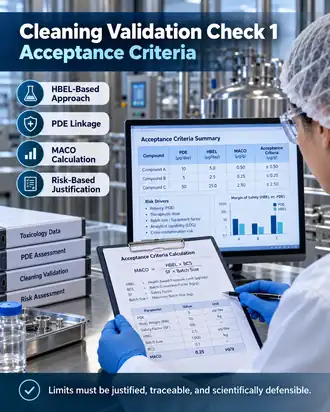
Each measured result should be compared with the correct surface, rinse, equipment and cumulative-train criteria. Confirm calculation units, blanks, recovery factors, analytical sensitivity and any deviation before concluding compliance. “Not detected” never proves zero residue. A visually clean result is an important observation but cannot automatically substitute for a scientifically established analytical limit.
Requirements Versus Site-Specific Limits
Regulatory publications establish expectations for scientific justification and suitability, not a single numerical result for all products. The table explicitly separates those principles from values that the site must establish.
| Control | Acceptance basis | Official source / qualification |
|---|---|---|
| Product residue | HBEL-based and scientifically justified; not a universal ppm threshold | PICS §7.12; EMA HBEL |
| Sampling recovery | Method/substrate-specific demonstrated suitability | PICS §7.9 |
| Visual inspection | No visible residue as minimum; additional evidence when needed | PICS §7.8 |
Practical Pharmaceutical Example
Example: a tablet line changes from a low-HBEL compound to a larger-dose product. A smooth vessel wall passes visual inspection, but the discharge valve has a difficult seal and the swab study shows variable recovery. The team should improve the method, focus sampling on the seal and demonstrate repeatable cleaning performance before allowing the validation report to claim control.
Deviation Investigation, Troubleshooting and CAPA
Unexpected results require an investigation that distinguishes genuine process failure from a compromised analytical or sampling procedure. Preserve original results and evaluate potential product impact before authorising any repeat testing or re-cleaning.
| Problem | Possible cause | Investigation | Corrective action | Preventive action |
|---|---|---|---|---|
| Unexpected swab result | Local soil pocket or poor technique | Check position, recovery and raw data | Investigate and reclean per procedure | Update risk map and training |
| Repeated pass after reclean | Testing-until-clean behavior | Review failed earlier runs and cleaning capability | Open deviation and assess impact | Redesign procedure and monitoring |
GMP Documentation Requirements
Retain an approved strategy, HBEL rationale, worst-case evaluation, surface inventory, sampling maps, recovery and method validation data, executed protocols, raw results, deviations and the QA-authorised report. Link routine verification and change controls back to the validated operating range.
Related Pharmatalks Resources
Continue with these technical articles in this same offline-compatible series. Links are relative and work locally or when the complete package is deployed intact.
- HBEL, PDE and MACO: Cleaning Residue Limits
- Worst-Case Selection in Cleaning Validation
- Dirty and Clean Hold Times: Validation Guide
Existing Google Drive protocol / guide: Cleaning Validation Master Plan (user-held reference; contents not verified for this package) and Annex 15 copy.
Frequently Asked Questions
What is cleaning validation?
It is documented evidence that an approved cleaning procedure reproducibly reduces relevant residues and contaminants below justified limits.
Does visually clean prove validated clean?
No. Visual inspection is a minimum GMP check; analytical verification may also be required, particularly for low-HBEL products.
Are three successful runs always required?
No universal run count should be assumed; establish and justify the study design using risk, variability and current guidance.
What residues need assessment?
Consider product actives, degradants, detergents, cleaning agents and relevant microbiological contamination based on risk.
How is routine verification different?
Verification checks individual cleanings, while validation establishes the capability of the approved process.
Who approves the final report?
Authorised personnel, including the quality function as defined in the pharmaceutical quality system, review evidence and deviations.
Conclusion
Five evidence-based controls connect residue limits, challenge selection, sampling, analytical methods and QA release decisions. A defensible decision combines an approved procedure, representative evidence, risk-based interpretation and traceable documentation. Check site-specific assumptions against the actual product and process before using these concepts in a GMP decision.
Official References
- PIC/S PI 006-4, Recommendations on Qualification and Validation (2026), Section 7: 7.1–7.13 — Official PIC/S recommendation; effective 1 October 2026.
- European Commission, EU GMP Annex 15 Qualification and Validation (2015), Section 10: 2; 10 — European Commission GMP guidance.
- FDA, Guide to Inspections: Validation of Cleaning Processes (1993): General Requirements; Analytical Methods; Sampling — FDA investigator guidance, nonbinding and historical.
- ICH Q9(R1), Quality Risk Management (EMA current guideline): Risk assessment, control and review — ICH harmonised quality risk management guidance.
Author: Pharmatalks Scientific Education • Editorial review date: 2026-11-06. Educational interpretation, not a substitute for regulatory guidance or approved facility-specific validation documentation.