← Back to Cleaning Validation Library / Inspection & Verification
Visually Clean vs Validated Clean: GMP Evidence
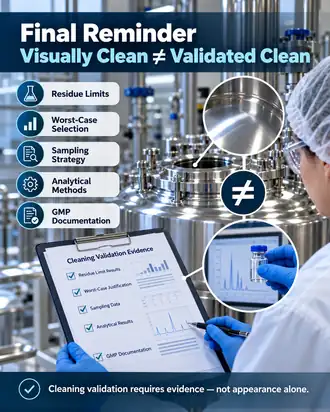
Visual inspection is a mandatory foundational control but cannot automatically establish the absence of invisible residue.
What Does Visually Clean Mean?
Visually clean means an appropriately trained person finds no visible residue on equipment under defined inspection conditions. Validated clean means the approved cleaning process is supported by evidence that appropriate contamination limits can be met consistently. These claims are not equivalent. PIC/S PI 006-4 §7.8 treats visual cleanliness as a minimum, while discussing analytical verification and limited scientifically justified circumstances where visual thresholds may support decisions.
Why This GMP Control Matters
Visual inspection can identify discoloration, films, particles and missed surfaces rapidly. However, the eye has no fixed universal detection limit. Illumination, inspection distance, substrate reflectivity, surface geometry, observer training and residue characteristics all affect detectability. For a low-HBEL API, the amount that is toxicologically relevant may be invisible well before equipment appears dirty.
Technical Comparison and Method Selection
The distinctions below establish what each approach measures, and which risk it can and cannot support. Choose options using product knowledge, equipment design and intended application.
| Approach / term | Technical role | Interpretation or limitation |
|---|---|---|
| Visual check | Visible contamination | Immediate and location-dependent |
| Swab assay | Local chemical residue | Quantitative for validated sites |
| Rinse assay | Extractable residues from contacted paths | May average hotspots |
| Microbial test | Bioburden when relevant | Specific to method and sample |
Procedure: Critical Parameters and Studies
Develop inspection instructions that define disassembly, access, light source, distance, mirrors or borescopes and training requirements. Determine, where scientifically necessary, the residue visibility threshold under representative conditions and compare it with the health-based and process-specific residue limit. Decide when additional swab or rinse verification must be performed; preserve the sampling rationale for partially inaccessible equipment.
Equipment, sample and process control points
Before execution, confirm training, equipment state, calibration and source records. The study plan should describe who collects each observation, how it is calculated and what would make the study invalid.
| Step | Evidence / tool | Critical parameter or check |
|---|---|---|
| Prepare inspection | Defined access and lighting | Qualified inspector |
| Inspect surfaces | Include difficult positions | Use mirrors or borescope when justified |
| Compare threshold | Visibility versus relevant residue limit | Scientific visibility study if relied upon |
| Escalate failure | Deviation and possible re-clean | Assess actual contaminated equipment |
Acceptance Criteria and Results
A failed visual inspection is a failure of an applicable requirement and should be documented and investigated. A passing visual check is evidence only for the visual criterion; it cannot override a failed chemical or microbial result. Some firms may establish a visual threshold supported by data, but its applicability is a risk-based decision rather than permission to eliminate all analytical oversight.
Requirements Versus Site-Specific Limits
Regulatory publications establish expectations for scientific justification and suitability, not a single numerical result for all products. The table explicitly separates those principles from values that the site must establish.
| Control | Acceptance basis | Official source / qualification |
|---|---|---|
| Visual condition | Visually clean is the minimum expectation | PICS §7.8.2 |
| Inspection capability | Qualified personnel and defined conditions | PICS §7.8.4–7.8.5 |
| Analytical need | Based on HBEL, threshold and risk | PICS §7.8.3 |
Practical Pharmaceutical Example
Example: a stainless mixing bowl is spotless under bright overhead lights but the operator cannot view the underside of an impeller. The visual result must not be generalized to the hidden surface. A disassembly plan, validated borescope observation or suitable sampling method is needed to control that risk.
Deviation Investigation, Troubleshooting and CAPA
Unexpected results require an investigation that distinguishes genuine process failure from a compromised analytical or sampling procedure. Preserve original results and evaluate potential product impact before authorising any repeat testing or re-cleaning.
| Problem | Possible cause | Investigation | Corrective action | Preventive action |
|---|---|---|---|---|
| Unseen rear surface | Access limitation | Review drawings and actual view | Add access or targeted sampling | Design for inspectability |
| Passing visual / failed swab | Invisible residue | Evaluate cleaning and assay evidence | Contain and investigate | Tighten cleaning process |
GMP Documentation Requirements
Keep visual inspection SOPs, qualification evidence, light/inspection conditions, equipment maps, failure images if appropriate, sample results, risk assessments and documented ongoing verification. Inspection should remain independent of a pressure to release equipment quickly.
Related Pharmatalks Resources
Continue with these technical articles in this same offline-compatible series. Links are relative and work locally or when the complete package is deployed intact.
- Cleaning Validation: 5 Critical GMP Checks
- HBEL, PDE and MACO: Cleaning Residue Limits
- Worst-Case Selection in Cleaning Validation
Existing Google Drive protocol / guide: Cleaning Validation Master Plan (user-held reference; contents not verified for this package) and Annex 15 copy.
Frequently Asked Questions
Is visually clean sufficient for validation?
Not generally. It is a minimum observation and may need quantitative or other verification.
Can the eye detect all harmful residues?
No. Detection depends on surface, lighting, residue and observer; hazardous quantities can be invisible.
Are borescopes acceptable?
They can support defined inspections when qualified and suitable for equipment geometry.
How are visible thresholds established?
With controlled experimental evidence under representative viewing conditions where the strategy relies on them.
What if a visually clean item fails an assay?
The chemical result and potential contamination risk must be investigated; visual passing does not overturn it.
How often should visual inspection occur?
According to controlled procedures and site risk; ensure it is done at appropriate cleaning stages.
Conclusion
Visual inspection is a mandatory foundational control but cannot automatically establish the absence of invisible residue. A defensible decision combines an approved procedure, representative evidence, risk-based interpretation and traceable documentation. Check site-specific assumptions against the actual product and process before using these concepts in a GMP decision.
Official References
- PIC/S PI 006-4, Recommendations on Qualification and Validation (2026), Section 7: 7.1–7.13 — Official PIC/S recommendation; effective 1 October 2026.
- FDA, Guide to Inspections: Validation of Cleaning Processes (1993): General Requirements; Analytical Methods; Sampling — FDA investigator guidance, nonbinding and historical.
- European Commission, EU GMP Annex 15 Qualification and Validation (2015), Section 10: 2; 10 — European Commission GMP guidance.
- EMA, Guideline on Setting Health-Based Exposure Limits in Shared Facilities: 4; 6; 7 — EMA scientific guidance.
Author: Pharmatalks Scientific Education • Editorial review date: 2026-11-06. Educational interpretation, not a substitute for regulatory guidance or approved facility-specific validation documentation.