← Back to Cleaning Validation Library / Validation
Dirty and Clean Hold Times: Validation Guide
Dirty and clean equipment hold times control residue drying and potential microbial growth before reuse.
What Are Dirty and Clean Hold Times?
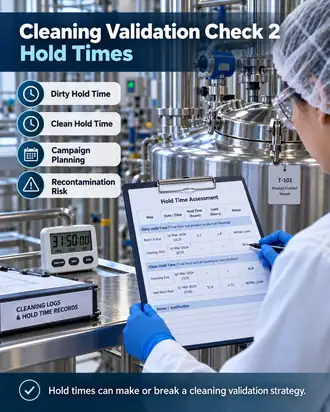
Dirty hold time is the interval from a defined end-of-processing point to the start of a defined cleaning step. Clean hold time concerns the controlled interval after an approved clean to subsequent use, with appropriate storage conditions. These are different risks: delayed cleaning can harden product residues, while prolonged clean storage may allow recontamination or microbial proliferation when conditions are unsuitable.
Why This GMP Control Matters
Hold-time studies should reflect the actual equipment state, not only a clock. The finish time of production, wet versus dried residues, ambient humidity, equipment disassembly, covered or uncovered status, draining and sanitisation practices may all affect the challenge. FDA cleaning guidance explicitly highlights time delays before cleaning; PI 006-4 additionally addresses microbial concerns and maintaining validated cleaning processes.
Technical Comparison and Method Selection
The distinctions below establish what each approach measures, and which risk it can and cannot support. Choose options using product knowledge, equipment design and intended application.
| Approach / term | Technical role | Interpretation or limitation |
|---|---|---|
| Dirty hold | Processing stop to cleaning start | Drying, adhesion and hard-to-remove soils |
| Clean hold | Clean completion to next use | Recontamination, wet storage and microbes |
| Post-clean storage | Condition while idle | Drainage, covers, air and handling |
Procedure: Critical Parameters and Studies
Define unambiguous time stamps in SOPs. Challenge dirty hold under realistically worst conditions, cleaning with the approved sequence and evaluating relevant residues at hard-to-clean surfaces. For clean hold, store cleaned equipment under its intended condition and verify suitability at the proposed maximum interval using the applicable chemical and microbiological checks. Ensure cleaning and sanitisation steps are not confused, especially for bioburden-sensitive products.
Equipment, sample and process control points
Before execution, confirm training, equipment state, calibration and source records. The study plan should describe who collects each observation, how it is calculated and what would make the study invalid.
| Step | Evidence / tool | Critical parameter or check |
|---|---|---|
| Define start and finish | Unambiguous batch and equipment events | Consistent time stamps |
| Challenge dirty interval | Full maximum proposed duration | Realistic residue and ambient conditions |
| Challenge clean interval | Intended storage state | Suitable inspection and microbial controls |
| Evaluate excursion | Time outside approved window | QA impact and disposition |
Acceptance Criteria and Results
Do not accept a maximum hold period merely because one early trial passed. Use justified sampling points, defined environmental conditions and a risk-based number of independent runs. Distinguish hold-time deviations from routine late-start events; a time excursion requires impact assessment rather than silent extension of the operating window.
Requirements Versus Site-Specific Limits
Regulatory publications establish expectations for scientific justification and suitability, not a single numerical result for all products. The table explicitly separates those principles from values that the site must establish.
| Control | Acceptance basis | Official source / qualification |
|---|---|---|
| Dirty maximum | Site-validated period under defined conditions | PICS §7.3; FDA guide |
| Clean maximum | Site-validated period with storage controls | PICS §7.7; §7.13 |
| Microbiological outcome | Risk-based acceptance criterion linked to intended use | PICS §7.7 |
Practical Pharmaceutical Example
Example: a cream residue dries around a pump rotor during an overnight pause. The established immediate-clean method is no longer representative. A study at the proposed maximum dirty hold may need additional mechanical effort, and QA should determine whether the cleaning instruction can remain unchanged or needs a specific delayed-clean procedure.
Deviation Investigation, Troubleshooting and CAPA
Unexpected results require an investigation that distinguishes genuine process failure from a compromised analytical or sampling procedure. Preserve original results and evaluate potential product impact before authorising any repeat testing or re-cleaning.
| Problem | Possible cause | Investigation | Corrective action | Preventive action |
|---|---|---|---|---|
| Residue increase over hold | Drying/adhesion | Compare immediate vs delayed cleaning | Adjust procedure and revalidate | Prevent unplanned delays |
| Positive pre-use micro sample | Wet storage or handling | Examine drying, covers, and sampling | Contain equipment and assess impact | Improve storage controls |
GMP Documentation Requirements
Keep equipment log time stamps, approved clean/dirty status, environmental conditions, storage configuration, hold-time protocol, test results, microbial assessments where applicable, cleaning-cycle records, excursions and approval decisions. The status label alone is not sufficient evidence of an effective hold-time control.
Related Pharmatalks Resources
Continue with these technical articles in this same offline-compatible series. Links are relative and work locally or when the complete package is deployed intact.
- Swab Sampling and Recovery in Cleaning Validation
- Rinse Sampling: Methods, Limits and Pitfalls
- Analytical Methods for Cleaning Residues
Existing Google Drive protocol / guide: Cleaning Validation Master Plan (user-held reference; contents not verified for this package) and Annex 15 copy.
Frequently Asked Questions
What is dirty hold time?
The controlled interval before an approved cleaning operation begins following defined processing activity.
What is clean hold time?
The controlled period in which equipment stays suitable for use after cleaning under defined storage conditions.
Are fixed universal hold-time hours prescribed?
No. Durations depend on equipment, residues, procedure and risk and require site-specific evidence.
Why does residue drying matter?
Drying can alter adhesion, solubility and cleaning effectiveness, invalidating shorter-hold assumptions.
Is microbial testing always needed?
The need and extent depend on product, equipment, moisture and manufacturing risks.
What happens after an excursion?
Quarantine or control status as appropriate, investigate and assess scientifically before using the equipment.
Conclusion
Dirty and clean equipment hold times control residue drying and potential microbial growth before reuse. A defensible decision combines an approved procedure, representative evidence, risk-based interpretation and traceable documentation. Check site-specific assumptions against the actual product and process before using these concepts in a GMP decision.
Official References
- PIC/S PI 006-4, Recommendations on Qualification and Validation (2026), Section 7: 7.1–7.13 — Official PIC/S recommendation; effective 1 October 2026.
- FDA, Guide to Inspections: Validation of Cleaning Processes (1993): General Requirements; Analytical Methods; Sampling — FDA investigator guidance, nonbinding and historical.
- European Commission, EU GMP Annex 15 Qualification and Validation (2015), Section 10: 2; 10 — European Commission GMP guidance.
- ICH Q9(R1), Quality Risk Management (EMA current guideline): Risk assessment, control and review — ICH harmonised quality risk management guidance.
Author: Pharmatalks Scientific Education • Editorial review date: 2026-11-06. Educational interpretation, not a substitute for regulatory guidance or approved facility-specific validation documentation.