← Back to Cleaning Validation Library / Sampling
Rinse Sampling: Methods, Limits and Pitfalls
Rinse testing can access large or closed equipment surfaces, but solubility and localized contamination are essential limitations.
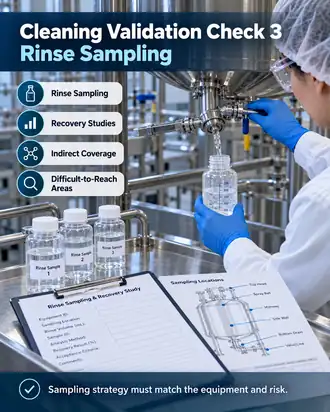
What Is Rinse Sampling?
Rinse sampling collects a controlled volume of liquid exposed to a cleaned equipment path and measures target residues carried into that liquid. It is particularly useful for long piping, inaccessible surfaces and equipment that should not routinely be dismantled. A rinse sample represents an averaged extraction of the contacted system rather than a direct measurement of every local surface.
Why This GMP Control Matters
Both FDA cleaning guidance and PIC/S PI 006-4 warn that a apparently clean rinse may overlook insoluble or poorly wetted residue. A large volume can dilute a localized contamination pocket below the method’s quantification capability. Rinsing cannot be regarded as a complete replacement for targeted swabbing when accessible high-risk sites exist. The intended rinse path, recovered volume, solvent compatibility and contact time must be justified.
Technical Comparison and Method Selection
The distinctions below establish what each approach measures, and which risk it can and cannot support. Choose options using product knowledge, equipment design and intended application.
| Approach / term | Technical role | Interpretation or limitation |
|---|---|---|
| Rinse | Inaccessible/large wetted areas | Averages residues; dilution possible |
| Swab | Accessible risk locations | Directly targets local residues |
| Conductivity | Ionic constituents in rinse | Indirect; must correlate with residue risk |
| TOC | Oxidizable organic carbon | Non-specific unless justified |
Procedure: Critical Parameters and Studies
Define whether samples are collected from a final process rinse, a separate validation rinse or a controlled extractive rinse; these are not necessarily interchangeable. Record the route, valves, flow direction, mixing, contact time, sampled volume and relevant material surfaces. Validate recovery using a representative system or coupons and ensure any added validation rinse does not inadvertently alter the normal process being assessed.
Equipment, sample and process control points
Before execution, confirm training, equipment state, calibration and source records. The study plan should describe who collects each observation, how it is calculated and what would make the study invalid.
| Step | Evidence / tool | Critical parameter or check |
|---|---|---|
| Trace path | Piping schematic and valve states | No unrepresented branches |
| Select rinse | Compatible liquid and controlled volume | Demonstrated residue solubility |
| Collect | Flow, time, fraction and volume | Repeatable sampling |
| Quantify | Target residue assay or justified alternate | LOQ below relevant criterion |
Acceptance Criteria and Results
Analytically quantify the product residue or relevant contaminant itself when rinse sampling is used for validation. Routine indirect tests such as conductivity may support monitoring only where the association with cleaning effectiveness has been demonstrated and justified. Convert concentration to recovered mass using actual representative volumes before comparing with the correct residue allocation.
Requirements Versus Site-Specific Limits
Regulatory publications establish expectations for scientific justification and suitability, not a single numerical result for all products. The table explicitly separates those principles from values that the site must establish.
| Control | Acceptance basis | Official source / qualification |
|---|---|---|
| Recovery | Sufficient and reproducible on applicable materials | PICS §7.9(b) |
| Specific analyte | Direct measurement during validation | PICS §7.9(b)(iii) |
| System residue | Appropriate allocated limit for contacted train | PICS §7.12 |
Practical Pharmaceutical Example
Example: a transfer line passes a final rinse conductivity check, but a hydrophobic API remains at a low-flow dead leg. The indirect signal can still appear normal. A scientifically targeted sampling plan would challenge that leg and use a residue-specific assay or otherwise justify the approach for that contaminant.
Deviation Investigation, Troubleshooting and CAPA
Unexpected results require an investigation that distinguishes genuine process failure from a compromised analytical or sampling procedure. Preserve original results and evaluate potential product impact before authorising any repeat testing or re-cleaning.
| Problem | Possible cause | Investigation | Corrective action | Preventive action |
|---|---|---|---|---|
| False low result | Poor solubility or dilution | Inspect rinse chemistry and dead legs | Add targeted collection or swab | Optimize geometry and sample plan |
| Inconsistent concentrations | Variable rinse volume or routing | Audit time and valve states | Correct SOP and qualify operators | Automate verified rinse path |
GMP Documentation Requirements
Document flow diagrams, valve alignment, sampling sequence, sampling fluids, volumes, blank results, recovery evidence, method LOQ, calculations and any process changes. QA must be able to reconstruct which wetted surfaces the rinse represented and which surfaces it did not.
Related Pharmatalks Resources
Continue with these technical articles in this same offline-compatible series. Links are relative and work locally or when the complete package is deployed intact.
- Analytical Methods for Cleaning Residues
- LOQ, Precision and Recovery: Method Performance
- GMP Cleaning Validation Documentation & QA Review
Existing Google Drive protocol / guide: Cleaning Validation Master Plan (user-held reference; contents not verified for this package) and Annex 15 copy.
Frequently Asked Questions
Can rinse replace all swab samples?
Not generally. Accessible hard-to-clean surfaces should be directly sampled where feasible.
Why can rinses miss contamination?
Insoluble residues, trapped pockets and large dilution volumes can obscure localized contamination.
Is conductivity sufficient for validation?
Only with strong scientific justification; direct testing for the relevant contaminant is the general expectation.
What should be recorded?
Rinse route, solvent, time, volume, locations, blanks, recovery and the analytical method used.
How is residue mass obtained?
A measured concentration may be related to the recovered, validated rinse volume with consistent units.
What makes a rinse protocol representative?
Realistic equipment materials, flow and valve states, and proof that relevant residues can be recovered.
Conclusion
Rinse testing can access large or closed equipment surfaces, but solubility and localized contamination are essential limitations. A defensible decision combines an approved procedure, representative evidence, risk-based interpretation and traceable documentation. Check site-specific assumptions against the actual product and process before using these concepts in a GMP decision.
Official References
- PIC/S PI 006-4, Recommendations on Qualification and Validation (2026), Section 7: 7.1–7.13 — Official PIC/S recommendation; effective 1 October 2026.
- FDA, Guide to Inspections: Validation of Cleaning Processes (1993): General Requirements; Analytical Methods; Sampling — FDA investigator guidance, nonbinding and historical.
- ICH Q2(R2), Validation of Analytical Procedures (FDA final guidance 2024): Validation characteristics — ICH harmonised guideline adopted by FDA.
- European Commission, EU GMP Annex 15 Qualification and Validation (2015), Section 10: 2; 10 — European Commission GMP guidance.
Author: Pharmatalks Scientific Education • Editorial review date: 2026-11-06. Educational interpretation, not a substitute for regulatory guidance or approved facility-specific validation documentation.