← Back to Cleaning Validation Library / Documentation
GMP Cleaning Validation Documentation & QA Review
Protocols, traceable raw data, deviations and justified QA conclusions establish that cleaning control has actually been demonstrated.
What Documentation Does GMP Require?
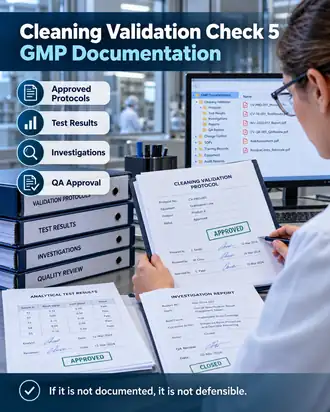
GMP cleaning validation documentation is the controlled record set that explains why a procedure was selected, how it was challenged, what results were generated and who reviewed the final conclusion. A signed summary without supporting raw results does not demonstrate control. Under EU GMP Annex 15, studies should follow approved protocols, predefined criteria and documented deviation management. PIC/S PI 006-4 describes a lifecycle approach to documentation and maintaining validated status.
Why This GMP Control Matters
Documentation begins well before laboratory testing. The validation master plan or equivalent describes scope and responsibilities; toxicology and risk files establish why limits are appropriate; and equipment maps and sampling protocols show what has been tested. Every original sample identification should link to the equipment, batch or campaign, cleaned date, sampled location, analyst, laboratory record and final result.
Technical Comparison and Method Selection
The distinctions below establish what each approach measures, and which risk it can and cannot support. Choose options using product knowledge, equipment design and intended application.
| Approach / term | Technical role | Interpretation or limitation |
|---|---|---|
| Protocol | Predetermined study plan and criteria | Approved before execution |
| Executed record | Actual steps, dates and observations | Attributable source data |
| Deviation/CAPA | Scientific failure assessment | Impact and effectiveness review |
| Final report | Integrated conclusion and recommendation | Authorised approval |
Procedure: Critical Parameters and Studies
Prepare a protocol that states objectives, equipment and product matrices, cleaning instructions, challenge conditions, dirty/clean holds, sampling locations, recovery method, analytical procedures, acceptance criteria, deviations and approval roles. Confirm that controlled versions were effective when testing began. Record any change from the approved plan contemporaneously and determine whether the change invalidates a run or requires more evidence.
Equipment, sample and process control points
Before execution, confirm training, equipment state, calibration and source records. The study plan should describe who collects each observation, how it is calculated and what would make the study invalid.
| Step | Evidence / tool | Critical parameter or check |
|---|---|---|
| Plan | VMP and responsibilities | Approved scope and owners |
| Execute | Log books, test results, sample IDs | Time-stamped traceability |
| Investigate | Deviations and technical anomalies | No selective omission |
| Close | Report, QA disposition, ongoing controls | Formal lifecycle oversight |
Acceptance Criteria and Results
At closeout, QA should assess completeness rather than merely arithmetic compliance. Examine failing or invalid tests, trends, unusual recovery, missing raw data, unapproved recleaning, instrumentation issues and product impact. The report should distinguish a justified successful process from an unresolved failure and define continued verification and change-control triggers.
Requirements Versus Site-Specific Limits
Regulatory publications establish expectations for scientific justification and suitability, not a single numerical result for all products. The table explicitly separates those principles from values that the site must establish.
| Control | Acceptance basis | Official source / qualification |
|---|---|---|
| Protocol criteria | Predefined and scientifically justified | EU15 §2; PICS §7.4 |
| Raw result integrity | Original attributable data and audit trail | EU15 §2; GMP documentation principles |
| Release decision | Authorised formal review and justified conclusion | EU15 §2.9–2.10 |
Practical Pharmaceutical Example
Example: three summary reports list “pass,” but the third run used a different cleaning agent from the approved protocol and the analytical blank was missing. Quality cannot treat the dataset as interchangeable until the departures have been evaluated, documented and scientifically resolved.
Deviation Investigation, Troubleshooting and CAPA
Unexpected results require an investigation that distinguishes genuine process failure from a compromised analytical or sampling procedure. Preserve original results and evaluate potential product impact before authorising any repeat testing or re-cleaning.
| Problem | Possible cause | Investigation | Corrective action | Preventive action |
|---|---|---|---|---|
| Missing raw data | Fragmented system or transcription | Trace original instrument records | Hold conclusion pending investigation | Controlled data review checklist |
| Unapproved reclean | SOP mismatch or failure concealed | Reconstruct chronology and impact | Deviation, possible revalidation | Operator training and status controls |
GMP Documentation Requirements
Use a controlled index of current and superseded records, traceable electronic or paper source data, signatures, controlled report versions, linked CAPA and change controls, and retention practices consistent with the site pharmaceutical quality system. Make references accessible to inspectors without exposing sensitive information in public educational tools.
Related Pharmatalks Resources
Continue with these technical articles in this same offline-compatible series. Links are relative and work locally or when the complete package is deployed intact.
- Visually Clean vs Validated Clean: GMP Evidence
- Cleaning Validation: 5 Critical GMP Checks
- HBEL, PDE and MACO: Cleaning Residue Limits
Existing Google Drive protocol / guide: Cleaning Validation Master Plan (user-held reference; contents not verified for this package) and Annex 15 copy.
Frequently Asked Questions
What belongs in a cleaning validation protocol?
Scope, responsibilities, cleaning process, worst cases, sampling, analytical methods and predefined criteria.
Who should review deviations?
The quality system’s authorised technical and QA roles according to established responsibilities.
Can a report be approved if some results failed?
Only with a scientifically justified and documented conclusion that addresses all failures and their consequences.
Is electronic data different from paper?
Both must preserve attributable, complete, accurate and traceable evidence under applicable data integrity controls.
Why document dirty hold?
It is a potentially critical condition that influences residue behavior and reproducibility.
How is validated status maintained?
Through continued verification, trending, change control and periodic review proportionate to risk.
Conclusion
Protocols, traceable raw data, deviations and justified QA conclusions establish that cleaning control has actually been demonstrated. A defensible decision combines an approved procedure, representative evidence, risk-based interpretation and traceable documentation. Check site-specific assumptions against the actual product and process before using these concepts in a GMP decision.
Official References
- PIC/S PI 006-4, Recommendations on Qualification and Validation (2026), Section 7: 7.1–7.13 — Official PIC/S recommendation; effective 1 October 2026.
- European Commission, EU GMP Annex 15 Qualification and Validation (2015), Section 10: 2; 10 — European Commission GMP guidance.
- FDA, Guide to Inspections: Validation of Cleaning Processes (1993): General Requirements; Analytical Methods; Sampling — FDA investigator guidance, nonbinding and historical.
- ICH Q9(R1), Quality Risk Management (EMA current guideline): Risk assessment, control and review — ICH harmonised quality risk management guidance.
Author: Pharmatalks Scientific Education • Editorial review date: 2026-11-06. Educational interpretation, not a substitute for regulatory guidance or approved facility-specific validation documentation.