← Back to Cleaning Validation Library / Risk & Limits
Worst-Case Selection in Cleaning Validation
Worst-case selection weighs toxicity, solubility, cleanability, equipment and next-product exposure rather than choosing a single simplistic ranking.
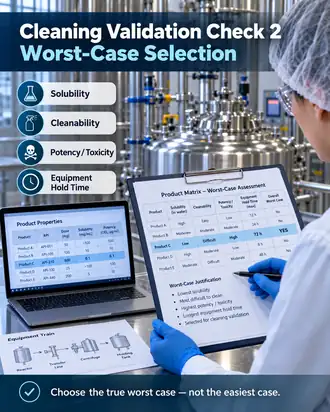
What Does Worst-Case Selection Mean?
Worst-case selection is the documented identification of product, equipment and process conditions that most rigorously challenge a cleaning procedure. Toxicological potency or low HBEL, poor solubility, adhesion to surfaces, difficult formulation residues, low cleaning efficiency and inaccessible geometry all matter. The highest-dose product is not automatically the hardest to clean, and the least soluble product is not necessarily the most hazardous carryover.
Why This GMP Control Matters
Grouping products into cleaning families reduces redundant validation only when evidence supports equivalence. A defensible matrix separates the inherent hazard from the probability of residual retention. It may rank solubility in the actual cleaning solvent, cleanability-study results, dose/HBEL sensitivity and residue behavior after drying. Equipment geometry and cleaning mechanism should be considered independently rather than hidden inside a product score.
Technical Comparison and Method Selection
The distinctions below establish what each approach measures, and which risk it can and cannot support. Choose options using product knowledge, equipment design and intended application.
| Approach / term | Technical role | Interpretation or limitation |
|---|---|---|
| Low HBEL | High impact if residues transfer | Hazard lens |
| Poor solubility | More resistant to the cleaning fluid | Removal lens |
| Adherent formulation | Can dry into joints and seals | Cleanability lens |
| Complex geometry | Stagnant regions and shadow surfaces | Equipment lens |
Procedure: Critical Parameters and Studies
Build a product list that captures API, formulation, detergents, processing temperature and contact materials. Perform bench or pilot cleanability studies with realistic soils. Compare products using a documented scoring or categorical evaluation with explained weights. Include the next-product exposure scenario and material-specific swab recovery. Select representative challenges, but retain a written rationale for excluded products and for the grouping boundaries.
Equipment, sample and process control points
Before execution, confirm training, equipment state, calibration and source records. The study plan should describe who collects each observation, how it is calculated and what would make the study invalid.
| Step | Evidence / tool | Critical parameter or check |
|---|---|---|
| Inventory | Product master and contact materials | No missing changeovers |
| Gather data | HBEL, solubility and wash studies | Use actual process temperature/solvent |
| Rank and bracket | Document rationale and uncertainty | Avoid unsupported numeric cutoffs |
| Challenge | Worst soil and difficult locations | Replicate intended cleaning sequence |
Acceptance Criteria and Results
Ranking should be revisited after technical changes. A new coating polymer, sticky excipient or lower HBEL may overturn the original selection. A good matrix shows the evidence behind every assigned category and identifies uncertainty; numeric scores are internal decision aids rather than regulatory acceptance limits. Trending cleaning failures can also reveal that the chosen representative is no longer conservative.
Requirements Versus Site-Specific Limits
Regulatory publications establish expectations for scientific justification and suitability, not a single numerical result for all products. The table explicitly separates those principles from values that the site must establish.
| Control | Acceptance basis | Official source / qualification |
|---|---|---|
| Representative product | Scientifically justified challenge to a cleaning family | PICS §7.3; ICH Q9 |
| Grouping equivalence | Supported by product/equipment knowledge | PICS §7.3 |
| Acceptance result | Apply product- and scenario-specific cleaning criteria | PICS §7.12 |
Practical Pharmaceutical Example
Example: a poorly soluble but low-potency API and a readily soluble high-potency API use the same blender. The former challenges soil removal, while the latter challenges residue sensitivity and exposure limits. Both may warrant attention because no single worst-case representative automatically brackets every hazard and cleaning condition.
Deviation Investigation, Troubleshooting and CAPA
Unexpected results require an investigation that distinguishes genuine process failure from a compromised analytical or sampling procedure. Preserve original results and evaluate potential product impact before authorising any repeat testing or re-cleaning.
| Problem | Possible cause | Investigation | Corrective action | Preventive action |
|---|---|---|---|---|
| Surprise residue | Excipient omitted from matrix | Review formulation and wash chemistry | Amend study and repeat justified challenge | Add formulation change trigger |
| New product fails bracket | Original class not representative | Recalculate risk and inspect surfaces | Expand validation coverage | Annual grouping review |
GMP Documentation Requirements
The validation file should contain the approved grouping protocol, product attributes, solubility conditions, actual cleanability data, risk-ranked equipment surfaces, selected representatives, reviewer signatures and triggers for change control. Capture whether the grouping is prospective or based on legacy evidence.
Related Pharmatalks Resources
Continue with these technical articles in this same offline-compatible series. Links are relative and work locally or when the complete package is deployed intact.
- Dirty and Clean Hold Times: Validation Guide
- Swab Sampling and Recovery in Cleaning Validation
- Rinse Sampling: Methods, Limits and Pitfalls
Existing Google Drive protocol / guide: Cleaning Validation Master Plan (user-held reference; contents not verified for this package) and Annex 15 copy.
Frequently Asked Questions
What is a worst-case product?
The selected product or family member that meaningfully challenges one or more critical cleaning or exposure risks.
Is lowest solubility always worst?
No. Toxicology, next-product dose, adhesion, equipment design and actual cleaning results also influence selection.
Can more than one worst case exist?
Yes. Separate representatives may be needed for toxicological risk and cleaning difficulty.
How are cleaning groups justified?
With documented comparisons and evidence that the chosen representatives conservatively cover other members.
Should detergents be considered?
Yes. Their removal and analytical detectability belong in the cleaning risk assessment.
When is a matrix updated?
After relevant changes to formulations, equipment, procedures, HBELs or cleaning performance.
Conclusion
Worst-case selection weighs toxicity, solubility, cleanability, equipment and next-product exposure rather than choosing a single simplistic ranking. A defensible decision combines an approved procedure, representative evidence, risk-based interpretation and traceable documentation. Check site-specific assumptions against the actual product and process before using these concepts in a GMP decision.
Official References
- PIC/S PI 006-4, Recommendations on Qualification and Validation (2026), Section 7: 7.1–7.13 — Official PIC/S recommendation; effective 1 October 2026.
- ICH Q9(R1), Quality Risk Management (EMA current guideline): Risk assessment, control and review — ICH harmonised quality risk management guidance.
- EMA, Guideline on Setting Health-Based Exposure Limits in Shared Facilities: 4; 6; 7 — EMA scientific guidance.
- FDA, Guide to Inspections: Validation of Cleaning Processes (1993): General Requirements; Analytical Methods; Sampling — FDA investigator guidance, nonbinding and historical.
Author: Pharmatalks Scientific Education • Editorial review date: 2026-11-06. Educational interpretation, not a substitute for regulatory guidance or approved facility-specific validation documentation.